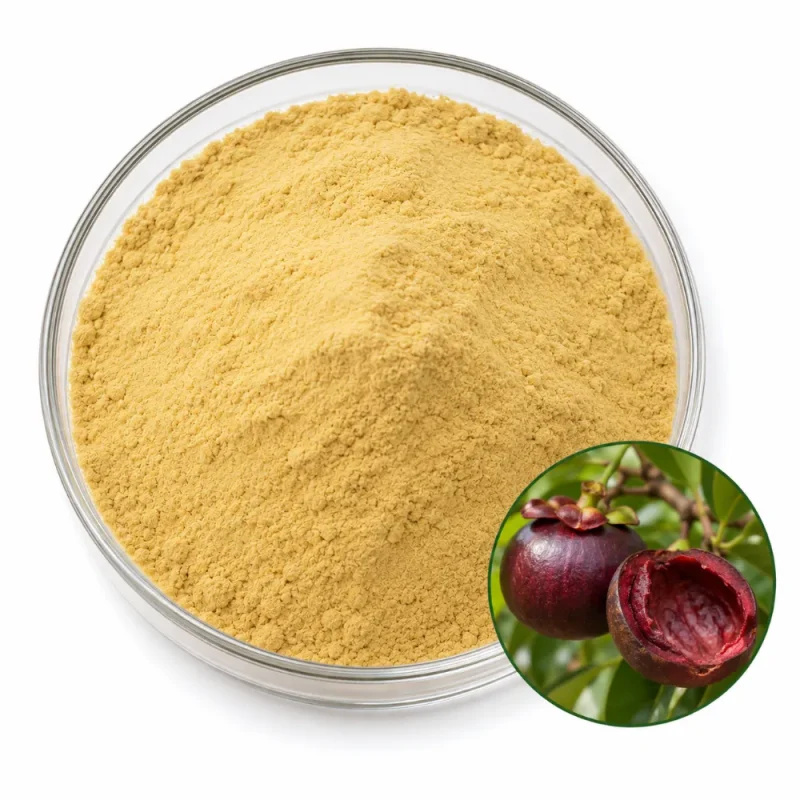
Garcinia indica Extract 20% Garcinol

Garcinia indica extract starts from the dried fruit rind of Garcinia indica, the kokum tree of the Western Ghats, whose purple-red fruits are sold dried as kokum, and the seed, which yields kokum butter, the leaf and the bark are not part of the starting material. Ethanol extraction takes up the lipophilic benzophenones of the rind, and the concentrate is dried to a light brown powder.

The single grade is 20% garcinol by HPLC. The powder is 80 mesh and insoluble in water. It fits capsules, tablets and lipid-based fills in which a garcinol-rich rind fraction is the design target.

Garcinol Standardization & Grades

Garcinol is a polyisoprenylated benzophenone, a bright yellow, lipophilic polyphenol that is the signature compound of the kokum rind. It is accompanied by its cyclized isomer isogarcinol and by hydroxycitric acid and anthocyanins, which are polar and largely separated from the garcinol-rich fraction by the choice of ethanol extraction. The botanical entity is Garcinia indica (Thouars) Choisy, and the extract is standardized to garcinol because it is the defining, measurable benzophenone of the species and the compound that separates kokum from other Garcinia rinds.

The grade is a single point at 20%, so there is no grade table. The figure is garcinol as measured by HPLC, and it is not a total polyphenol figure or a hydroxycitric acid figure. Garcinia indica has no 10:1 extract or milled rind row in the catalog, so the standardized extract is the form to use whenever a garcinol figure has to appear in the specification of a Garcinia indica extract. The hydroxycitric acid–rich extract of a different species is a separate product, the Garcinia cambogia extract.

Garcinol Analysis & Purity Risks

HPLC separates garcinol from isogarcinol on a reversed-phase column and quantifies the peak against a reference standard, with UV detection at a wavelength where the benzophenone chromophore absorbs strongly. The result is garcinol specifically. A UV total would count other phenolics, and a gravimetric benzophenone figure would count isogarcinol and other isoprenylated compounds as well, so neither can be converted into the HPLC value.

For identity, the fingerprint of the rind is read beside garcinol. Isogarcinol appears as a neighboring peak, and the ratio between the two is informative, because garcinol cyclizes to isogarcinol in acid and with heat. A high isogarcinol share therefore signals a material that has been exposed to acidic or hot conditions, which is a quality signal as much as an identity one.

Purity risks follow from the botanical group. The genus contains several species with overlapping common names, among them Garcinia cambogia, which is the hydroxycitric acid source, and Garcinia mangostana, the mangosteen. Their benzophenones and xanthones differ. The stated species and the stated rind part are therefore part of the identity. Rind that has been smoked or stored damp changes color and loses garcinol, which is why the starting material is checked.

Sample preparation uses a nonpolar or mid-polar organic solvent that dissolves the lipophilic benzophenone, and the solution is kept neutral and protected from light. Prepared samples left on the bench cyclize, so the holding time and the temperature of the autosampler are part of the method definition.

Raw material handling also matters. The fruit is cut, the rind is separated from the seed and sun-dried, and some traditional drying uses salt, which adds ash. A rind that has been brine-cured must be washed before extraction, because the salt carries into the powder.

Typical Specifications

Specification ItemProduct Information
Latin NameGarcinia indica
Plant PartFruit & Berry
ProcessingEthanol Extraction
Compound ClassPolyphenols
Common NameKokum, Garcinia indica
Ingredient TypeStandardized Extract
Marker Compound(s)Garcinol
Primary Grade20% Garcinol (HPLC)
AppearanceLight Brown powder
Solubility / DispersibilityInsoluble in Water
Quality Parameters
Moisture (LOD)≤5.0%
Total Ash≤5.0%
Particle Size80 mesh
Heavy MetalsLead ≤2 ppm · Arsenic ≤1 ppm · Cadmium ≤1 ppm · Mercury ≤0.1 ppm
MicrobiologyTPC ≤1,000 cfu/g · Yeast & Mold ≤100 cfu/g · E. coli Negative · Salmonella Negative/25 g
Shelf Life24 months in unopened original packaging, cool and dry storage

Applications by Grade

20% Grade for Compact Capsules

The 20% grade of Garcinia indica extract reaches a garcinol target in a small fill, which suits compact capsules. The lipophilic powder is sticky and clings to hopper walls, so a flow agent and a dry room help keep fill weights steady.

20% Grade in Lipid-Based Fills

The 20% grade disperses in an oil or lecithin carrier, which suits softgel-style or liquid-fill capsules and keeps the benzophenone away from water. Mill the powder fine first, and choose a fresh, antioxidant-stabilized oil to protect the polyphenol from oxidation.

20% Grade in Tablet Blends

Tablets of the 20% grade need a dry binder and a lubricant, because the sticky extract can adhere to punches in humid rooms. A film coat limits dust and covers the sour, resinous taste of the rind.

20% Grade in Sachet Premixes

Sachets dilute the 20% grade with a bulking carrier so the filler can weigh an accurate dose. The extract is insoluble in water, so the label should call for stirring, and a fine grind avoids visible yellow specks in the cup.

20% Grade in Stick-Pack Drink Powders

Stick-pack drink powders pair the 20% grade with tamarind, tropical or spiced flavors that match the tangy, sour character of kokum. The cup is hazy and amber, and a wetting agent in the premix helps the powder sink.

20% Grade in Stepwise Dilutions

A small dose of the 20% grade is reached by diluting it in stages with a bulking carrier ahead of the filler. Verify uniformity on a test batch, because a sticky lipophilic powder at low inclusion clumps and segregates easily.

Technical & Quality Considerations

Garcinia indica extract is a light brown to yellow-brown powder with a faint, sour-fruity odor and a sour, resinous taste. Being insoluble in water, it needs a suspension system or a lipid carrier in a liquid format. Garcinol dissolves in ethanol and in lipid phases but not in water, which is why oily or alcoholic phases give a more uniform dispersion than an aqueous mix.

Garcinol is a polyphenol with several phenolic hydroxyl groups, so it oxidizes in air and light and chelates iron to form dark complexes. In acid and at elevated temperature it also cyclizes to isogarcinol, which changes the assay without changing the color much. Opaque oxygen-barrier packaging, a nitrogen flush of the drum and cool storage slow these changes, and a sample retained from release shows how the lot ages.

Production begins with a screen for the soft lumps of the sticky rind powder, a premix with part of the carrier and a weight check on early fills. The sticky powder forms soft lumps in storage, so a screen directly before blending is useful. Store the drums sealed and cool, adding a desiccant liner where the climate is humid.

Compatibility with other ingredients needs a trial. Iron-fortified premixes will discolor visibly, and acidic bases accelerate cyclization of garcinol, so an accelerated stability study at the target blend shows early whether a combination is sound.

Packaging & Commercial Supply

Essencefield supports product evaluation, formulation trials, commercial orders, and ongoing ingredient supply. Packaging, storage, and shipping arrangements are determined by product characteristics, order quantity, stability requirements, and destination-market needs.

Supply ItemGeneral Information
SampleAvailable upon request for formulation, testing, and supplier evaluation
Order Quantities100 g · 1 kg · 5 kg · 25 kg · 100 kg · 500 kg · Bulk
Sample Lead TimeTypically 5–7 days after sample confirmation
Production Lead TimeTypically 15–30 days after order and specification confirmation
PackagingSuitable protective inner packaging with bags, cartons, drums, or other appropriate outer packaging
StorageStore in tightly sealed, suitable protective packaging in a cool, dry environment. Protect from moisture, heat, and direct sunlight. Specific storage conditions follow the approved product specification.
DocumentationCOA · Product Specification · TDS · SDS · Applicable declarations (as applicable)

Final order quantities, lead times, packaging, documentation, and shipping arrangements are confirmed according to the selected product and commercial requirements.

Request Ingredient Specifications & Quote

Share your target specification, application, quantity, and documentation needs. We’ll help confirm suitable options, samples, and commercial supply details.