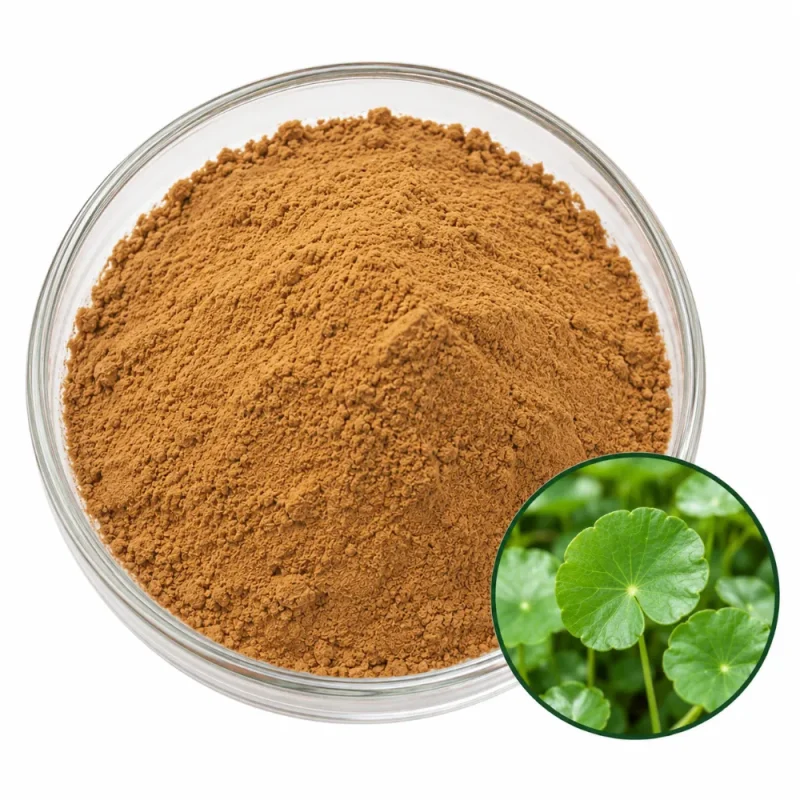
Gotu Kola / Centella asiatica Extract 8% total triterpenes

Ethanol extraction of the aerial parts of Centella asiatica, the leaves, petioles and stems, concentrates the ursane-type triterpene saponins of the plant into this gotu kola extract. The main constituents are asiaticoside and madecassoside, together with their aglycones asiatic acid and madecassic acid. The dried liquor is a light brown powder.

The primary grade is 8% total triterpenes by UV, supplied as a single grade in 80 mesh. The marker is a sum of related compounds and not one named molecule, and the asiaticosides are followed as a secondary marker. The powder is slightly soluble in water and is used in capsules, tablets and powder blends.

Total Triterpene Standardization & Grades

Triterpenes are the marker family of Centella asiatica (L.) Urb. The plant builds pentacyclic triterpenes of the ursane type, and in the leaf they occur mostly as saponins. Asiaticoside and madecassoside carry sugar chains, while asiatic acid and madecassic acid are the matching sugar-free forms. A total-triterpene figure adds this group together, so it describes a class of material and not a single compound. The extract is standardized to the total because the glycosides and aglycones convert into each other as the leaf is dried and extracted, and one combined number keeps them together. Only aerial parts are used, and the percentage describes the finished powder.

The grade is a single level, so there is no table to choose from. The rest of the powder is made of other ethanol-soluble leaf material, which gives a fuller leaf profile than the highly concentrated cosmetic extracts of the same plant. Related forms are supplied separately: the 10:1 Centella Extract Powder, the milled Gotu Kola (Centella) Powder and the purified aglycone Asiatic Acid 98%. Buyers who need one named compound should look at the last of these. Choosing between the 8% gotu kola extract and the 10:1 extract is a question of whether a defined total-triterpene level is part of the product description, because the ratio extract carries no marker figure at all.

Total Triterpene Analysis & Purity Risks

The UV method reads the combined response of the triterpene group in a prepared sample solution. It does not separate the members, so it cannot say how much of the total is asiaticoside and how much is madecassoside. HPLC resolves the individual peaks and adds or reports them separately, which often gives a different figure for the same lot. A UV total and an HPLC sum measure different things and are not converted into each other.

The secondary marker is the asiaticoside fraction, reported next to the total. It is a separate assay with its own result, and it does not replace the total-triterpene figure. In an HPLC fingerprint the four named triterpenes appear as a recognizable pattern, and the proportion between madecassoside and asiaticoside varies with the origin and the chemotype of the plant. This pattern is therefore a useful identity check on top of the single percentage. Sample preparation matters as well: the saponins dissolve poorly in plain water, so the extract is dissolved in an alcoholic solvent before reading, and a solution that is not fully clear gives a low result.

Purity risks follow from the botany. Gotu kola is often confused with pennywort of the genus Hydrocotyle, and the name brahmi is also used in India for Bacopa monnieri, which is a different plant with different chemistry. The creeping plant grows close to wet soil, and its aerial parts can carry soil particles, which is why ash and heavy metals are controlled. The saponins hydrolyze under heat and alkaline conditions, so a lot that has been overheated shifts toward the aglycones while the total stays about the same.

Typical Specifications

Specification ItemProduct Information
Latin NameCentella asiatica
Plant PartLeaf & Herb
ProcessingEthanol Extraction
Compound ClassTriterpenoids, Terpenoids
Common NameGotu kola, Centella
Ingredient TypeStandardized Extract
Marker Compound(s)Total triterpenes (asiaticoside, madecassoside, asiatic acid, madecassic acid)
Primary Grade8% Total Triterpenes (UV)
AppearanceLight Brown powder
Solubility / DispersibilitySlightly Soluble in Water
Quality Parameters
Moisture (LOD)≤5.0%
Total Ash≤5.0%
Particle Size80 mesh
Heavy MetalsLead ≤2 ppm · Arsenic ≤1 ppm · Cadmium ≤1 ppm · Mercury ≤0.1 ppm
MicrobiologyTPC ≤1,000 cfu/g · Yeast & Mold ≤100 cfu/g · E. coli Negative · Salmonella Negative/25 g
Shelf Life24 months in unopened original packaging, cool and dry storage

Applications by Grade

8% Grade in Capsule Fills

The 8% gotu kola extract fills capsules at a moderate weight and flows fairly well once a glidant is added. The saponins make the powder slightly cohesive, so a dry filling room and a sieved blend keep the fill weight steady from lot to lot.

8% Grade in Tablet Blends

Tablets take the extract with a dry binder and a lubricant. The leaf material is fibrous and mildly hygroscopic, so a compression trial on the full blend, followed by a hardness check after storage, shows whether the tablet holds its shape.

8% Grade for Foaming-Aware Drink Powders

Because the saponins foam in water, drink powders based on this extract need a short stir and a defoaming check in the filling line. The cup is a hazy light brown suspension, which suits opaque or flavored bases better than clear drinks.

8% Grade in Powder Stick Premixes

Sticks carry the extract at gram-level inclusion in a dry premix with a sweetener and a flow agent. Blend the extract with the sweetener first, and check the lumps that form when the premix meets moisture in humid filling rooms.

8% Grade in Botanical Blends

The extract combines with other plant powders and extracts in multi-ingredient capsules. Because the total-triterpene figure is stated per gram of the extract, record the inclusion level in the batch sheet so the contribution of each ingredient can be traced.

Technical & Quality Considerations

The powder is light brown with a herbaceous odor and a faintly bitter taste. It is slightly soluble in water and dissolves better in ethanol and methanol, and in water it gives a hazy dispersion that foams when shaken, which is typical of saponin-rich extracts. The glycosides are stable in dry storage but hydrolyze when heated in water or exposed to alkaline bases, so processes that heat the extract for long periods change the balance between the glycosides and the aglycones. Light and oxygen darken the color slowly.

For scale-up, sieve the extract, premix small inclusions in two steps with a dry carrier, and check the fill weight at every lot change. Keep opened drums closed and shaded, because the powder takes up moisture and lumps. Tablets need a hardness check after storage, and drink powders need a foaming and dispersion test in the intended base. Compare each lot with a retained sample for color, flow and odor, and record the species, plant part and UV method on the batch record so the gotu kola extract keeps its identity with the percentage.

Foam is the practical feature of this leaf extract. Saponins lower surface tension, so a blender or a high-speed mixer entrains air, and a powder that looks free-flowing in the drum can pack down after transport. Allow the blend to rest before filling, and keep the mixing time short. In a drink base the same saponins give a persistent head on the cup, which is why gotu kola extract is better placed in opaque, flavored mixes than in clear drinks.

Packaging & Commercial Supply

Essencefield supports product evaluation, formulation trials, commercial orders, and ongoing ingredient supply. Packaging, storage, and shipping arrangements are determined by product characteristics, order quantity, stability requirements, and destination-market needs.

Supply ItemGeneral Information
SampleAvailable upon request for formulation, testing, and supplier evaluation
Order Quantities100 g · 1 kg · 5 kg · 25 kg · 100 kg · 500 kg · Bulk
Sample Lead TimeTypically 5–7 days after sample confirmation
Production Lead TimeTypically 15–30 days after order and specification confirmation
PackagingSuitable protective inner packaging with bags, cartons, drums, or other appropriate outer packaging
StorageStore in tightly sealed, suitable protective packaging in a cool, dry environment. Protect from moisture, heat, and direct sunlight. Specific storage conditions follow the approved product specification.
DocumentationCOA · Product Specification · TDS · SDS · Applicable declarations (as applicable)

Final order quantities, lead times, packaging, documentation, and shipping arrangements are confirmed according to the selected product and commercial requirements.

Request Ingredient Specifications & Quote

Share your target specification, application, quantity, and documentation needs. We’ll help confirm suitable options, samples, and commercial supply details.