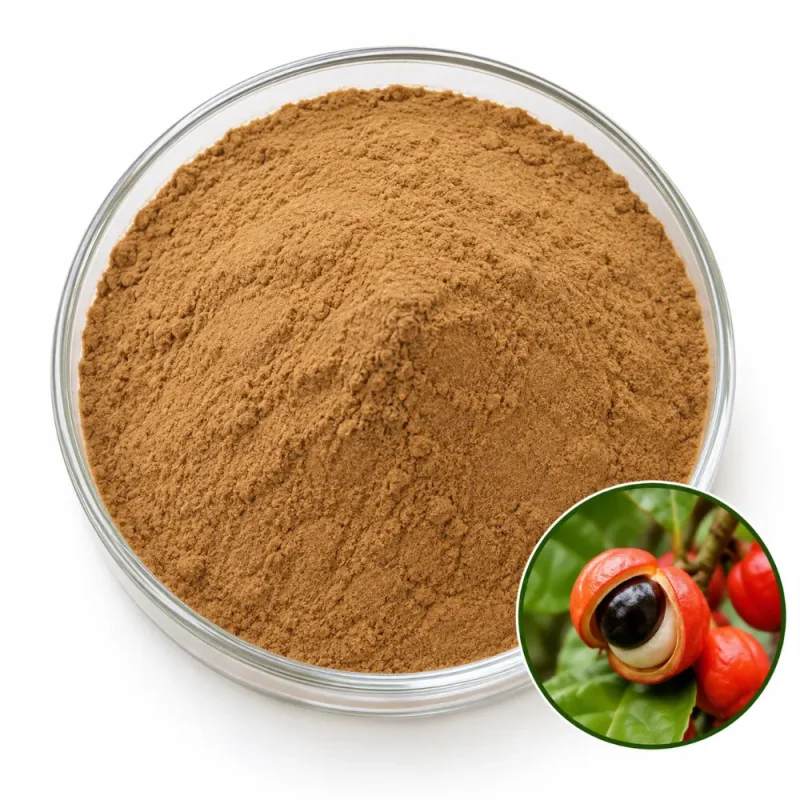
Guarana Extract 10–20% Caffeine / Total Alkaloids

Guarana extract is prepared from the seed of Paullinia cupana, the guarana vine of the Amazon basin, and the pod wall, leaf and stem are not part of the starting material. Ethanol extraction takes up the methylxanthine alkaloids and the tannins of the seed, and the concentrate is dried to a light brown powder.

Caffeine is measured by HPLC, with a primary grade of 20% and a lower grade of 10%. The powder is 80 mesh and water soluble. The 20% grade fits capsules and tablets that need a small fill, while the 10% grade fits drink powders and blends in which the seed matrix is wanted.

Caffeine Standardization & Grades

Caffeine is a methylxanthine alkaloid, and guarana seed is among the richest natural sources of it, together with smaller amounts of theobromine and theophylline, the other methylxanthines. The seed also holds catechins and procyanidin tannins in quantity. The botanical entity is Paullinia cupana Kunth, and the extract is standardized to caffeine, with total alkaloids as the related class, because caffeine is the defining, measurable alkaloid of the seed and the figure on which guarana products are compared.

GradeAssay & MethodWhere It Fits
10% CaffeineHPLCDrink powders and blends, higher inclusion
20% CaffeineHPLCCapsules and tablets, small fill weight

Grade choice follows dose and fill weight. The 20% grade carries twice the caffeine of the 10% grade per gram, so a capsule reaches its target with less powder, while the 10% grade is bulkier, carries more of the seed’s tannin and is easier to blend dry. Guarana is also sold as the Guarana Extract Powder, a 10:1 ratio extract with no marker figure. For a guarana extract specification that must show a caffeine figure, use the standardized extract.

Caffeine Analysis & Purity Risks

HPLC separates caffeine from theobromine and theophylline on a reversed-phase column and quantifies the peaks against reference standards, with UV detection at 273 nm where the xanthine chromophore absorbs strongly. The result is caffeine specifically. A total alkaloid figure by titration or by UV would count the other methylxanthines, and neither can be converted into the HPLC value for caffeine.

For identity, the fingerprint of the seed is read beside caffeine. Theobromine and theophylline appear as neighbors, and catechin, epicatechin and procyanidin B2 form the tannin cluster that is characteristic of guarana. The ratio of caffeine to the other methylxanthines helps to separate guarana from other caffeine sources such as coffee, tea and cola nut.

Purity risks follow from the chemistry. Caffeine is identical whether it comes from the seed or from a synthetic source, so a single HPLC number cannot show where the caffeine came from, and added caffeine can lift a figure. Stable-isotope testing and the companion tannin fingerprint are two ways to check origin. The stated species and the stated seed part are also part of the identity, since Paullinia species other than cupana are sold in small amounts.

Sample preparation uses hot water or a polar solvent, because caffeine dissolves easily, followed by filtration. The tannins can bind caffeine in cold, concentrated solution, so extraction at moderate heat gives a more complete yield.

Raw material handling also matters. Seeds are fermented, roasted, ground and sometimes pressed into sticks, and the roasting stage changes the tannin color and flavor. Overheated seed gives a dark, bitter extract with burnt notes.

Typical Specifications

Specification ItemProduct Information
Latin NamePaullinia cupana
Plant PartSeed & Grain
ProcessingEthanol Extraction
Compound ClassAlkaloids
Common NameGuarana
Ingredient TypeStandardized Extract
Marker Compound(s)Caffeine (with related methylxanthine alkaloids)
Primary Grade20% Caffeine (HPLC)
Available Grades10% · 20% Caffeine (HPLC)
AppearanceLight Brown powder
Solubility / DispersibilityWater Soluble
Quality Parameters
Moisture (LOD)≤5.0%
Total Ash≤5.0%
Particle Size80 mesh
Heavy MetalsLead ≤2 ppm · Arsenic ≤1 ppm · Cadmium ≤1 ppm · Mercury ≤0.1 ppm
MicrobiologyTPC ≤1,000 cfu/g · Yeast & Mold ≤100 cfu/g · E. coli Negative · Salmonella Negative/25 g
Shelf Life24 months in unopened original packaging, cool and dry storage

Applications by Grade

20% Grade for Compact Capsules

The 20% grade of guarana extract reaches a caffeine target in a small fill, which suits compact capsules. The powder is hygroscopic and tannic, so fill in a dry room and seal the capsules in a desiccated bottle.

10% Grade in Drink Powders

The 10% grade dissolves into a clear to slightly hazy brown cup with a bitter, astringent and slightly chocolate-like taste. Berry, cola and citrus flavors suit it, and the serving size should be set with the total caffeine of the drink in mind.

20% Grade in Tablet Blends

Tablets of the 20% grade need a dry binder and a glidant, because the tannin-bearing powder compacts into dark, hard tablets. A film coat limits dust and covers the bitterness, and hardness should be checked after storage.

10% Grade in Energy-Bar Blends

In cold-pressed energy bars the 10% grade is blended into the dry fraction before the syrup is added. The roasted, cocoa-like flavor of guarana sits under chocolate, nut and date notes, and the brown color disappears in dark bases.

10% Grade in Stick-Pack Blends

Stick packs of the 10% grade carry the guarana extract at a practical gram weight per stick alongside other water-soluble ingredients. Foil laminate that transmits little moisture preserves flow through the full shelf life of the product.

20% Grade in Stepwise Dilutions

When the dose is small, dilute the 20% grade in steps with a bulking carrier ahead of the filler. Confirm distribution on a small batch first, since a high-potency powder at a low inclusion rate does not stay mixed on its own.

Technical & Quality Considerations

Guarana extract is a light brown powder with a faint, roasted, cocoa-like odor and a bitter, astringent taste. It is water soluble, giving a clear to slightly hazy brown solution. Caffeine itself dissolves moderately in water and more readily when warm, while the tannins dissolve partly and bind some of the caffeine in cold, concentrated solution, which can cloud a cooled drink.

Caffeine is very stable to heat, light and pH, which makes guarana suitable for hot-fill and baked formats. The tannins are the less stable component: they oxidize in air, give blue-black complexes with iron and bind proteins, so dairy-based and plant-protein beverages may haze and mineral premixes may discolor. Stainless contact surfaces and low-iron fillers help.

Production starts with a sieve, a premix with part of the carrier and a weight check on early fills of the seed extract. The tannic powder takes up water and cakes in humid air, so use a dry room, sealed drums and desiccant liners, and store cool. A closed charging system limits the fine brown dust.

Labeling and total caffeine from all sources in a formula are decisions for regulatory review in the target market, and the caffeine figure of this extract belongs in the calculation.

Taste and release behavior differ between the two grades. The 20% grade tastes sharply bitter because caffeine itself is bitter, while the 10% grade is softened by the seed’s tannins and carries a cocoa-like note. In a drink, the tannin complexes with caffeine are loosely held, so the caffeine is available quickly in a warm cup and more slowly in a cold one. Formulators who match a drink to an existing product should compare the two at the same temperature before fixing the grade.

Packaging choices follow the same logic. Caffeine itself is stable, so the pack is chosen to protect the tannin fraction: moisture-tight to prevent caking, and opaque where the shade matters. A desiccant in bottles and a foil seal on sachets are usually enough.

Packaging & Commercial Supply

Essencefield supports product evaluation, formulation trials, commercial orders, and ongoing ingredient supply. Packaging, storage, and shipping arrangements are determined by product characteristics, order quantity, stability requirements, and destination-market needs.

Supply ItemGeneral Information
SampleAvailable upon request for formulation, testing, and supplier evaluation
Order Quantities100 g · 1 kg · 5 kg · 25 kg · 100 kg · 500 kg · Bulk
Sample Lead TimeTypically 5–7 days after sample confirmation
Production Lead TimeTypically 15–30 days after order and specification confirmation
PackagingSuitable protective inner packaging with bags, cartons, drums, or other appropriate outer packaging
StorageStore in tightly sealed, suitable protective packaging in a cool, dry environment. Protect from moisture, heat, and direct sunlight. Specific storage conditions follow the approved product specification.
DocumentationCOA · Product Specification · TDS · SDS · Applicable declarations (as applicable)

Final order quantities, lead times, packaging, documentation, and shipping arrangements are confirmed according to the selected product and commercial requirements.

Request Ingredient Specifications & Quote

Share your target specification, application, quantity, and documentation needs. We’ll help confirm suitable options, samples, and commercial supply details.