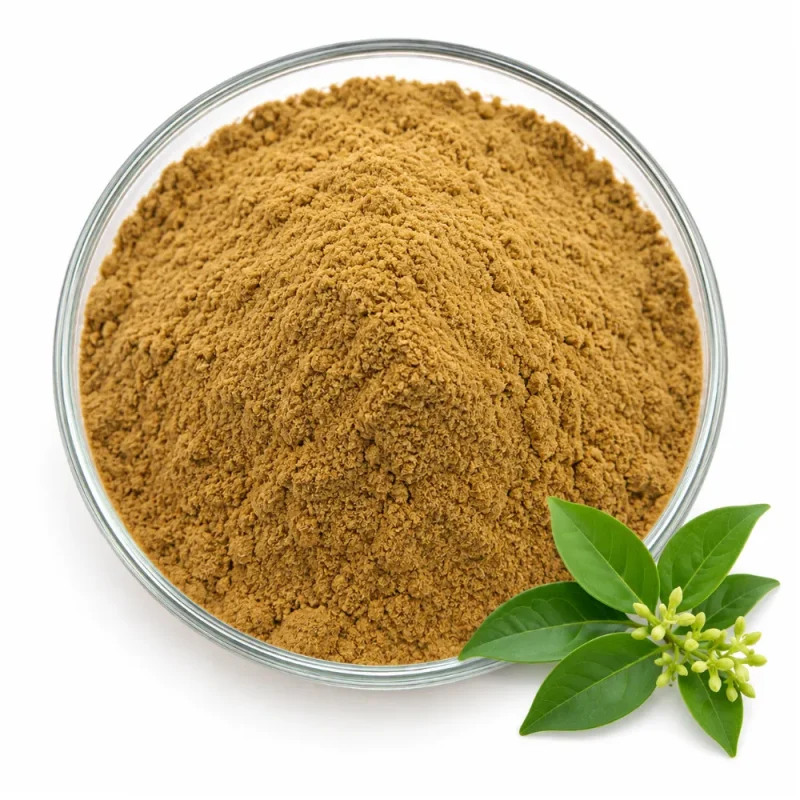
Gymnema Sylvestre Extract 25–75% Gymnemic Acids

Gymnema sylvestre extract is prepared from the leaves of Gymnema sylvestre, the climbing vine of tropical India known as gurmar, and not from the stems, flowers or fruit. Ethanol extraction takes up the triterpene saponins of the leaf, and the liquor is dried to a light brown powder.

The grade range is 25–75% gymnemic acids by HPLC, and the primary grade is the 75% end. The powder is 80 mesh and slightly soluble in water. The 25% grade suits chewable bases and blended powders, while the 75% grade carries a high saponin load for compact capsules and tablets.

Gymnemic Acid Standardization & Grades

Gymnemic acids are triterpene saponins, glycosides in which a four-ring triterpene skeleton carries sugar and glucuronic acid units. They are not one compound but a mixture of related members, and public chemical databases list no single entry for them. That is why a reference standard is built from a defined set of named members, and why a percentage is meaningful only together with that set. The botanical entity is Gymnema sylvestre (Retz.) R.Br. ex Sm., a plant of the Apocynaceae, and the part used is the leaf.

GradeAssay & MethodWhere It Fits
25% Gymnemic AcidsHPLCChewable bases and blended powders
75% Gymnemic AcidsHPLCCapsules and tablets with small fill

The two grades differ widely. The 75% grade is a saponin concentrate that supplies a marker dose from a small fill. The 25% grade keeps more of the plant matrix, the flavonoids, the sugars and the polypeptide gurmarin, so Gymnema sylvestre extract at this level is closer to the leaf and easier to blend. The same plant is also supplied as a 10:1 ratio extract, the Gymnema Extract Powder, as a milled leaf, the Gymnema (Gudmar) Powder, and as the isolated fraction Gymnemic Acid. The name gurmar means sugar destroyer in Hindi, which refers to the sensory effect of the leaf on sweet taste. Gymnema sylvestre extract at 75% is therefore a concentrate, while Gymnema sylvestre extract at 25% stays close to the leaf in taste and texture. Both are extracts of the same leaf and differ in concentration, not in botanical identity.

Gymnemic Acid Analysis & Purity Risks

Both grades are measured by HPLC against a reference set of gymnemic acids. Because the saponins are a mixture, some methods hydrolyze them to the shared aglycone and calculate back to gymnemic acids with a factor, while others quantify named members directly. The two approaches can give different percentages for the same lot, so the procedure belongs with the figure. A UV total or a gravimetric saponin figure cannot be converted into an HPLC result.

The chromatogram of a Gymnema sylvestre leaf extract shows a cluster of saponin peaks, and the pattern is a fingerprint of Gymnema sylvestre against other leaf materials. The sensory effect on sweet taste is mainly attributed to the saponins, and a separate polypeptide, gurmarin, acts differently with a pH-dependent effect. Gurmarin is a protein-like molecule and is not part of the saponin figure, so a saponin grade and a polypeptide product are not the same thing.

Sample preparation uses an alcohol diluent, because the saponins dissolve poorly in cold water, and the solution is filtered and injected on a reversed-phase column with UV detection at a low wavelength, since saponins absorb weakly. Tight integration rules are needed for a cluster of closely spaced peaks.

Purity risks follow from naming and from the plant itself. Gurmar and gudmar are common names, not a species, and Gymnema sylvestre is the species that carries the saponin profile described here, and a stated species and a fixed part are the first checks. Young shoots carry more of the saponins than mature leaf, so harvest stage changes the starting level. The old synonym Periploca sylvestris still appears in some trade documents.

Typical Specifications

Specification ItemProduct Information
Latin NameGymnema sylvestre
Plant PartLeaf & Herb
ProcessingEthanol Extraction
Compound ClassSaponins
Common NameGymnema, Gurmar, Gudmar
Ingredient TypeStandardized Extract
Marker Compound(s)Gymnemic acids (triterpene saponins)
Primary Grade75% Gymnemic Acids (HPLC)
Available Grades25% · 75% Gymnemic Acids (HPLC)
AppearanceLight Brown powder
Solubility / DispersibilitySlightly Soluble in Water
Quality Parameters
Moisture (LOD)≤5.0%
Total Ash≤5.0%
Particle Size80 mesh
Heavy MetalsLead ≤2 ppm · Arsenic ≤1 ppm · Cadmium ≤1 ppm · Mercury ≤0.1 ppm
MicrobiologyTPC ≤1,000 cfu/g · Yeast & Mold ≤100 cfu/g · E. coli Negative · Salmonella Negative/25 g
Shelf Life24 months in unopened original packaging, cool and dry storage

Applications by Grade

75% Grade for Compact Capsules

The 75% grade reaches a saponin target from a small fill, which suits capsules and tablets. The light brown powder is bitter, foaming and hygroscopic, so fill in a dry room, add a glidant and keep a desiccant in the closure of the bottle.

75% Grade in Tablet Blends

Tablets of the 75% grade need a dry binder and a lubricant, because saponin powders soften compacts under humidity. A swallowed, film-coated tablet avoids contact with the tongue and prevents the grade from altering the taste of other foods.

25% Grade in Chewable Bases

The 25% grade is used in chewable and lozenge-style bases where the sweet-suppressing effect of the saponins needs to be planned. Contact with the tongue lowers sweetness for a time, so a flavor system is designed around bitter or sour notes.

25% Grade in Dry Premixes

Dry premixes carry the 25% grade in a blend with other leaf extracts. Pre-blend it with part of the carrier, and expect foam when the mix is stirred into water, which gentle mixing or a defoamer controls.

25% Grade in Tea-Style Blends

Tea-style blends use the 25% grade with spices and dried fruit. The powder is only slightly soluble and gives a hazy brown infusion, and the effect on sweet taste means that sugar in the cup tastes weaker for a short time.

75% Grade in Stick Packs

Stick packs carry the 75% grade at a very low fill with a flow agent. Seal the packs in moisture-barrier film, because the saponin powder clumps at the seal and the clumps dissolve slowly and foam in the cup.

Technical & Quality Considerations

The extract is a light brown powder with a herbal, slightly grassy odor and a bitter, astringent taste. The effect on sweet taste lasts for tens of minutes after contact with the tongue and is a planning point for any product that is tasted, sucked or chewed. The powder is hygroscopic, and bitterness is the main limit on dose in drinks.

Saponin powders are fine and dusty, so use closed transfers where possible and wipe hoppers after each run.

Taste handling is part of formulation. Because the saponins suppress the perception of sweetness for a time, a product that is tasted before it is swallowed, such as a chewable or a lozenge, needs a flavor plan that does not depend on sugar. A sensory panel on the final product, tasted in the order the consumer will taste it, shows the effect before scale-up. Glycosides of this type are stable in neutral and mildly acidic bases at normal processing temperatures, but long exposure to strong acid or alkali can split the sugar units and change the chromatographic pattern. Clean the line after a run, since the sticky residue carries odor and bitterness into the next product.

Packaging & Commercial Supply

Essencefield supports product evaluation, formulation trials, commercial orders, and ongoing ingredient supply. Packaging, storage, and shipping arrangements are determined by product characteristics, order quantity, stability requirements, and destination-market needs.

Supply ItemGeneral Information
SampleAvailable upon request for formulation, testing, and supplier evaluation
Order Quantities100 g · 1 kg · 5 kg · 25 kg · 100 kg · 500 kg · Bulk
Sample Lead TimeTypically 5–7 days after sample confirmation
Production Lead TimeTypically 15–30 days after order and specification confirmation
PackagingSuitable protective inner packaging with bags, cartons, drums, or other appropriate outer packaging
StorageStore in tightly sealed, suitable protective packaging in a cool, dry environment. Protect from moisture, heat, and direct sunlight. Specific storage conditions follow the approved product specification.
DocumentationCOA · Product Specification · TDS · SDS · Applicable declarations (as applicable)

Final order quantities, lead times, packaging, documentation, and shipping arrangements are confirmed according to the selected product and commercial requirements.

Request Ingredient Specifications & Quote

Share your target specification, application, quantity, and documentation needs. We’ll help confirm suitable options, samples, and commercial supply details.