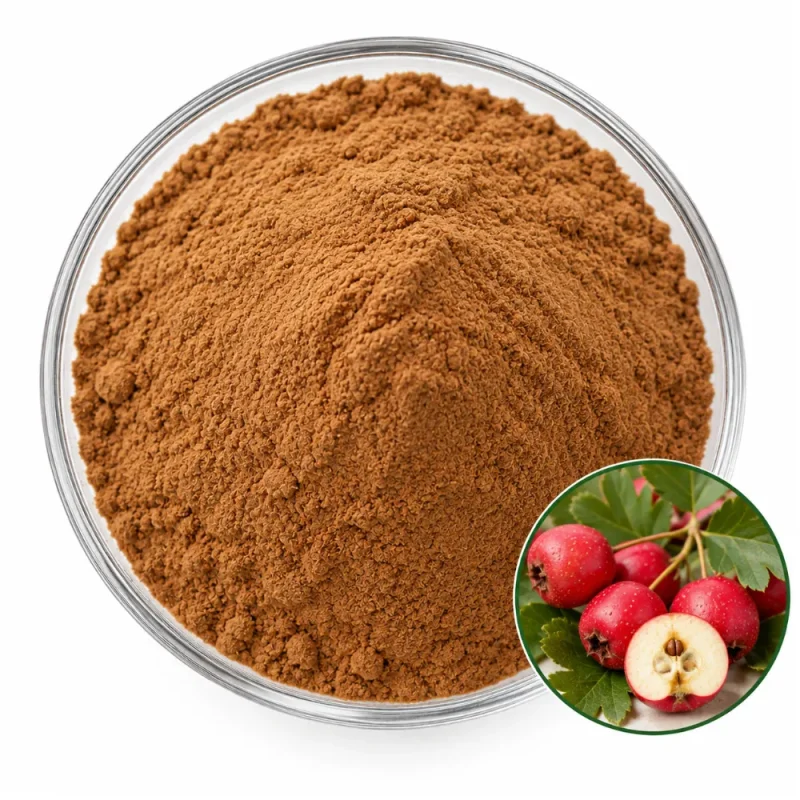
Hawthorn Extract 2–20% Flavonoids

Hawthorn extract is prepared from the leaf of Crataegus pinnatifida, the Chinese hawthorn, and not from the fruit, the flowers or the European hawthorn species. Ethanol extraction takes up the flavonoids of the leaf, and the liquor is dried to a light brown powder.

The grade range is 2–20% total flavonoids by UV, and the primary grade is the 20% end. The powder is 80 mesh and slightly soluble in water. The 2% grade suits tea-style blends and drink powders, while the 20% grade carries a high flavonoid load for compact capsules and tablets.

Flavonoid Standardization & Grades

Flavonoids are plant phenols built on a three-ring skeleton, and the grade reports their total. In hawthorn leaf the main members are C-glycosyl flavones, among them vitexin and its glucoside and rhamnoside, together with flavonol glycosides such as rutin, hyperoside and isoquercitrin, and the flavan-3-ol epicatechin. The grade is a class total and does not name one compound. The botanical entity is Crataegus pinnatifida Bunge, a tree of the Rosaceae with deeply lobed leaves, and the part used is the leaf.

GradeAssay & MethodWhere It Fits
2% Total FlavonoidsUVTea-style blends and drink powders
20% Total FlavonoidsUVCapsules and tablets with small fill

The two grades are different in character. The 20% grade is a flavonoid concentrate that supplies a defined load from a small fill. The 2% grade is closer to the leaf, with more of the sugars, tannins and chlorophyll, so hawthorn extract at this level suits tea-style blends and drink powders. Hawthorn leaf and hawthorn fruit extracts are both sold as hawthorn extract, and the plant part, not the name, defines the product. The fruit and the leaf of hawthorn are separate materials, and the fruit is supplied as the Hawthorn Fruit Extract Powder. The leaf is also supplied as a 10:1 ratio extract, the Hawthorn Leaf Extract Powder, and the purified flavone is listed as Vitexin 98%.

Flavonoid Analysis & Purity Risks

The flavonoid figure is measured by UV. This is a colorimetric method: the sample forms a colored complex with a metal salt reagent, and the absorbance is read against a reference flavonoid. The result is expressed on that reference, such as rutin or vitexin, and counts every compound that gives the reaction. It is not an HPLC result, and it cannot be converted into a figure for vitexin alone.

The reference matters. A procedure that reads against rutin gives a different percentage from one that reads against vitexin for the same extract, because the response of each flavonoid differs. The data for this product lists a vitexin-type marker as a secondary figure, and HPLC is used beside the UV total to show the pattern of individual C-glycosides and flavonol glycosides.

Sample preparation affects the reading. The extract is dissolved in alcohol, mixed with the reagent, and left for a fixed time before the absorbance is read, and a blank corrects for the color of the extract itself. Chlorophyll in a green leaf extract can interfere, so a clean extract gives a more repeatable result.

Purity risks follow from the botany. European pharmacopoeias use the leaf and flower of Crataegus monogyna and Crataegus laevigata, while Chinese practice uses the fruit of Crataegus pinnatifida, so the species, the part and the region of use differ. A stated species and the leaf as the plant part are the first checks, and a fingerprint of the C-glycosides helps identity. Hawthorn is a large genus with many hybrids, and hawthorn leaves of different species look similar when dried and cut, so the species name on the certificate is not a formality.

Typical Specifications

Specification ItemProduct Information
Latin NameCrataegus pinnatifida
Plant PartLeaf & Herb
ProcessingEthanol Extraction
Compound ClassFlavonoids, Polyphenols
Common NameHawthorn, Chinese Hawthorn Leaf
Ingredient TypeStandardized Extract
Marker Compound(s)Total flavonoids (C-glycosyl flavones and flavonol glycosides)
Primary Grade20% Total Flavonoids (UV)
Available Grades2% · 20% Total Flavonoids (UV)
AppearanceLight Brown powder
Solubility / DispersibilitySlightly Soluble in Water
Quality Parameters
Moisture (LOD)≤5.0%
Total Ash≤5.0%
Particle Size80 mesh
Heavy MetalsLead ≤2 ppm · Arsenic ≤1 ppm · Cadmium ≤1 ppm · Mercury ≤0.1 ppm
MicrobiologyTPC ≤1,000 cfu/g · Yeast & Mold ≤100 cfu/g · E. coli Negative · Salmonella Negative/25 g
Shelf Life24 months in unopened original packaging, cool and dry storage

Applications by Grade

20% Grade for Compact Capsules

The 20% grade puts a flavonoid load into a small fill, so it suits capsules and tablets. The light brown powder is slightly soluble in water, so it fills as a dry solid, and a glidant helps hopper flow in humid rooms.

20% Grade in Tablet Blends

Tablets of the 20% grade need a dry binder and a moisture-tolerant filler, because flavonoid powders take up water and soften compacts. Keep the blend away from iron-bearing equipment, which darkens flavonoids on contact, and check the tablet face for specks.

2% Grade in Tea-Style Blends

Tea-style blends use the 2% grade with dried leaf and flower pieces. The powder is slightly soluble and gives a hazy, brown-green infusion, so a filter bag or a note to stir keeps the cup uniform.

2% Grade in Drink Powders

Drink powders carry the 2% grade with fruit and citrus flavors. The slightly soluble solid forms a haze in water, and a thickener or a suspension aid keeps the particles from settling in the glass or bottle.

2% Grade in Gummy Premixes

Gummy premixes accept the 2% grade as a fine dispersion in warm syrup. Add the powder after the main cook and stir well, since the tannin-bearing fraction can stiffen a pectin or gelatin gel and change its clarity, so a small pilot run is worth doing.

20% Grade in Stick Packs

Stick packs carry the 20% grade at a small fill with a flow agent and a fine carrier. Seal the packs in moisture-barrier film, because the powder clumps at the seal, and check the dissolved drink for sediment.

Technical & Quality Considerations

The extract is a light brown powder with a faint, herbal odor and a mildly bitter, astringent taste. It is slightly soluble in water, and solutions are hazy and yellow-brown. C-glycosyl flavones such as vitexin resist hydrolysis better than O-glycosides, which makes hawthorn leaf extract relatively tolerant of acid and heat, but the flavonol glycosides darken on contact with iron and copper.

For production, sieve the powder before blending to break up soft agglomerates and pre-blend with a portion of the carrier. The 20% grade packs more densely than the 2% grade, and a fine flow aid helps it pass through hoppers and feeders. Control humidity in weighing and filling, since the powder gains water slowly and then cakes.

In liquids, wet the powder with a small amount of alcohol or a surfactant solution before dilution, and use high-shear mixing so that it does not float. Keep the drum sealed and away from light, compare each lot with a retained sample for color, taste and the flavonoid reading, and clean the line after a run, because the green-brown powder stains mixers and hoppers. Hawthorn leaf extract keeps its color best in a sealed liner away from sunlight, and a cool, dry store protects the powder from caking. A retained sample from each lot tested again near the end of shelf life shows whether the packaging holds the flavonoid reading and the color.

Packaging & Commercial Supply

Essencefield supports product evaluation, formulation trials, commercial orders, and ongoing ingredient supply. Packaging, storage, and shipping arrangements are determined by product characteristics, order quantity, stability requirements, and destination-market needs.

Supply ItemGeneral Information
SampleAvailable upon request for formulation, testing, and supplier evaluation
Order Quantities100 g · 1 kg · 5 kg · 25 kg · 100 kg · 500 kg · Bulk
Sample Lead TimeTypically 5–7 days after sample confirmation
Production Lead TimeTypically 15–30 days after order and specification confirmation
PackagingSuitable protective inner packaging with bags, cartons, drums, or other appropriate outer packaging
StorageStore in tightly sealed, suitable protective packaging in a cool, dry environment. Protect from moisture, heat, and direct sunlight. Specific storage conditions follow the approved product specification.
DocumentationCOA · Product Specification · TDS · SDS · Applicable declarations (as applicable)

Final order quantities, lead times, packaging, documentation, and shipping arrangements are confirmed according to the selected product and commercial requirements.

Request Ingredient Specifications & Quote

Share your target specification, application, quantity, and documentation needs. We’ll help confirm suitable options, samples, and commercial supply details.