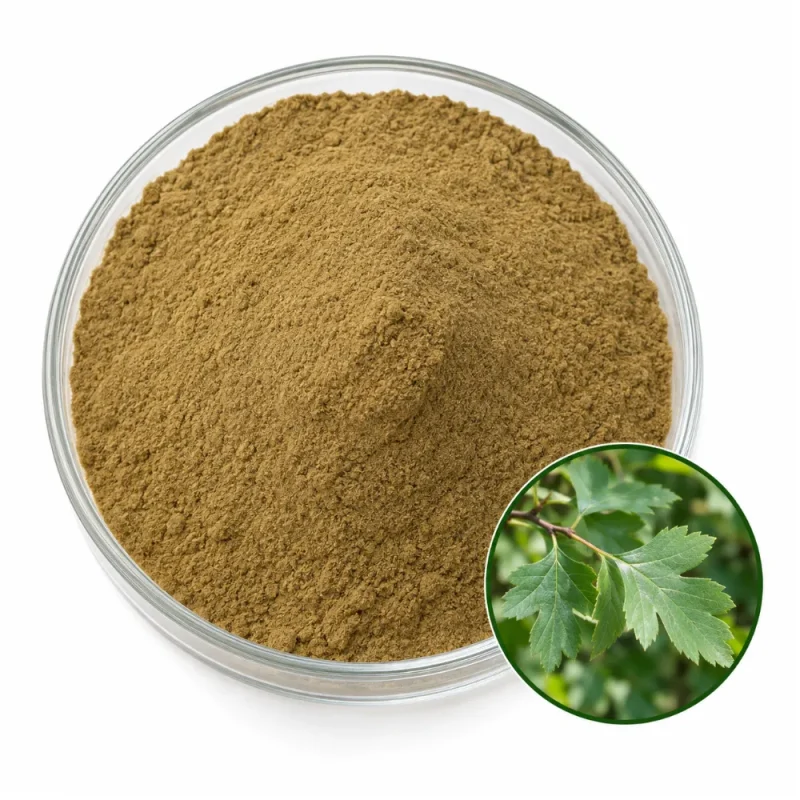
Hawthorn Leaf Extract Powder

Hawthorn leaf extract comes from the deeply lobed, serrated foliage that gives Crataegus pinnatifida its species name, not from the tree’s red fruit. Water extraction concentrates the soluble leaf fraction, and the liquor is dried to a yellow-green powder. Flowers and fruit are left out.

The 10:1 ratio extract of hawthorn leaf states no flavonoid percentage. Particle size is 80 mesh, and the powder disperses readily in water. A flavonoid-standardized extract, the fruit extracts and the fruit powder are separate products, each built on a different organ or a defined marker.

Crataegus pinnatifida Leaf Identity & Plant Part

The botanical entity is Crataegus pinnatifida Bunge, the Chinese hawthorn of the rose family, Rosaceae. The part used is the leaf, picked from the tree and dried. Fruit, flowers and thorns are not included in this hawthorn leaf extract, and the tree yields several parts that make quite different ingredients.

European pharmacopoeial monographs for Crataegus monogyna and C. laevigata describe the leaf together with the flower. This extract is leaf only, from the Chinese species, and carries no flower fraction. A specification that says only “hawthorn extract” cannot tell a buyer whether leaf, flower or fruit was used, or which species.

Reported leaf constituents include C-glycosylflavones such as vitexin, vitexin-2″-O-glucoside and vitexin-2″-O-rhamnoside, alongside hyperoside, rutin, isoquercitrin and epicatechin.

Hawthorn Leaf Extract vs Fruit & Grades

FormWhat It IsChoose It When
10:1 Hawthorn Leaf ExtractWater-extracted, concentrated and dried C. pinnatifida leafA dispersible leaf extract without a marker is wanted
Hawthorn Extract 2–20% FlavonoidsStandardized extract with a defined flavonoid rangeThe specification names a flavonoid figure
Hawthorn Fruit Extract PowderExtract of the red fruit rather than the leafA sour, fruity extract is the brief
Crataegus Pinnatifida Extract PowderSecond entry for the same species, titled by its Latin nameThe Latin name must appear in the product title

A 10:1 figure says that ten parts of hawthorn leaf lie behind each part of powder. It does not give a vitexin or hyperoside content, and a leaf extract at this ratio can sit well below a flavonoid-graded product on any individual marker.

Appearance separates the two extracts first: yellow-green for the leaf, red-brown for the fruit. The Latin-name entry is the same species under a different title and adds no further grade. When a label has to declare flavonoids, the standardized extract is the product to use. The ratio extract of the leaf serves formulas that want hawthorn leaf identity, a green-yellow tint and a mild leafy taste. Fruit extracts are sour, red-brown and belong in different formats.

Leaf age changes the powder: young leaves give a paler, milder lot, while older leaves are darker and more astringent.

Typical Specifications

Specification ItemProduct Information
Latin NameCrataegus pinnatifida
Plant PartLeaf & Herb
ProcessingWater Extraction
Common NameHawthorn Leaf
Ingredient TypeRatio Extract
Extract Ratio10:1
AppearanceYellow-Green powder
Solubility / DispersibilityWater Dispersible
Quality Parameters
Moisture (LOD)≤5.0%
Total Ash≤5.0%
Particle Size80 mesh
Heavy MetalsLead ≤2 ppm · Arsenic ≤1 ppm · Cadmium ≤1 ppm · Mercury ≤0.1 ppm
MicrobiologyTPC ≤1,000 cfu/g · Yeast & Mold ≤100 cfu/g · E. coli Negative · Salmonella Negative/25 g
Shelf Life24 months in unopened original packaging, cool and dry storage

Application Areas

Leaf Extract Capsule Fills

The yellow-green tint of hawthorn leaf extract shows through clear shells, so opaque capsules are the usual choice. The powder flows well enough for machine filling after a flow check, and a desiccant in the bottle limits moisture uptake over the storage period.

Instant Herbal Tea Mixes

Instant tea mixes combine the extract with chrysanthemum, lemon balm or green tea. Its mild, leafy and slightly astringent character suits an infusion, and the powder dissolves in hot water to a light golden-green cup without leaving leaf fragments behind.

Leaf Extract Coated Tablets

Coating hides both the leafy, astringent taste and the green-yellow color of hawthorn leaf extract in tablets. Because the powder takes up moisture, hardness and disintegration are checked after several weeks of storage, and the coat doubles as a moisture barrier in the bottle.

Botanical Powder Sticks

Single-serve sticks carry the extract with a sweetener and a citrus or herbal carrier. The pale green tint reads as natural in the finished drink, and the powder disperses in cold water with a faint haze that settles little over an hour.

Formulation Notes

The powder is yellow-green with a faint leafy aroma and a slightly bitter, astringent taste. In water it disperses to a pale golden-green, lightly hazy liquid. The C-glycosylflavones are fairly stable, but color and clarity drift under strong light, heat and alkaline conditions, so drinks stay best at a mildly acidic to neutral pH.

Hawthorn leaf extract takes up moisture and forms lumps where air is humid. Blend it first with a measured portion of the filler, screen soft agglomerates away, and add a small amount of glidant if the powder arches over the hopper outlet. Iron and copper contact can darken flavonoid-rich powders, so stainless steel or plastic scoops are preferred.

After opening, reseal the liner and use the container within a sensible period. Room air makes the leaf powder tacky and dulls the green shade, and the loss shows first in lightly colored blends.

Packaging & Commercial Supply

Essencefield supports product evaluation, formulation trials, commercial orders, and ongoing ingredient supply. Packaging, storage, and shipping arrangements are determined by product characteristics, order quantity, stability requirements, and destination-market needs.

Supply ItemGeneral Information
SampleAvailable upon request for formulation, testing, and supplier evaluation
Order Quantities100 g · 1 kg · 5 kg · 25 kg · 100 kg · 500 kg · Bulk
Sample Lead TimeTypically 5–7 days after sample confirmation
Production Lead TimeTypically 15–30 days after order and specification confirmation
PackagingSuitable protective inner packaging with bags, cartons, drums, or other appropriate outer packaging
StorageStore in tightly sealed, suitable protective packaging in a cool, dry environment. Protect from moisture, heat, and direct sunlight. Specific storage conditions follow the approved product specification.
DocumentationCOA · Product Specification · TDS · SDS · Applicable declarations (as applicable)

Final order quantities, lead times, packaging, documentation, and shipping arrangements are confirmed according to the selected product and commercial requirements.

Request Ingredient Specifications & Quote

Share your target specification, application, quantity, and documentation needs. We’ll help confirm suitable options, samples, and commercial supply details.