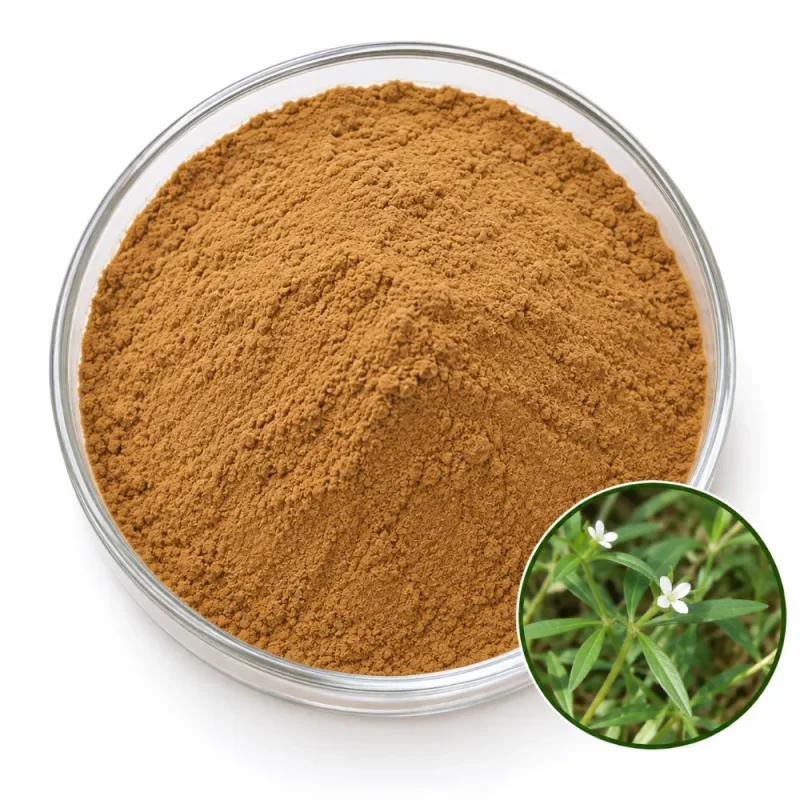
Hedyotis Diffusa Extract 1–10% Iridoids

Ethanol extraction of the aerial parts of Hedyotis diffusa, a slender madder-family herb also listed as Oldenlandia diffusa, concentrates its iridoid glycosides in this Hedyotis diffusa extract. The extract is dried to a light brown powder that dissolves in water and is milled to 80 mesh.

Iridoids are measured by HPLC and offered as a 1–10% range, with 10% as the primary grade and 1% as the lower grade. A second marker pair, ursolic and oleanolic acid, is tracked on the same material. The higher grade suits compact capsules, and the lower grade suits drink mixes.

Iridoid Standardization & Grades

Iridoids are cyclopentane-fused monoterpenoids that occur as glycosides, and they dominate the water-soluble fraction of Hedyotis diffusa Willd. The best-known examples in this herb are asperuloside, asperulosidic acid and scandoside methyl ester. Standardizing a Hedyotis diffusa extract to iridoids gives buyers a measurable figure for the polar glycoside fraction, which is the part that explains why the powder dissolves in water.

GradeAssay & MethodWhere It Fits
1% IridoidsHPLCDrink mixes, high-inclusion blends
10% IridoidsHPLCCapsules and tablets, small fill weight

The choice between the two grades is mainly a question of fill weight and cost per dose. Delivering a given iridoid amount takes ten times the powder at 1% as at 10%, so the 10% grade is the one for compact dosage forms. The 1% grade retains more of the whole-herb matrix, including the triterpenoid acids that sit in the less polar fraction, and it is simple to blend at gram-level inclusion. No sibling extract or powder of this species is currently listed in the catalog.

Iridoid Analysis & Purity Risks

HPLC separates the iridoid glycosides on a reversed-phase column and detects them at a low UV wavelength, where the iridoid chromophore absorbs. The iridoid figure is the sum of resolved iridoid peaks quantified against reference standards. It describes the glycoside fraction only and cannot be compared with a colorimetric total or with a single-compound result from another method.

The second marker pair is measured separately. Ursolic and oleanolic acid are pentacyclic triterpenoid acids that appear in the less polar fraction, so a lot can carry a high iridoid figure with a modest triterpenoid acid level, or the reverse. This is why the iridoid grade is read together with the chromatographic profile and not alone. The fingerprint also confirms that the pattern of the main iridoid peaks matches the herb.

The main purity risk is species identity. Hedyotis corymbosa and other small members of the same genus are visually close to Hedyotis diffusa and are known as look-alike or substitute herbs in the dried trade. Their iridoid pattern differs, so a fingerprint that shows the expected asperulosidic acid peak and the expected ratios is the practical check. A second risk is incomplete drying of the herb before extraction, which can degrade the glycosides and darken the powder. Roots and flowering tops of unrelated weeds are not part of this identity.

Sample preparation also affects the iridoid result. The glycosides dissolve in aqueous methanol, but they are labile, so extracts are prepared fresh, kept cool in the autosampler and injected without delay. A standard solution that has stood for days can show falling peak areas for the acylated and acidic iridoids, and a lot that is retested on a different day should be read against a freshly prepared standard.

Raw-material handling matters just as much. The herb is gathered whole in the green state, dried promptly and cleaned of soil and of mixed-in weeds before extraction, because sand raises ash and foreign leaves dilute the marker fraction. Material that has been stored damp loses iridoids to enzymatic and microbial breakdown, and the loss shows as a flatter iridoid cluster in the fingerprint.

Typical Specifications

Specification ItemProduct Information
Latin NameHedyotis diffusa
Plant PartLeaf & Herb
ProcessingEthanol Extraction
Compound ClassIridoids, Terpenoids
Common NameHedyotis, Spreading Hedyotis
Ingredient TypeStandardized Extract
Marker Compound(s)Iridoids; ursolic and oleanolic acid
Primary Grade10% Iridoids (HPLC)
Available Grades1% · 10% Iridoids (HPLC)
AppearanceLight Brown powder
Solubility / DispersibilityWater Soluble
Quality Parameters
Moisture (LOD)≤5.0%
Total Ash≤5.0%
Particle Size80 mesh
Heavy MetalsLead ≤2 ppm · Arsenic ≤1 ppm · Cadmium ≤1 ppm · Mercury ≤0.1 ppm
MicrobiologyTPC ≤1,000 cfu/g · Yeast & Mold ≤100 cfu/g · E. coli Negative · Salmonella Negative/25 g
Shelf Life24 months in unopened original packaging, cool and dry storage

Applications by Grade

10% Grade in Small Capsule Fills

The 10% grade of Hedyotis diffusa extract reaches an iridoid target in a compact fill, which suits two-piece capsules. The glycoside-rich powder is mildly hygroscopic, so fill in a dry room and add a flow agent to keep the powder from bridging in the hopper.

10% Grade in Moisture-Coated Tablets

Tablets of the 10% grade tolerate direct compression at low loads, while higher loads benefit from dry granulation. A moisture-barrier film coat keeps the tablet from softening, and a hardness check after a month of storage shows whether the glycoside fraction is pulling water.

1% Grade in Amber Drink Powders

The 1% grade dissolves readily and fits instant drink powders and stick packs. Its brown tone and herbal bitterness sit best under tea, citrus or malt flavors, and a clear solution makes it easy to judge whether the powder has dissolved completely.

1% Grade in Granulated Herbal Blends

Granulated herbal blends can carry the 1% grade alongside other cut or powdered herbs. The extract dissolves faster than the cut material, so it is dosed as a fine powder within the pack, and the blend is sampled from several depths to confirm even iridoid distribution.

10% Grade in Triterpenoid-Balanced Premixes

Premixes that pair this extract with other triterpenoid ingredients use the 10% grade for its higher iridoid load per gram. The ursolic and oleanolic acids of the herb add to the triterpenoid total of the mix, which matters when a formula states a combined figure.

Technical & Quality Considerations

Hedyotis diffusa extract is a light brown powder with a mild herbal, slightly bitter character. It dissolves in water to a clear to slightly hazy amber solution, and the iridoid glycosides are the main reason for that solubility. The less polar triterpenoid acids dissolve poorly, so a small amount of fine, undissolved material may settle in a still solution.

Iridoid glycosides are sensitive to strong acid and to enzymes that cleave the sugar. In acidic beverages and in the presence of native glycosidases from fresh plant material, the glycoside can hydrolyze to a reactive aglycone that darkens and polymerizes. Neutral to mildly acidic bases, short heat treatment and finished products free of fresh herb preparations keep the shade of the extract steady.

The dry powder takes up moisture, which causes caking and a gradual browning. Opaque, sealed packaging and a desiccant sachet inside the container hold the powder free-flowing during storage in a bottle or drum.

In production, the powder is sieved and metered under low humidity, and dust collection is advised because fine herbal powder irritates the eyes and airways. For liquid formats, dissolve the extract in room-temperature water first and add acids afterward. A short accelerated stability run with the intended pack shows early whether color, flow and clarity are stable in the finished mix.

Packaging & Commercial Supply

Essencefield supports product evaluation, formulation trials, commercial orders, and ongoing ingredient supply. Packaging, storage, and shipping arrangements are determined by product characteristics, order quantity, stability requirements, and destination-market needs.

Supply ItemGeneral Information
SampleAvailable upon request for formulation, testing, and supplier evaluation
Order Quantities100 g · 1 kg · 5 kg · 25 kg · 100 kg · 500 kg · Bulk
Sample Lead TimeTypically 5–7 days after sample confirmation
Production Lead TimeTypically 15–30 days after order and specification confirmation
PackagingSuitable protective inner packaging with bags, cartons, drums, or other appropriate outer packaging
StorageStore in tightly sealed, suitable protective packaging in a cool, dry environment. Protect from moisture, heat, and direct sunlight. Specific storage conditions follow the approved product specification.
DocumentationCOA · Product Specification · TDS · SDS · Applicable declarations (as applicable)

Final order quantities, lead times, packaging, documentation, and shipping arrangements are confirmed according to the selected product and commercial requirements.

Request Ingredient Specifications & Quote

Share your target specification, application, quantity, and documentation needs. We’ll help confirm suitable options, samples, and commercial supply details.