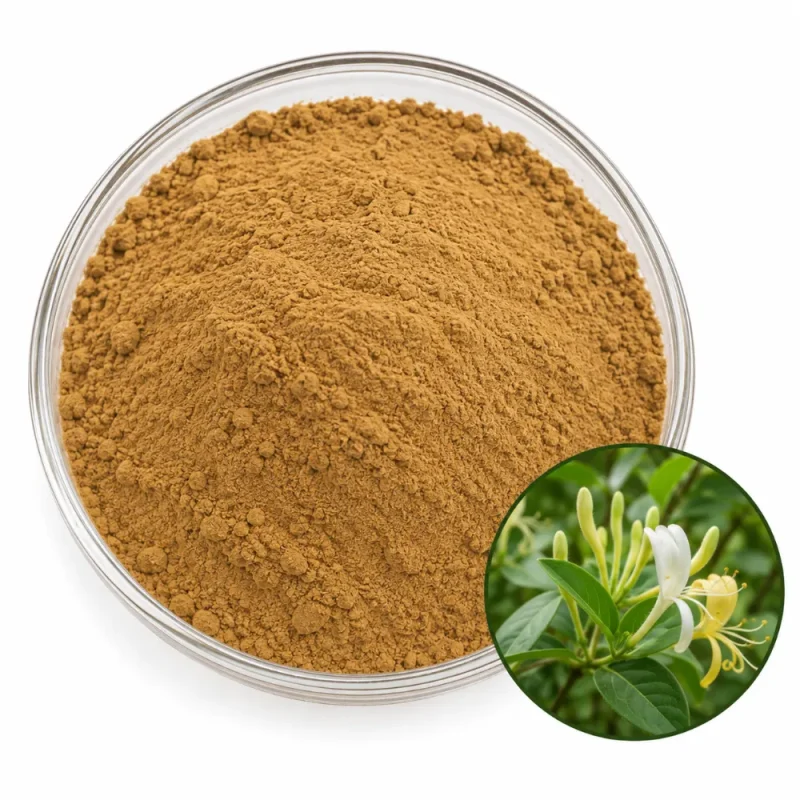
Honeysuckle Extract 5–25% Chlorogenic Acid

The dried flower buds of Lonicera japonica, the Japanese honeysuckle used in East Asian herbal trade as jin yin hua, are extracted with ethanol to give this honeysuckle extract. Drying and milling give a free-flowing light brown powder of 80 mesh that dissolves in water to an amber solution, which suits dry and liquid formats alike.

Chlorogenic acid is measured by HPLC and offered as a 5–25% range, with 25% as the primary grade and 5% as the lower grade. The higher grade fits small-fill capsules and tablets, and the lower grade fits drink powders and blends that can carry more of the flower matrix.

Chlorogenic Acid Standardization & Grades

Chlorogenic acid is the caffeic acid ester of quinic acid, a hydroxycinnamate that the flower of Lonicera japonica Thunb. accumulates together with its isomers and with dicaffeoylquinic acids. The compound is the usual quality marker for this flower in trade, and a honeysuckle extract is standardized to it because it is easy to measure and varies widely between lots of raw flower. Green coffee beans and several other plants also contain it, so the figure on its own does not identify the botanical.

GradeAssay & MethodWhere It Fits
5% Chlorogenic AcidHPLCDrink powders, higher-inclusion blends
25% Chlorogenic AcidHPLCCapsules and tablets, small fill weight

Grade choice follows dose and fill weight. Reaching the same chlorogenic acid target takes five times as much powder at 5% as at 25%, so the 25% grade is the one for compact dosage forms. The 5% grade keeps more of the flavonoid and iridoid fraction of the flower and is easy to blend at gram-level inclusion. The same flower is also supplied as a 10:1 ratio extract without a marker figure, the Honeysuckle Flower Extract Powder, as a milled flower, Honeysuckle Flower Powder, and as a single compound, 3,4-Dicaffeoylquinic Acid 98%.

Chlorogenic Acid Analysis & Purity Risks

HPLC separates chlorogenic acid from its positional isomers on a reversed-phase column and detects it in the near-UV, where the caffeoyl group absorbs strongly. The figure is chlorogenic acid itself, namely the 5-O-caffeoylquinic isomer, quantified against a reference standard. The neighboring isomers, neochlorogenic and cryptochlorogenic acid, elute close by and are read as separate peaks. A method that adds them together reports a higher total that cannot be compared with this single-compound result.

For identity, the fingerprint of the flower extract shows chlorogenic acid beside its isomers, the dicaffeoylquinic acids and luteolin-type flavonoid glycosides. This combined pattern points to honeysuckle flower and separates it from green coffee extract, which is dominated by 5-caffeoylquinic acid and has a different companion profile.

Purity risks follow from the botanical group. Trade names for honeysuckle cover several Lonicera species, and pharmacopeias treat the flower of Lonicera japonica separately from the flowers of related species, so the stated species and the flower part are part of the identity. The stem and leaf of the same vine are a different drug with a different marker profile.

Sample handling matters for this analyte. Caffeoylquinic acids isomerize in warm or alkaline solution through acyl migration, so prepared samples are kept cool and slightly acidic and are injected promptly. A sample left on the bench can show a shifted isomer ratio even when the sum is unchanged.

Raw material also shapes the figure. The flower is picked as an unopened bud or just-opened flower, because chlorogenic acid and the dicaffeoylquinic acids fall as the flower ages and turns yellow, and they are lost faster if the harvest is dried slowly in damp air. A lot made from open, old flowers shows a lower marker share and a more brown extract, and the loss is visible in the fingerprint before it appears in the assay.

Typical Specifications

Specification ItemProduct Information
Latin NameLonicera japonica
Plant PartFlower
ProcessingEthanol Extraction
Compound ClassPolyphenols
Common NameHoneysuckle, Japanese Honeysuckle
Ingredient TypeStandardized Extract
Marker Compound(s)Chlorogenic Acid
Primary Grade25% Chlorogenic Acid (HPLC)
Available Grades5% · 25% Chlorogenic Acid (HPLC)
AppearanceLight Brown powder
Solubility / DispersibilityWater Soluble
Quality Parameters
Moisture (LOD)≤5.0%
Total Ash≤5.0%
Particle Size80 mesh
Heavy MetalsLead ≤2 ppm · Arsenic ≤1 ppm · Cadmium ≤1 ppm · Mercury ≤0.1 ppm
MicrobiologyTPC ≤1,000 cfu/g · Yeast & Mold ≤100 cfu/g · E. coli Negative · Salmonella Negative/25 g
Shelf Life24 months in unopened original packaging, cool and dry storage

Applications by Grade

25% Grade in Dense Capsule Fills

The 25% grade of honeysuckle extract reaches a chlorogenic acid target in a small fill, which suits two-piece capsules. The powder is hygroscopic and sticks to tamping pins when it picks up moisture, so a dry filling room and a flow agent keep capsule weights steady.

25% Grade in Film-Coated Tablets

Tablets of the 25% grade need a dry binder, and the pressed tablet should be film coated to keep out moisture. Chlorogenic acid darkens when it oxidizes, so a coated tablet in a sealed pack keeps its pale brown shade longer than an uncoated one.

5% Grade in Floral Instant Drinks

The 5% grade dissolves readily and fits instant drink powders and stick packs. Its flavor is mildly bitter and floral, so it pairs with citrus, peach or tea flavors, and the clear amber solution makes it easy to see whether the powder has dissolved.

5% Grade in Gummy Bases

In gummies, the 5% grade is dissolved into the syrup before depositing. Keep the cook temperature moderate and add the extract late, because prolonged heat shifts the isomer pattern of the caffeoylquinic acids and deepens the color of the piece.

5% Grade in Herbal Tea Granules

Granulated blends for infusion can pair the 5% grade with cut honeysuckle buds, which gives the tea a visible flower and a dissolved chlorogenic acid base. The extract dissolves quickly, so it is dosed inside the bag as a fine powder and kept apart from moist ingredients.

Technical & Quality Considerations

Honeysuckle extract is a light brown powder with a floral, mildly bitter character that carries through both grades. It dissolves in water to a clear amber solution, and chlorogenic acid is also soluble in ethanol, so hydroalcoholic and aqueous liquid formats are both workable. The solution color deepens slowly in light and air.

Chlorogenic acid is an ester, and an ester bond is sensitive to alkaline conditions and to prolonged heat. High-pH premixes hydrolyze it to caffeic acid and quinic acid, and neutral solutions held warm shift the isomer ratio. Mildly acidic bases, short heat treatment and low storage temperature in the finished product keep the compound stable. The phenolic groups also oxidize to colored quinones in the presence of iron or copper, so chelating agents help in mineral-rich bases.

The dry powder takes up moisture and caking follows. Sealed packaging with a desiccant sachet keeps the lot loose and free-flowing.

In production, sieve the powder, meter it under low humidity and keep drums closed between charges. Fine dust from a phenolic extract is a nuisance to the eyes and airways, so local extraction at the charging point is advised. An accelerated stability run with the intended pack shows early whether the color, flow and chlorogenic acid figure are stable in the finished mix.

Color and aroma are quick checks on each lot. A pale tan to light brown shade with a soft floral note is typical for this honeysuckle extract, while a dark, caramel-like shade points to heat or oxidation damage during concentration. Both are visible before any assay result arrives.

Packaging & Commercial Supply

Essencefield supports product evaluation, formulation trials, commercial orders, and ongoing ingredient supply. Packaging, storage, and shipping arrangements are determined by product characteristics, order quantity, stability requirements, and destination-market needs.

Supply ItemGeneral Information
SampleAvailable upon request for formulation, testing, and supplier evaluation
Order Quantities100 g · 1 kg · 5 kg · 25 kg · 100 kg · 500 kg · Bulk
Sample Lead TimeTypically 5–7 days after sample confirmation
Production Lead TimeTypically 15–30 days after order and specification confirmation
PackagingSuitable protective inner packaging with bags, cartons, drums, or other appropriate outer packaging
StorageStore in tightly sealed, suitable protective packaging in a cool, dry environment. Protect from moisture, heat, and direct sunlight. Specific storage conditions follow the approved product specification.
DocumentationCOA · Product Specification · TDS · SDS · Applicable declarations (as applicable)

Final order quantities, lead times, packaging, documentation, and shipping arrangements are confirmed according to the selected product and commercial requirements.

Request Ingredient Specifications & Quote

Share your target specification, application, quantity, and documentation needs. We’ll help confirm suitable options, samples, and commercial supply details.