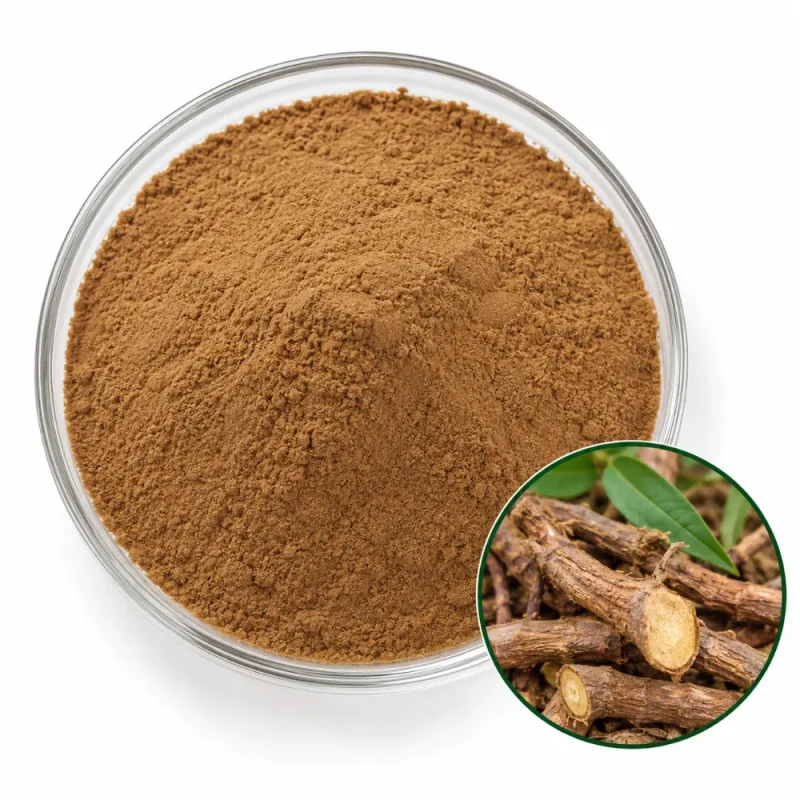
Indian Sarsaparilla Extract 30% Saponins

Hemidesmus indicus, a twining Indian vine whose root is used as anantamul, gives this Indian sarsaparilla extract after ethanol extraction of the dried root. The concentrate is dried and milled to a light brown, 80 mesh powder that dissolves in water, with a faint vanilla-like and woody root note.

Saponins are measured by UV at a single 30% grade. The plant is not related to the true sarsaparilla of the genus Smilax, and the identity statement fixes the species and the root as the material. The powder fits capsules, tablets, drink powders and syrup bases.

Saponin Standardization & Grades

Hemidesmus indicus (L.) R.Br. belongs to the milkweed family, and its root is rich in an aromatic principle, 2-hydroxy-4-methoxybenzaldehyde, which gives the fresh root a vanilla-like note. Alongside it the root carries triterpenoid constituents such as lupeol and a range of glycosides. The extract is standardized to saponins as a group, giving buyers one figure for the glycoside fraction that is soluble in water and responsible for much of the foaming behavior of the root extract.

The grade is a single 30% figure, which keeps ordering simple: each lot is measured against the same target and the same method. A single grade also removes the question of which level is meant when a formula states a saponin amount. The same root is supplied as a 10:1 ratio extract without a marker figure, the Hemidesmus Indicus Extract Powder. That product is the one to consider when a whole-root profile matters more than a defined saponin figure.

Because the Indian sarsaparilla standardization is to a group of compounds and not to one molecule, the number describes the saponin fraction only. It should not be read as a figure for the aromatic aldehyde, the lupeol-type triterpenoids or any single component, none of which is part of the specification.

The standardization also leaves room for a clear comparison with the supplier of any other root extract in the same family. Where a formula combines this extract with other roots rich in saponins, the totals add up in the marker fraction, so the combined saponin load of a finished product should be calculated from each ingredient figure and not from the label of one component.

Saponin Analysis & Purity Risks

The UV method for Indian sarsaparilla extract measures total saponins by color development. The saponins are reacted with vanillin and strong acid under controlled heating, and the resulting color is read against a saponin reference standard. The figure is a group total, and it responds to any triterpenoid or steroidal saponin, not only to those typical of Hemidesmus.

For identity, the chromatographic fingerprint of the root extract is compared with authentic material. The vanilla-note aldehyde and the triterpenoid peaks form a pattern that is specific to the plant and cannot be read from the colorimetric result, which is why identity and content are checked by separate methods.

Substitution is the main purity risk. True sarsaparilla (Smilax species) is a different plant with steroidal saponins and a different fingerprint, and the root of Decalepis hamiltonii, which shares the aromatic aldehyde and is sold under similar trade names, is another look-alike. The stated species and the root as the part are therefore part of the specification, and the fingerprint is used to separate them.

A second risk is sugar carry-over. Free sugars from the root react in the acid color step and raise the apparent saponin total, so a 30% extract depends on a purification step that removes them. Roots that have been stored damp also lose the volatile aldehyde and develop a musty note, which signals handling problems before an assay result arrives.

Handling of the root before extraction influences the result. The root is washed, sliced and dried promptly, because the thin, fragrant bark carries much of the aromatic aldehyde and is lost if the root is peeled. Roots that have been stored for years show a flat aroma and a lower share of soluble solids, which the extract inherits.

Typical Specifications

Specification ItemProduct Information
Latin NameHemidesmus indicus
Plant PartRoot & Rhizome
ProcessingEthanol Extraction
Compound ClassSaponins
Common NameIndian Sarsaparilla, Anantamul
Ingredient TypeStandardized Extract
Marker Compound(s)Saponins
Primary Grade30% Saponins (UV)
AppearanceLight Brown powder
Solubility / DispersibilityWater Soluble
Quality Parameters
Moisture (LOD)≤5.0%
Total Ash≤5.0%
Particle Size80 mesh
Heavy MetalsLead ≤2 ppm · Arsenic ≤1 ppm · Cadmium ≤1 ppm · Mercury ≤0.1 ppm
MicrobiologyTPC ≤1,000 cfu/g · Yeast & Mold ≤100 cfu/g · E. coli Negative · Salmonella Negative/25 g
Shelf Life24 months in unopened original packaging, cool and dry storage

Applications by Grade

30% Grade in Foam-Aware Capsule Fills

The 30% grade of Indian sarsaparilla extract fits two-piece capsules at a modest fill weight. Saponins make the powder hygroscopic and foam-prone, so a dry filling room and a flow agent that does not trap air keep fill weights steady across the run.

30% Grade in Root-Style Tablets

Tablets of the 30% grade need a dry binder and a film coat, because a saponin-rich root extract softens in humid air. The mild vanilla-like root note is pleasant but weak, and a coating covers the slightly bitter tail of the powder.

30% Grade in Cooling Drink Powders

Instant drink powders use the 30% grade for its water solubility and its root note. It pairs with citrus, lemon and sweet spice flavors, and a low-shear mix keeps the foam down when the powder is stirred into water.

30% Grade in Syrup Bases

Syrup concentrates can carry the 30% grade dissolved in a sugar base. High sugar levels reduce foam, but the saponins can cloud the syrup in the presence of acid or hard water, so check clarity after a week and set the pH before adding the extract.

30% Grade in Sarsaparilla-Style Soda Bases

Root-beer or sarsaparilla-style flavor bases pair the root note of Indian sarsaparilla extract with vanilla and spice. Its saponins also stabilize foam, which adds head to the finished drink, so the extract is dosed in small amounts and not in the maximum amount that the carrier tolerates.

Technical & Quality Considerations

Indian sarsaparilla extract is a light brown powder with a faint vanilla-like and woody root note. It dissolves in water to a clear to slightly hazy brown solution, and the dissolved saponins are surface-active, so agitation produces a stable foam. This foaming is the most visible physical trait of the extract and shapes how mixers and fillers are set.

Saponin glycosides hydrolyze under strong acid and heat, so neutral to mildly acidic bases keep the profile stable. The aromatic aldehyde of the root is more fragile than the saponins: it oxidizes to the corresponding acid over time and fades, so the vanilla note weakens in light and warm storage even when the saponin figure is unchanged.

The dry Indian sarsaparilla powder is hygroscopic and cakes when damp. Keeping the drum sealed with a desiccant packet preserves the pourable texture.

On the production line, sieve the powder before use and meter it under low humidity. Mineral premixes need compatibility trials, because divalent salts can cloud a saponin solution over several days. An accelerated stability run in the intended pack shows early whether color, flow, aroma and clarity remain stable in the finished mix.

Aroma and color give a quick check at receipt. A light brown powder with a faint vanilla-like and woody note is expected, while a sharp or musty smell points to damp storage. A uniform shade across the drum indicates good blending of the dried concentrate.

Packaging & Commercial Supply

Essencefield supports product evaluation, formulation trials, commercial orders, and ongoing ingredient supply. Packaging, storage, and shipping arrangements are determined by product characteristics, order quantity, stability requirements, and destination-market needs.

Supply ItemGeneral Information
SampleAvailable upon request for formulation, testing, and supplier evaluation
Order Quantities100 g · 1 kg · 5 kg · 25 kg · 100 kg · 500 kg · Bulk
Sample Lead TimeTypically 5–7 days after sample confirmation
Production Lead TimeTypically 15–30 days after order and specification confirmation
PackagingSuitable protective inner packaging with bags, cartons, drums, or other appropriate outer packaging
StorageStore in tightly sealed, suitable protective packaging in a cool, dry environment. Protect from moisture, heat, and direct sunlight. Specific storage conditions follow the approved product specification.
DocumentationCOA · Product Specification · TDS · SDS · Applicable declarations (as applicable)

Final order quantities, lead times, packaging, documentation, and shipping arrangements are confirmed according to the selected product and commercial requirements.

Request Ingredient Specifications & Quote

Share your target specification, application, quantity, and documentation needs. We’ll help confirm suitable options, samples, and commercial supply details.