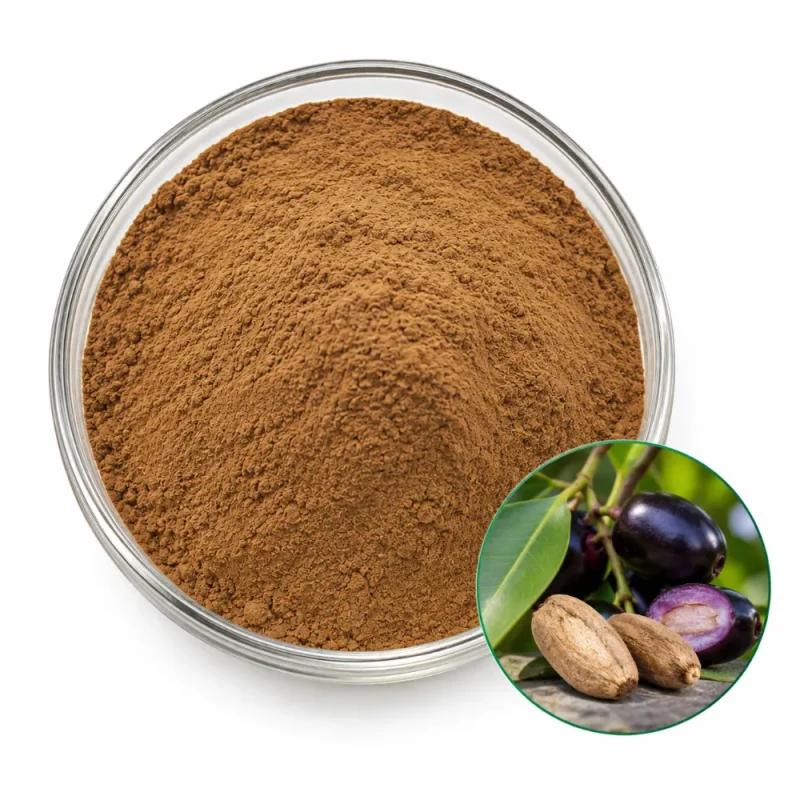
Jamun Seed Extract 2.5–5% Bitters

The stone of the jamun fruit, Syzygium cumini, known as the Java plum and black plum across South Asia, is dried, milled and extracted with ethanol to give this jamun seed extract. The concentrate is dried and milled to a light brown powder of 80 mesh that is only slightly soluble in water and has a dry, astringent character.

Bitters are offered as a 2.5–5% range, with 5% as the primary grade and 2.5% as the lower grade. The figure describes the bitter fraction of the seed, and the fruit pulp is not part of this product. The higher grade fits capsules and tablets, and the lower grade fits blends.

Bitters Standardization & Grades

The seed of Syzygium cumini (L.) Skeels is a hard, starch-rich kernel that carries ellagitannins, gallic acid derivatives, a glycoside called jamboline and a series of bitter-tasting compounds. These bitter constituents are the reason jamun seed has a long history in South Asian herbal practice, and a bitters figure gives buyers one number for that fraction when no single marker compound can stand for the whole group.

GradeAssay & MethodWhere It Fits
2.5% BittersBitters (group figure)Blends, larger-fill capsules
5% BittersBitters (group figure)Capsules and tablets

A group figure has no reference compound of its own, so the number is meaningful only when the same procedure is applied to every lot. The 5% grade carries twice the bitter fraction per gram, which makes a smaller capsule fill possible, while the 2.5% grade is bulkier and blends easily at gram-level inclusion. The seed is also supplied as a 10:1 ratio extract without a marker figure, the Jamun Seed Extract Powder, and the fruit is available as Jamun Powder, a different material with a sweet-sour pulp profile.

Bitters Analysis & Purity Risks

Bitters is a group measurement, not a single-compound assay. It is read as the amount of a defined fraction with bitter character, so it counts several kinds of compound together and cannot be translated into a content of tannin, gallic acid or any other named substance. A lot with the same bitters figure can therefore differ in its individual composition, and the fingerprint is used to describe the profile behind the number.

For identity, the chromatographic profile shows gallic acid and ellagic acid derivatives beside the ellagitannin peaks typical of the genus Syzygium. This pattern separates jamun seed from the seed of other fruit trees and from tannin-rich woods, which a bitters assay alone would not detect.

The purity risks are botanical. Trade names overlap between Syzygium cumini and several related myrtle-family fruits, including the rose apple (Syzygium jambos), whose seeds look similar and sell under comparable names. Whole fruit pulp or skin mixed into seed material would change the profile, because the pulp is rich in anthocyanins and has little bitter fraction. The stated species and the seed part are therefore part of the identity.

Raw-material handling matters. Seeds are separated from pulp, washed, dried and milled, and incomplete cleaning leaves sugar and pulp residue that darkens the extract during concentration. Seed that was stored damp develops mold and loses the bitter fraction, which shows as a weaker taste.

Tannins also bind protein and some metal ions, so sample solutions are prepared in the same way for each lot to avoid losses that would lower the apparent result.

Sample preparation affects the reading for tannin-rich material. Tannins bind to protein and to filter materials, so the extract is dissolved in a defined solvent and passed through the same type of filter for every lot. A standard solution that has stood for days can change as the gallic acid derivatives oxidize, which is why standards and samples are prepared on the day of the test.

Typical Specifications

Specification ItemProduct Information
Latin NameSyzygium cumini
Plant PartSeed & Grain
ProcessingEthanol Extraction
Compound ClassPolyphenols
Common NameJamun, Java Plum
Ingredient TypeStandardized Extract
Marker Compound(s)Bitters
Primary Grade5% Bitters
Available Grades2.5% · 5% Bitters
AppearanceLight Brown powder
Solubility / DispersibilitySlightly Soluble in Water
Quality Parameters
Moisture (LOD)≤5.0%
Total Ash≤5.0%
Particle Size80 mesh
Heavy MetalsLead ≤2 ppm · Arsenic ≤1 ppm · Cadmium ≤1 ppm · Mercury ≤0.1 ppm
MicrobiologyTPC ≤1,000 cfu/g · Yeast & Mold ≤100 cfu/g · E. coli Negative · Salmonella Negative/25 g
Shelf Life24 months in unopened original packaging, cool and dry storage

Applications by Grade

5% Grade in Astringent Capsule Fills

The 5% grade of jamun seed extract fits two-piece capsules at a modest fill weight. The tannin-rich powder is astringent and slightly tacky, so a flow agent and a dry filling room keep capsule weights steady, and the capsule shell should be opaque to hide the brown fill.

5% Grade in Tablet Blends

Tablets of the 5% grade need a dry binder and a film coat. The bitter, puckering taste is strong at the tablet surface, so a coating is more than cosmetic here, and a hardness check after a month of storage shows moisture pickup by the tannins.

2.5% Grade in Herbal Powder Sachets

Herbal powder sachets use the 2.5% grade at gram-level doses beside other roots and seeds. The extract is much finer than the cut herbs, so premixing in stages avoids layering, and a flavor system with fruit and spice notes balances the bitterness.

2.5% Grade in Instant Drink Powders

Instant drink powders carry the 2.5% grade, giving a pale brown, slightly hazy drink because the extract is only partly soluble. Tannins react with milk proteins and with iron, so milk-based drink formats and iron-fortified bases need a compatibility trial.

5% Grade in Chewable Tablet Bases

Chewable tablets can mask the bitterness of the 5% grade with sweeteners and cocoa- or fruit-flavored bases. Tannin-rich powders darken in the presence of alkaline fillers, so choose neutral or slightly acidic excipients and check color after storage.

Technical & Quality Considerations

Jamun seed extract is a light brown powder with a woody, astringent and bitter character. It is only slightly soluble in water, and the tannins dissolve better in hot water and in aqueous alcohol, so warm preparation and gentle stirring give a more uniform dispersion than cold water.

Tannins and gallic acid derivatives are sensitive to oxidation, particularly at higher pH and in the presence of iron or copper, where they darken to a blue-black or brown shade. Chelating agents, acidic to neutral bases and sealed packaging protect the color. Strong heat can also hydrolyze ellagitannins to ellagic acid, which is poorly soluble and may appear as a fine sediment.

The dry powder takes up moisture, which causes caking and darkening. A foil liner and a desiccant are enough to hold the powder loose through the shelf life. Tannin-rich dust irritates the eyes and nose, so closed charging and local extraction are advised.

In production, sieve the powder, premix it with some of the carrier and watch the first capsules or tablets for weight and hardness. An accelerated stability run in the intended pack shows early whether color, flow and taste remain acceptable across the shelf life.

A quick check at receipt is useful. A light brown, fine powder with a dry, woody and astringent note is expected for jamun seed extract. A purple or reddish cast points to pulp residue from the fruit, and a musty smell suggests damp storage. Both are visible before any assay result arrives.

Packaging & Commercial Supply

Essencefield supports product evaluation, formulation trials, commercial orders, and ongoing ingredient supply. Packaging, storage, and shipping arrangements are determined by product characteristics, order quantity, stability requirements, and destination-market needs.

Supply ItemGeneral Information
SampleAvailable upon request for formulation, testing, and supplier evaluation
Order Quantities100 g · 1 kg · 5 kg · 25 kg · 100 kg · 500 kg · Bulk
Sample Lead TimeTypically 5–7 days after sample confirmation
Production Lead TimeTypically 15–30 days after order and specification confirmation
PackagingSuitable protective inner packaging with bags, cartons, drums, or other appropriate outer packaging
StorageStore in tightly sealed, suitable protective packaging in a cool, dry environment. Protect from moisture, heat, and direct sunlight. Specific storage conditions follow the approved product specification.
DocumentationCOA · Product Specification · TDS · SDS · Applicable declarations (as applicable)

Final order quantities, lead times, packaging, documentation, and shipping arrangements are confirmed according to the selected product and commercial requirements.

Request Ingredient Specifications & Quote

Share your target specification, application, quantity, and documentation needs. We’ll help confirm suitable options, samples, and commercial supply details.