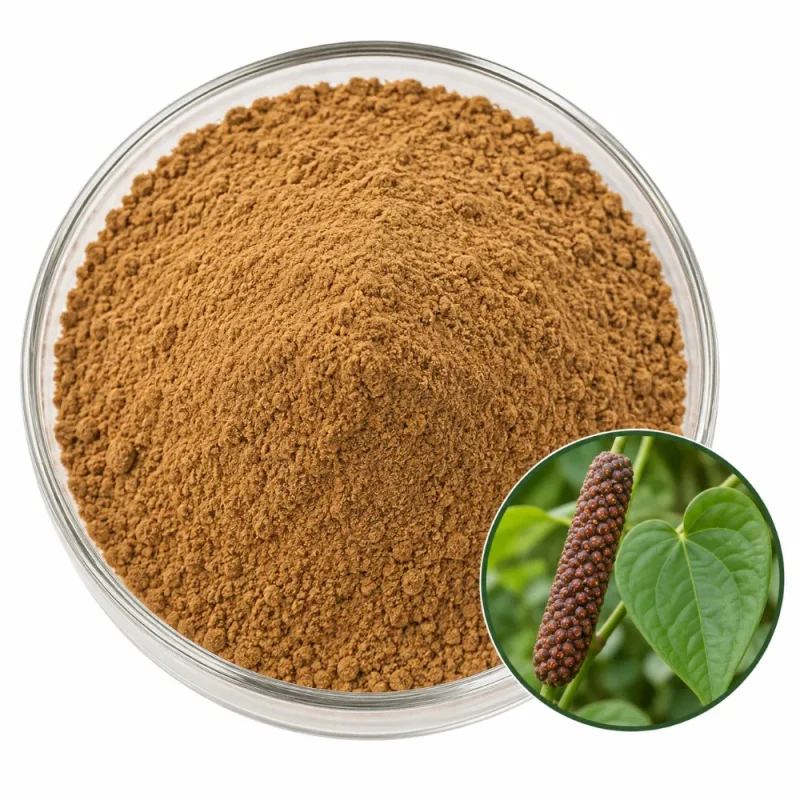
Long Pepper Extract 1–3% Piperine

The dried unripe fruit spikes of Piper longum, the Indian long pepper of the pepper family, are extracted with ethanol to give this long pepper extract. The concentrate is dried to a light brown powder, milled to 80 mesh, that does not dissolve in water and keeps the pungent character of the spice.

Piperine is measured by HPLC and offered as a 1–3% range, with 3% as the primary grade and 1% as the lower grade. The higher grade fits small-fill capsules and tablets, and the lower grade suits blends and oil-based fills that can carry more of the fruit matrix.

Piperine Standardization & Grades

Piperine is the pungent amide alkaloid of the pepper family, built from a piperidine ring joined to a conjugated methylenedioxyphenyl chain. It is a characteristic compound of Piper longum L., the long pepper, but it is also the main alkaloid of black pepper, which is far richer in it. A long pepper extract is therefore standardized to piperine for consistency, while its identity as long pepper comes from the species, the fruit part and the accompanying amides such as piperlongumine and piperlonguminine.

GradeAssay & MethodWhere It Fits
1% PiperineHPLCBlends, oil-based fills
3% PiperineHPLCCapsules and tablets

At 3% the extract carries three times the piperine of the 1% grade per gram, so a capsule reaches its target with a smaller fill, while the 1% grade is bulkier and easier to blend. The same fruit is also supplied as a 10:1 ratio extract without a marker figure, the Piper Longum Extract Powder, and a related amide is available as a purified compound, Piperlongumine 98%. The standardized extract is the one to specify when a piperine figure has to appear on the specification.

Black pepper extracts sold at much higher piperine levels are a different species and a different product. The figure applies to long pepper only.

The fruit spike is the part used. Long pepper is harvested as the immature, cylindrical catkin-like fruit cluster, dried whole and ground before extraction. The root of the same plant, known as pippali moola, is a separate herbal drug with a different marker profile and is not part of this identity. Ripe, expanded fruit loses much of its pungency, which is why the spike is picked green.

Piperine Analysis & Purity Risks

HPLC separates piperine from its geometric isomers and from the related amides on a reversed-phase column. Piperine absorbs strongly in the UV because of its extended conjugation, so detection is sensitive, and the peak is quantified against a reference standard. The result is piperine itself, and the companion amides of long pepper appear as separate peaks.

Light is the analytical hazard. Piperine isomerizes under UV and visible light to isopiperine, chavicine and isochavicine, which have different retention times and lower pungency. A sample left in clear glass on the bench can lose its piperine peak and show new ones, so solutions are prepared in amber glassware and run promptly. A figure from a lot handled in light is a figure for a degraded lot.

Identity is read from the fingerprint. The amide profile of Piper longum, with piperlongumine and piperlonguminine beside piperine, differs from that of black pepper (Piper nigrum), where piperine dominates and the other amides are lower or absent. This pattern separates a genuine long pepper extract from piperine-spiked material.

The purity risks are the neighboring species and the spiking of low-grade material with purified piperine, which is an inexpensive compound. Retrofruit and the closely related Javanese long pepper (Piper retrofractum) are traded under overlapping names, so the stated species and the fruit part are part of the identity.

Raw material that is harvested late loses pungency as the fruit ripens, and stored fruit loses piperine to light and oxygen, which shows as a weaker, flatter taste.

Typical Specifications

Specification ItemProduct Information
Latin NamePiper longum
Plant PartFruit & Berry
ProcessingEthanol Extraction
Compound ClassAlkaloids
Common NameLong Pepper, Indian Long Pepper
Ingredient TypeStandardized Extract
Marker Compound(s)Piperine
Primary Grade3% Piperine (HPLC)
Available Grades1% · 3% Piperine (HPLC)
AppearanceLight Brown powder
Solubility / DispersibilityInsoluble in Water
Quality Parameters
Moisture (LOD)≤5.0%
Total Ash≤5.0%
Particle Size80 mesh
Heavy MetalsLead ≤2 ppm · Arsenic ≤1 ppm · Cadmium ≤1 ppm · Mercury ≤0.1 ppm
MicrobiologyTPC ≤1,000 cfu/g · Yeast & Mold ≤100 cfu/g · E. coli Negative · Salmonella Negative/25 g
Shelf Life24 months in unopened original packaging, cool and dry storage

Applications by Grade

3% Grade in Pungent Capsule Fills

The 3% grade of long pepper extract reaches a piperine target in a small fill, which suits two-piece capsules. The pungent dust irritates the nose, so closed charging and local extraction protect operators, and a flow agent keeps the powder from bridging.

3% Grade in Coated Tablets

Tablets of the 3% grade need a dry binder and an opaque film coat. The coat limits light exposure and hides the burning taste, and it prevents the piperine from migrating to the surface of the tablet, where it would be tasted at once.

1% Grade in Oil-Based Fills

The 1% grade disperses in an oil carrier, in which piperine dissolves better than in water. This suits softgel-style fills and liquid-filled capsules, and an amber capsule shell protects the piperine from light during storage.

1% Grade in Spice-Style Powder Blends

Savory and spice-style powder blends can carry the 1% grade for warm pungency beside ginger, turmeric or cinnamon. The extract is finer than ground spice, so premixing in stages avoids hot spots, and the blend is sampled from several depths for uniformity.

3% Grade in Stick-Pack Premixes

Stick-pack premixes use the 3% grade in a bulking carrier so the filler can meter an accurate dose of this pungent powder. Label directions should call for shaking, because the powder floats on water, and an opaque film protects the piperine from light.

Technical & Quality Considerations

Long pepper extract is a light brown powder with a warm, pungent and slightly resinous character that comes from piperine and its companion amides. It does not dissolve in water. Piperine dissolves in ethanol and in lipids, so oil bases, alcohol-containing bases and suspension systems give a more uniform product than a plain aqueous mix.

Light is the main stability threat. Piperine photoisomerizes into forms with lower pungency, and the extract loses strength in clear packaging. Opaque or amber containers and low warehouse light protect the profile. The amide is also hydrolyzed by strong alkali and by prolonged heat, which splits it into piperic acid and piperidine, so neutral bases and moderate processing temperatures hold the marker.

The dry powder is resinous and tends to cake in a warm warehouse. Sealed inner bags with a desiccant hold the powder loose from filling to use. Closed charging matters because airborne long pepper dust causes sneezing and coughing.

In production, sieve the powder, premix it with part of the carrier and weigh the first capsules or tablets. Compatibility trials are worthwhile with strongly acidic or alkaline ingredients. An accelerated stability run in the intended pack shows early whether color, flow, pungency and the piperine figure hold across the shelf life.

A quick check at receipt is useful. A light brown to tan powder with a sharp, peppery and slightly sweet note is expected for long pepper extract. A flat smell and a very dark shade point to light damage or heat during concentration. Both are visible before any assay result arrives.

Packaging & Commercial Supply

Essencefield supports product evaluation, formulation trials, commercial orders, and ongoing ingredient supply. Packaging, storage, and shipping arrangements are determined by product characteristics, order quantity, stability requirements, and destination-market needs.

Supply ItemGeneral Information
SampleAvailable upon request for formulation, testing, and supplier evaluation
Order Quantities100 g · 1 kg · 5 kg · 25 kg · 100 kg · 500 kg · Bulk
Sample Lead TimeTypically 5–7 days after sample confirmation
Production Lead TimeTypically 15–30 days after order and specification confirmation
PackagingSuitable protective inner packaging with bags, cartons, drums, or other appropriate outer packaging
StorageStore in tightly sealed, suitable protective packaging in a cool, dry environment. Protect from moisture, heat, and direct sunlight. Specific storage conditions follow the approved product specification.
DocumentationCOA · Product Specification · TDS · SDS · Applicable declarations (as applicable)

Final order quantities, lead times, packaging, documentation, and shipping arrangements are confirmed according to the selected product and commercial requirements.

Request Ingredient Specifications & Quote

Share your target specification, application, quantity, and documentation needs. We’ll help confirm suitable options, samples, and commercial supply details.