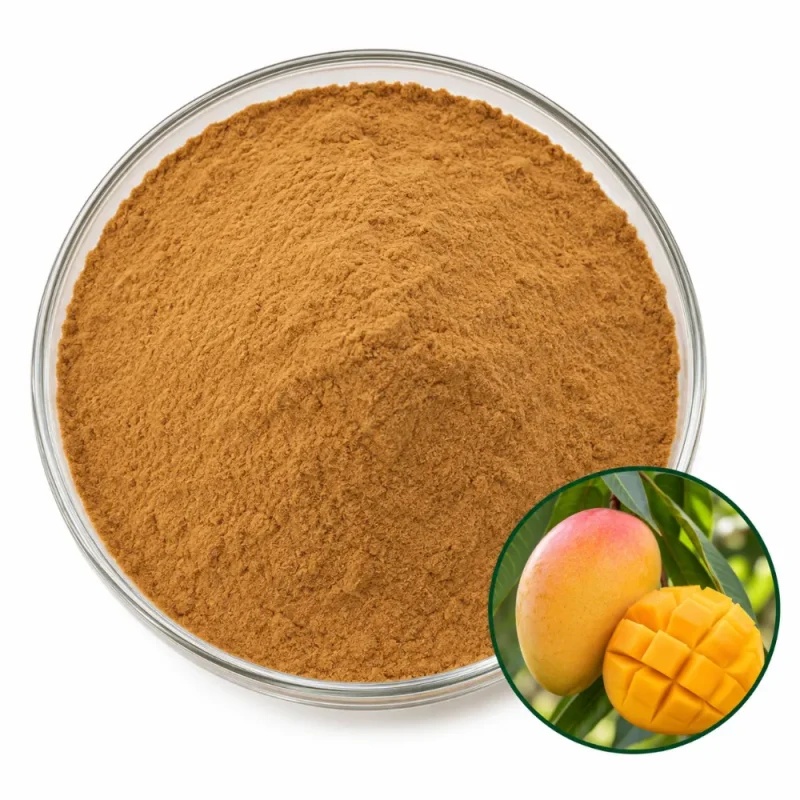
Mango Extract 10% Polyphenols

Leaves of Mangifera indica, the mango tree of tropical South and Southeast Asia, are extracted with ethanol to give this mango leaf extract, which is a leaf product and not a fruit, peel or seed-kernel extract. The concentrate is dried to a yellow-brown powder that dissolves in water and is milled to 80 mesh.

Total polyphenols are measured by UV with the Folin-Ciocalteu reagent at a single 10% grade, and the C-glycosyl xanthone mangiferin is tracked as a second marker. The powder fits capsules, tablets, drink powders and blends. It suits capsules, tablets and instant drinks, and the single grade keeps ordering and testing simple across repeat lots.

Polyphenol Standardization & Grades

The leaf of Mangifera indica L. is the richest part of the tree in mangiferin, a C-glycosylated xanthone, and it also carries gallotannins, flavonol glycosides and phenolic acids. Mango fruit, peel and seed kernel are different raw materials with different phenolic profiles, which is why search terms such as mango extract cover very different products. The leaf extract described here is standardized to total polyphenols, a group figure for the phenolic fraction of the leaf.

The grade is a single 10% level, so each lot is measured against the same target and the same method. Mangiferin is the companion marker that gives the extract its identity: it makes the leaf extract distinguishable from fruit-based mango products, in which it is a trace compound. The same tree is also supplied as a 10:1 ratio extract of the leaf, the Mango Leaf Extract Powder, as a general Mango Extract Powder, and as a single compound, Mangiferin 98%.

Because the grade is a group total, it should not be read as a figure for mangiferin or for any single phenolic. The 10% polyphenol level is a moderate concentration, which keeps the leaf matrix and its color in the powder.

Polyphenol Analysis & Purity Risks

The Folin-Ciocalteu method is a redox assay. Phenols reduce the reagent under alkaline conditions, a blue color forms, and the absorbance is read against a reference phenolic, usually gallic acid. The figure is a group total. It responds to any reducing compound, so ascorbic acid, some sugars and amino acids can raise it without adding phenolics, and it does not separate mangiferin from tannins.

Mangiferin is therefore read separately by chromatography. Its presence at a level typical of leaf material, along with the pattern of gallotannins and flavonol glycosides, identifies the extract as a mango leaf product. A lot with a high Folin total and a low mangiferin share is likely to be tannin-rich, while one with a high mangiferin share has a more xanthone-dominated profile.

Purity risks follow from the naming. Fruit pulp, peel and seed kernel extracts are sold as mango extract, and they carry different phenolics: the kernel is rich in gallotannins, and the peel in flavonol glycosides and carotenoids. A mango leaf extract also needs to be distinguished from extracts of other leaves that contain mangiferin in smaller amounts, such as some species of Anemarrhena and Iris. The stated species and the leaf part are part of the identity.

Leaf age matters. Young, reddish leaves carry less mangiferin than mature, dark green leaves, and leaves dried slowly or stored damp lose xanthone content to oxidation. The raw leaf is harvested from mature trees and dried promptly before extraction.

Sample preparation uses aqueous methanol, and mangiferin dissolves slowly, so sonication and a fixed extraction time are used to give reproducible readings from lot to lot.

A further analytical point concerns solubility. Mangiferin dissolves slowly in cold water and can leave a fine yellow residue when the extract is stirred in quickly. Analysts therefore dissolve the extract in warm aqueous methanol with sonication, and they filter the solution before injection, since undissolved particles block the column and lower the apparent mangiferin result.

Typical Specifications

Specification ItemProduct Information
Latin NameMangifera indica
Plant PartLeaf & Herb
ProcessingEthanol Extraction
Compound ClassPolyphenols
Common NameMango Leaf, Mango
Ingredient TypeStandardized Extract
Marker Compound(s)Total Polyphenols; Mangiferin
Primary Grade10% Polyphenols (UV, Folin-Ciocalteu)
AppearanceYellow-Brown powder
Solubility / DispersibilityWater Soluble
Quality Parameters
Moisture (LOD)≤5.0%
Total Ash≤5.0%
Particle Size80 mesh
Heavy MetalsLead ≤2 ppm · Arsenic ≤1 ppm · Cadmium ≤1 ppm · Mercury ≤0.1 ppm
MicrobiologyTPC ≤1,000 cfu/g · Yeast & Mold ≤100 cfu/g · E. coli Negative · Salmonella Negative/25 g
Shelf Life24 months in unopened original packaging, cool and dry storage

Applications by Grade

10% Grade in Leafy Capsule Fills

The 10% grade of mango leaf extract fits two-piece capsules at a moderate fill weight. The powder is mildly hygroscopic and sticks to tamping pins when damp, so a flow agent and a dry filling room keep capsule weights consistent, and a plain shell shows the yellow-brown fill.

10% Grade in Tannin-Aware Tablets

Tablets of the 10% grade need a dry binder and a film coat. Gallotannins bind to iron and darken, so avoid iron-bearing fillers and check the tablet color after a month of storage, since a bluish-gray cast signals metal contact.

10% Grade in Leaf-Tea Style Granules

Granulated blends for infusion pair the 10% grade with cut mango leaf, giving a visible leaf and a dissolved phenolic base. The extract dissolves quickly in hot water, so it is dosed as a fine powder inside the bag and kept apart from moist ingredients.

10% Grade in Tropical Drink Powders

Instant drink powders use the 10% grade at gram level. It dissolves to a clear amber solution with a mild, slightly astringent leaf flavor that pairs with mango, pineapple or citrus flavors, and the yellow-brown tone suits tropical fruit bases.

10% Grade in Mangiferin-Tracked Premixes

Premixes that track mangiferin use the 10% grade as a leaf-based source in multi-ingredient powders. Mangiferin dissolves slowly, so premix with a carrier first and check solubility of the finished mix in water at the intended drinking temperature.

Technical & Quality Considerations

Mango leaf extract is a yellow-brown powder with a mild, leafy and faintly astringent character. It dissolves in water to a clear amber solution, although mangiferin dissolves more slowly than the tannin fraction and can leave a fine yellow sediment in concentrated solutions.

Mangiferin is a stable C-glycoside, resistant to acid and enzyme hydrolysis, so it tolerates heat and low pH well. The gallotannin fraction is less stable: it hydrolyzes in strong acid and alkali and oxidizes with iron and copper to darker colors. Chelating agents, mildly acidic bases and opaque packaging protect the shade.

In humid air the powder cakes and darkens. An inner foil bag and a desiccant sachet keep moisture away from the powder. Phenolic dust irritates the eyes and nose, so closed charging and local extraction are advised.

On the line, weigh the first capsules or tablets and check the dissolution of the powder in the finished liquid. Compatibility trials with mineral premixes are worthwhile, because divalent salts and iron darken tannin solutions over several days. An accelerated stability run in the intended pack shows whether color, flow and clarity hold across the shelf life.

A quick check at receipt is useful. A yellow-brown, fine powder with a mild leafy note is expected for mango leaf extract, while a dark, caramel-like shade points to heat damage during concentration and a sharp smell suggests poorly dried leaf. Both are visible before any assay result arrives.

Packaging & Commercial Supply

Essencefield supports product evaluation, formulation trials, commercial orders, and ongoing ingredient supply. Packaging, storage, and shipping arrangements are determined by product characteristics, order quantity, stability requirements, and destination-market needs.

Supply ItemGeneral Information
SampleAvailable upon request for formulation, testing, and supplier evaluation
Order Quantities100 g · 1 kg · 5 kg · 25 kg · 100 kg · 500 kg · Bulk
Sample Lead TimeTypically 5–7 days after sample confirmation
Production Lead TimeTypically 15–30 days after order and specification confirmation
PackagingSuitable protective inner packaging with bags, cartons, drums, or other appropriate outer packaging
StorageStore in tightly sealed, suitable protective packaging in a cool, dry environment. Protect from moisture, heat, and direct sunlight. Specific storage conditions follow the approved product specification.
DocumentationCOA · Product Specification · TDS · SDS · Applicable declarations (as applicable)

Final order quantities, lead times, packaging, documentation, and shipping arrangements are confirmed according to the selected product and commercial requirements.

Request Ingredient Specifications & Quote

Share your target specification, application, quantity, and documentation needs. We’ll help confirm suitable options, samples, and commercial supply details.