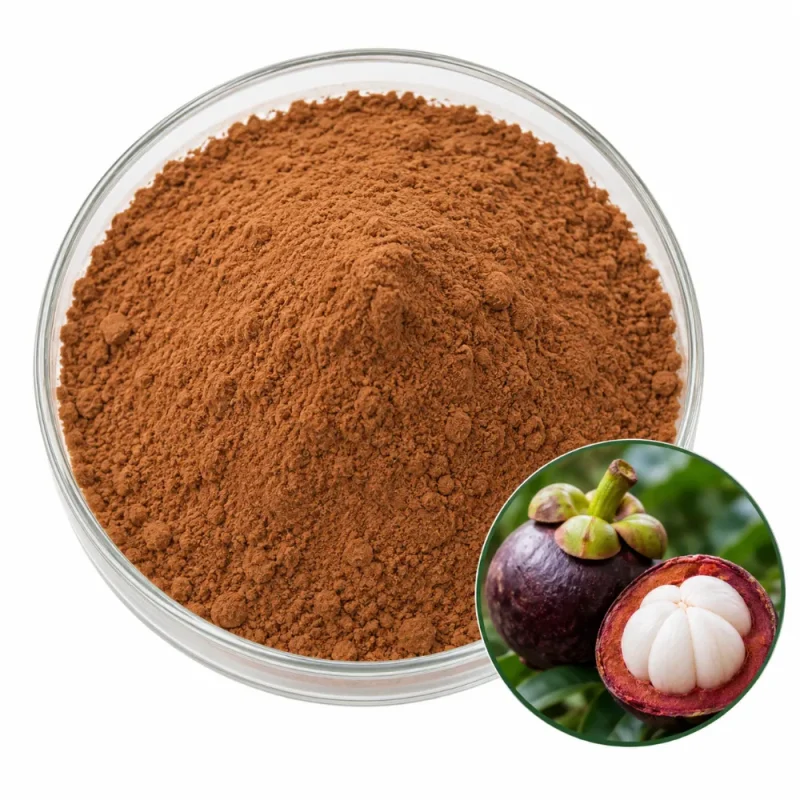
Mangosteen Extract 10–40% Total Xanthones / Mangostin-type marker

The dried pericarp, or rind, of the mangosteen fruit (Garcinia mangostana) is extracted with ethanol to give this mangosteen extract, which is a rind product and not a pulp or juice product. The concentrate is dried to a yellow-brown powder, milled to 80 mesh, that does not dissolve in water.

Total xanthones are measured by UV and offered as a 10–40% range, with 40% as the primary grade and 10% as the lower grade. The grade is expressed against a mangostin-type marker. The higher grade fits small-fill capsules and tablets, and the lower grade suits blends and oil-based fills.

Xanthone Standardization & Grades

Xanthones are tricyclic polyphenols with a dibenzo-gamma-pyrone core, and the pericarp of Garcinia mangostana L. is their richest source. The main ones carry prenyl side chains: alpha-mangostin and gamma-mangostin lead, followed by gartanin, 8-deoxygartanin and the garcinones. The word mangostin-type in the grade name signals that the total is read against this family of prenylated xanthones, which give the rind extract its color and its lipophilic character.

GradeAssay & MethodWhere It Fits
10% Total XanthonesUVBlends, oil-based fills
40% Total XanthonesUVCapsules and tablets, small fill weight

The grade spans a four-fold range. At 40% the extract carries four times the xanthone of the 10% grade per gram, which allows a compact capsule. At 10% the powder keeps more of the rind matrix, including tannins and pectin, and behaves like a rind extract in blends. The same fruit is also supplied as a 10:1 ratio extract without a marker figure, the Mangosteen Extract Powder, and as purified compounds, Alpha-Mangostin 98% and Garcinone E 98%.

The pericarp is the only part used in this extract. Mangosteen pulp and juice, which are sold as fruit products, carry different compounds and contain only trace xanthones.

The pericarp is the only part used. The thick, dark purple rind is separated from the white pulp, dried and ground before extraction, and the rind is rich in latex-like resin and tannins in addition to the xanthones. Seeds, pulp and the calyx are removed. A lot that contains pulp or seed shows a lower xanthone share and a lighter color, which the fingerprint reveals.

Xanthone Analysis & Purity Risks

The UV method for total xanthones reads the absorbance of the extract at wavelengths where the xanthone core absorbs strongly, and the result is calculated against a reference xanthone, commonly alpha-mangostin. The figure is a group total. It also responds to other conjugated phenolics, so a high total does not by itself prove that the extract is rich in prenylated xanthones, and it cannot be converted into a figure for single compounds.

Identity is therefore read from the chromatographic fingerprint. A mangosteen rind extract shows alpha-mangostin as the leading peak, with gamma-mangostin and the other xanthones in a recognizable cluster. The ratio of alpha to gamma varies with the extraction conditions and the fruit variety, and a cluster that is far from the usual pattern is investigated even if the total is in range.

Purity risks come from the naming and the part. Whole-fruit mangosteen products include pulp, rind and sometimes seed, and their xanthone content depends on how much rind they contain. Related Garcinia species, such as the kokum (Garcinia indica) and the gamboge tree (Garcinia cambogia), carry different chemistry, with garcinol and hydroxycitric acid as their markers. The stated species and the pericarp part are part of the identity.

Xanthones are lipophilic, so sample preparation needs a solvent such as methanol or acetonitrile with sonication. Incomplete dissolution gives a low reading that can be mistaken for a weak lot, and the sample solution is protected from light because prenylated xanthones darken slowly in solution.

Rind quality depends on harvest and drying. Rind from ripe fruit dried quickly at moderate temperature gives the expected yellow-brown shade, while slow drying in humid air produces mold and a dark, tarry extract.

Typical Specifications

Specification ItemProduct Information
Latin NameGarcinia mangostana
Plant PartFruit & Berry
ProcessingEthanol Extraction
Compound ClassPolyphenols
Common NameMangosteen, Mangosteen Pericarp
Ingredient TypeStandardized Extract
Marker Compound(s)Total Xanthones; mangostin-type xanthones
Primary Grade40% Total Xanthones (UV)
Available Grades10% · 40% Total Xanthones (UV)
AppearanceYellow-Brown powder
Solubility / DispersibilityInsoluble in Water
Quality Parameters
Moisture (LOD)≤5.0%
Total Ash≤5.0%
Particle Size80 mesh
Heavy MetalsLead ≤2 ppm · Arsenic ≤1 ppm · Cadmium ≤1 ppm · Mercury ≤0.1 ppm
MicrobiologyTPC ≤1,000 cfu/g · Yeast & Mold ≤100 cfu/g · E. coli Negative · Salmonella Negative/25 g
Shelf Life24 months in unopened original packaging, cool and dry storage

Applications by Grade

40% Grade in Rind-Extract Capsule Fills

The 40% grade of mangosteen extract reaches a xanthone target in a small fill, which suits two-piece capsules. The lipophilic powder clings to hopper walls and tamping pins, so a flow agent and a dry filling room keep fill weights steady across the run.

40% Grade in Pigmented Tablets

Tablets of the 40% grade carry a strong yellow-brown pigment that can stain equipment and show through light coats. An opaque, tinted film coat fixes the color, limits dust, and hides the bitter, astringent taste of the rind.

10% Grade in Oil-Suspension Softgels

The 10% grade disperses in an oil carrier, in which prenylated xanthones dissolve better than in water. This suits softgel-style fills and liquid-filled capsules, and fine milling plus gentle agitation avoids a resinous sediment in the oil.

10% Grade in Emulsified Beverage Concentrates

Beverage concentrates can carry the 10% grade in an emulsified base, because the extract does not dissolve in water. A food-grade emulsifier and homogenization keep the pigment dispersed, and a golden-yellow tint is expected in the finished concentrate.

10% Grade in Fruit-Style Powder Blends

Fruit-style powder blends use the 10% grade at gram level beside fruit powders and sweeteners. The tannic bite of the rind is balanced by acidity and sweetness, and the blend should be sampled from several depths to confirm that the pigment is evenly spread.

Technical & Quality Considerations

Mangosteen extract is a yellow-brown powder with a bitter, astringent and faintly resinous character. It does not dissolve in water, and the prenylated xanthones dissolve in ethanol, in lipids and in some surfactant systems, so oil, alcohol and emulsion bases give a more uniform product than a plain aqueous mix.

Xanthones are fairly stable to heat in the dry state, but the prenyl groups and the free hydroxyl groups make them sensitive to oxidation, especially in solution under light and at alkaline pH. They bind metal ions and form darker complexes, so chelating agents, mildly acidic bases and opaque packaging protect the shade of the finished product.

The dry powder is pigmented and slightly tacky, and it takes up moisture in humid air. Moisture control comes down to a sealed liner and a desiccant sachet in every drum. Closed charging and local extraction are advised, because the yellow-brown dust stains clothing and surfaces.

On the line, weigh the first capsules or tablets and inspect equipment for pigment build-up between lots. Compatibility trials with alkaline fillers and mineral premixes are worthwhile, because both darken xanthone-rich powders over several days. An accelerated stability run in the intended pack shows whether color, flow and the xanthone figure hold across the shelf life.

A quick check at receipt is useful. A yellow-brown, fine powder with a dry, tannic note is expected for mangosteen extract, while a very dark, tar-like shade points to heat damage and a musty smell suggests damp storage of the rind. Both are visible before any assay result arrives.

Packaging & Commercial Supply

Essencefield supports product evaluation, formulation trials, commercial orders, and ongoing ingredient supply. Packaging, storage, and shipping arrangements are determined by product characteristics, order quantity, stability requirements, and destination-market needs.

Supply ItemGeneral Information
SampleAvailable upon request for formulation, testing, and supplier evaluation
Order Quantities100 g · 1 kg · 5 kg · 25 kg · 100 kg · 500 kg · Bulk
Sample Lead TimeTypically 5–7 days after sample confirmation
Production Lead TimeTypically 15–30 days after order and specification confirmation
PackagingSuitable protective inner packaging with bags, cartons, drums, or other appropriate outer packaging
StorageStore in tightly sealed, suitable protective packaging in a cool, dry environment. Protect from moisture, heat, and direct sunlight. Specific storage conditions follow the approved product specification.
DocumentationCOA · Product Specification · TDS · SDS · Applicable declarations (as applicable)

Final order quantities, lead times, packaging, documentation, and shipping arrangements are confirmed according to the selected product and commercial requirements.

Request Ingredient Specifications & Quote

Share your target specification, application, quantity, and documentation needs. We’ll help confirm suitable options, samples, and commercial supply details.