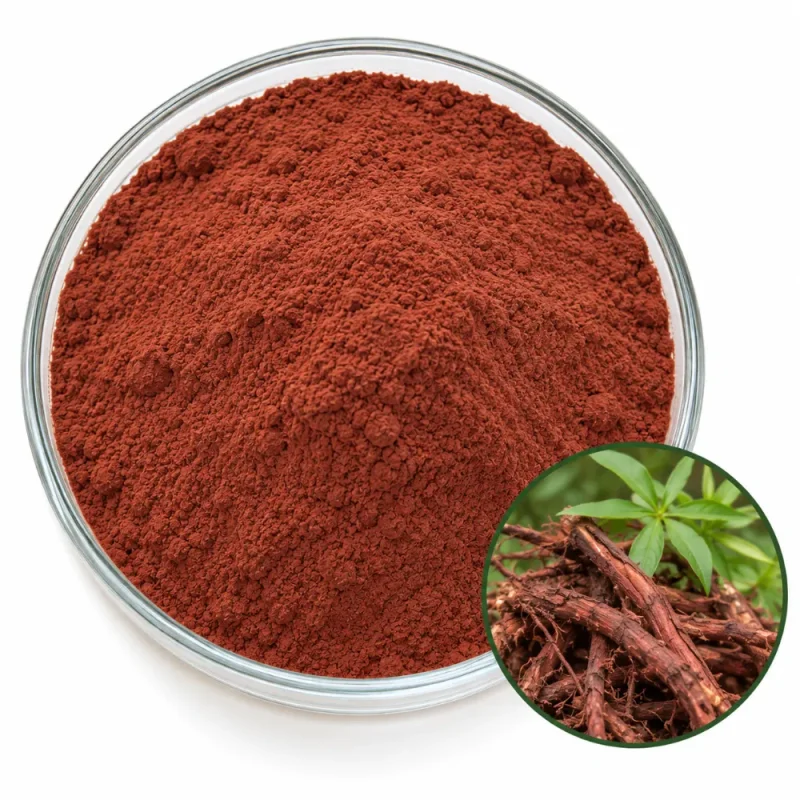
Manjistha Extract 5% Polyphenols

The root of Rubia cordifolia, the Indian madder known in Ayurvedic trade as manjistha, is extracted with ethanol to give this manjistha extract. The concentrate is dried to a light brown powder that dissolves in water and is milled to 80 mesh, and it does not carry the full red color of the dried root.

Total polyphenols are measured by UV with the Folin-Ciocalteu reagent at a single 5% grade. The powder fits capsules, tablets, drink powders and herbal blends that need a defined root extract with a mild, earthy flavor. It suits capsules, tablets and instant herbal drinks, and the single grade keeps ordering and testing simple across repeat lots.

Polyphenol Standardization & Grades

Rubia cordifolia L. is a climbing herb of the madder family, and its root is traded for the red pigments that give the plant its name. The pigments are hydroxyanthraquinones such as purpurin, munjistin and alizarin, together with naphthoquinones, glycosides and phenolic compounds. A manjistha extract is standardized to total polyphenols, which captures the phenolic fraction as a group and does not describe the anthraquinone pigments separately.

The grade is a single 5% level, so each lot is measured against the same target and the same method. A modest polyphenol figure suits a root in which much of the extractable material is made of other compound classes, and it avoids implying that the extract is a concentrated phenolic ingredient. The same root is also supplied as a 10:1 ratio extract without a marker figure, the Rubia Cordifolia (Madder Root) Extract Powder, and as a milled root, Manjistha Root Powder. For a specification that needs a stated polyphenol level, this is the grade to choose.

The number describes the Folin-reactive fraction. It should not be read as a figure for anthraquinones, for purpurin or for any single compound, none of which is part of the specification.

The root is the only part used. Manjistha roots are long, thin and reddish, and they are dug, washed, cut and dried before extraction, while the stems and leaves of the climbing plant are left out. A lot made from stem or from mixed aerial material carries fewer pigments and a different phenolic profile, which is why the root is named in the identity of every manjistha extract.

Polyphenol Analysis & Purity Risks

The Folin-Ciocalteu method is a redox assay. Phenolic hydroxyl groups reduce the reagent under alkaline conditions, a blue color forms, and the absorbance is read against a reference phenolic. The figure is a group total, and it responds to any reducing compound, including sugars, ascorbic acid and some amino acids. In a root extract that contains reducing sugars, a clean-up step is what keeps the figure honest.

Hydroxyanthraquinones also react with the reagent through their phenolic groups, so the Folin total includes part of the pigment fraction but cannot separate it from other phenolics. A lot with the same total can therefore differ in color and in anthraquinone content, which is why identity is read from the fingerprint.

The chromatographic fingerprint shows the anthraquinones and naphthohydroquinones typical of Rubia cordifolia in a pattern that differs from that of European madder (Rubia tinctorum), whose main pigment is alizarin-based. This pattern also separates manjistha from related Indian roots sold under the same trade name, because the trade name covers more than one Rubia species in some markets.

The purity risks are botanical and process-related. Roots of other Rubia species, of unrelated red-rooted herbs and of dyed material have been met in the dried drug trade, and a lot that is too red for a standardized extract may contain added pigment. The stated species and the root part are part of the identity.

Raw root is harvested after two or more years, washed free of soil and dried at moderate temperature. Roots dried in direct sun or stored damp lose pigment and polyphenols to oxidation, and the extract made from them is paler and less aromatic.

Typical Specifications

Specification ItemProduct Information
Latin NameRubia cordifolia
Plant PartRoot & Rhizome
ProcessingEthanol Extraction
Compound ClassPolyphenols
Common NameManjistha, Indian Madder
Ingredient TypeStandardized Extract
Marker Compound(s)Total Polyphenols
Primary Grade5% Polyphenols (UV, Folin-Ciocalteu)
AppearanceLight Brown powder
Solubility / DispersibilityWater Soluble
Quality Parameters
Moisture (LOD)≤5.0%
Total Ash≤5.0%
Particle Size80 mesh
Heavy MetalsLead ≤2 ppm · Arsenic ≤1 ppm · Cadmium ≤1 ppm · Mercury ≤0.1 ppm
MicrobiologyTPC ≤1,000 cfu/g · Yeast & Mold ≤100 cfu/g · E. coli Negative · Salmonella Negative/25 g
Shelf Life24 months in unopened original packaging, cool and dry storage

Applications by Grade

5% Grade in Root-Extract Capsule Fills

The 5% grade of manjistha extract fits two-piece capsules at a moderate fill weight. The powder is mildly hygroscopic and sticks to tamping pins when damp, so a flow agent and a dry filling room keep fill weights consistent through the run.

5% Grade in Pigment-Aware Tablets

Tablets of the 5% grade need a dry binder and a film coat, because trace pigment can migrate to the tablet surface and cause pinkish specks. An opaque coat and a desiccant in the bottle hold the tablet color through storage.

5% Grade in Ayurvedic-Style Powder Blends

Dry powder blends pair the 5% grade with other roots and herbs from the same tradition. The extract is much finer than the cut or milled root, so premixing in stages avoids layering, and sampling from several depths confirms that the pigment is spread evenly.

5% Grade in Instant Herbal Drinks

Instant drink powders use the 5% grade to give an amber to light-red tint with a mild, earthy and slightly bitter taste. The pigment changes shade with pH, turning more orange in acidic drinks and redder in neutral ones, so the base should be pH-controlled.

5% Grade in Gummy and Chew Bases

In gummies and chews, the 5% grade is dissolved into the syrup before depositing. The hydroxyanthraquinones shift color with heat and pH, so the mass is cooked gently, the extract is added late, and a color check after storage confirms that the finished piece stays stable.

Technical & Quality Considerations

Manjistha extract is a light brown to brownish-pink powder with an earthy, slightly woody and mildly bitter character. It dissolves in water to a clear to slightly hazy amber solution, and the dissolved material changes shade with the pH of the base, a visible sign of the anthraquinone fraction.

Hydroxyanthraquinones in manjistha extract are weak acids and indicator-like pigments. They are more orange or yellow in acid and more red or violet in neutral to alkaline conditions, and they form colored complexes with calcium, magnesium and iron. For this reason, mineral-rich bases and hard water can change the color of a finished drink, and chelating agents help to hold the shade.

The pigments are also light-sensitive and fade slowly under strong light, so opaque packaging is the usual choice. The dry powder takes up moisture and cakes when damp, and a desiccant sachet inside sealed packaging holds it free-flowing.

On the line, weigh the first capsules or tablets and check the color of the finished product against a retained sample. Compatibility trials with mineral premixes are worthwhile. An accelerated stability run in the intended pack shows early whether color, flow and clarity hold across the shelf life.

A quick check at receipt is useful. A light brown to brownish-pink fine powder with a faint earthy note is expected for manjistha extract, while a strongly red cast suggests added pigment and a musty smell suggests damp storage. Both are visible before any assay result arrives.

Packaging & Commercial Supply

Essencefield supports product evaluation, formulation trials, commercial orders, and ongoing ingredient supply. Packaging, storage, and shipping arrangements are determined by product characteristics, order quantity, stability requirements, and destination-market needs.

Supply ItemGeneral Information
SampleAvailable upon request for formulation, testing, and supplier evaluation
Order Quantities100 g · 1 kg · 5 kg · 25 kg · 100 kg · 500 kg · Bulk
Sample Lead TimeTypically 5–7 days after sample confirmation
Production Lead TimeTypically 15–30 days after order and specification confirmation
PackagingSuitable protective inner packaging with bags, cartons, drums, or other appropriate outer packaging
StorageStore in tightly sealed, suitable protective packaging in a cool, dry environment. Protect from moisture, heat, and direct sunlight. Specific storage conditions follow the approved product specification.
DocumentationCOA · Product Specification · TDS · SDS · Applicable declarations (as applicable)

Final order quantities, lead times, packaging, documentation, and shipping arrangements are confirmed according to the selected product and commercial requirements.

Request Ingredient Specifications & Quote

Share your target specification, application, quantity, and documentation needs. We’ll help confirm suitable options, samples, and commercial supply details.