
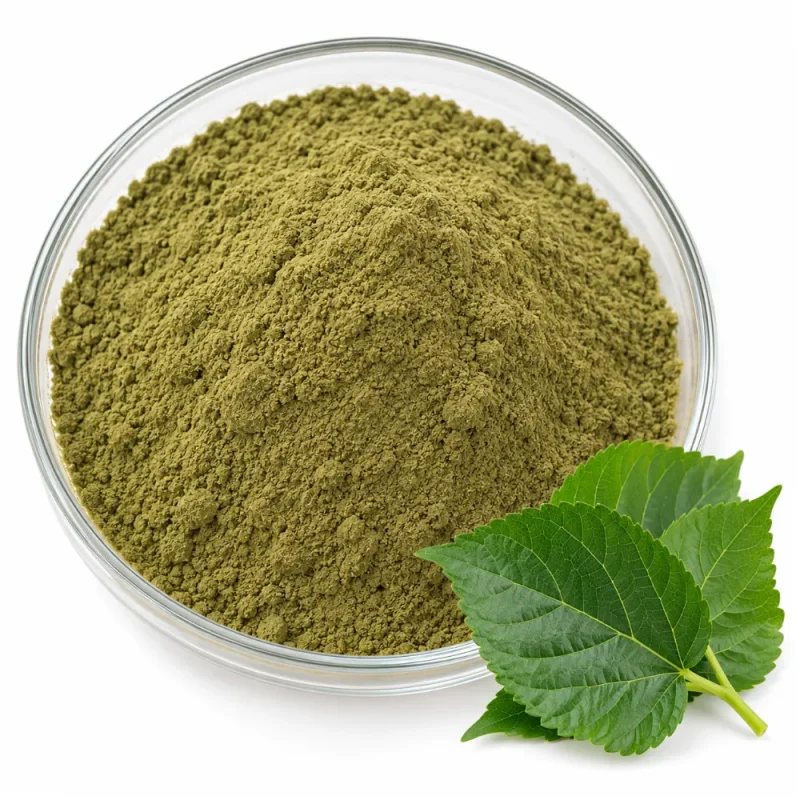
DNJ Standardization & Grades
DNJ is the abbreviation of 1-deoxynojirimycin, a small, very polar alkaloid in which a piperidine ring carries four hydroxyl groups. It looks like a sugar and is classed as an iminosugar. It is the standardization target because it is the characteristic alkaloid of the mulberry leaf and because it can be measured as a single compound against a pure reference. The botanical entity is Morus alba L., a tree of the Moraceae, and the part used is the leaf. The leaf also holds flavonoids such as rutin and quercetin glycosides, which are not counted in this grade.
| Grade | Assay & Method | Where It Fits |
|---|---|---|
| 1% DNJ | HPLC | Tea-style blends and drink powders |
| 5% DNJ | HPLC | Capsules and tablets with small fill |
The two grades differ by a factor of five. The 1% grade keeps more of the flavonoids, sugars and chlorophyll-derived solids of the leaf, so mulberry leaf extract at this level suits tea-style blends and drink powders. The leaf is also supplied as a 10:1 ratio extract, the Mulberry Leaf Extract Powder, as a milled leaf, the Mulberry Leaf Powder, and the mulberry flavonol is listed as the purified compound Morin 98%. The fruit and the root bark are separate materials. Mulberry leaf extract at 5% is the more concentrated of the two grades, and mulberry leaf extract at 1% is the fuller one. The leaf is the main food of the silkworm.


