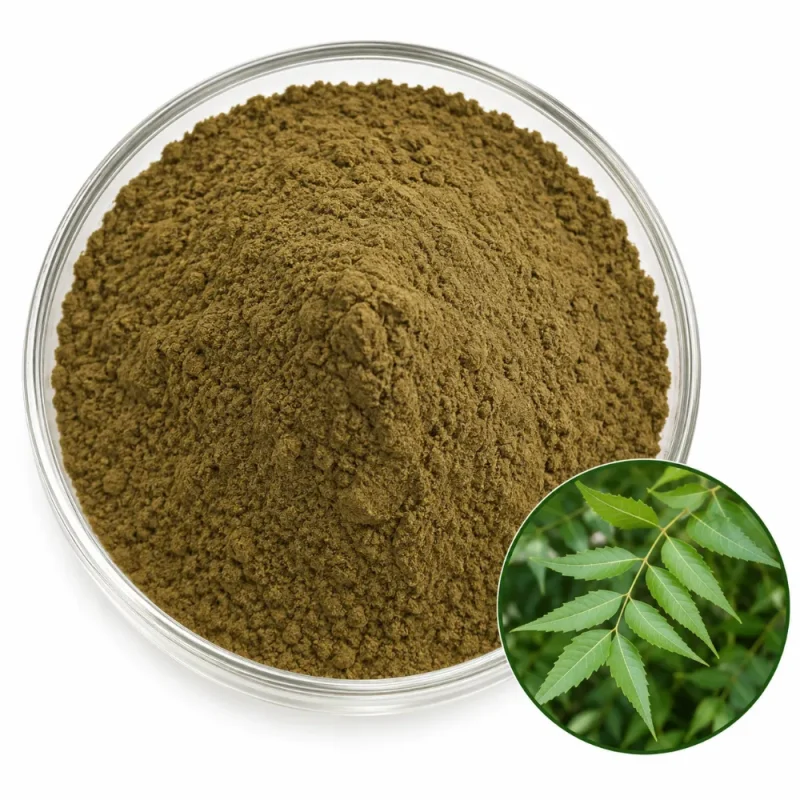
Neem Leaf Extract 4–10% Bitter Principles

Leaves of Azadirachta indica, the neem tree of the Indian subcontinent, are extracted with ethanol to give this neem leaf extract, which is a leaf product and not a seed, kernel or oil product. The concentrate is dried to a green powder, milled to 80 mesh, that is only slightly soluble in water.

Bitter principles are offered as a 4–10% range, with 10% as the primary grade and 4% as the lower grade. The figure describes the bitter fraction of the leaf as a group. The higher grade suits compact capsules, while the lower grade suits herbal blends and granules that can carry more of the leaf.

Bitter Principle Standardization & Grades

Neem is known for its bitterness, which comes from limonoids, a family of oxidized triterpenoids. In the leaf of Azadirachta indica A.Juss. the main bitter constituents include nimbin, nimbolide, nimbidin and related compounds, along with flavonoids such as quercetin glycosides and phenolic acids. A neem leaf extract is standardized to bitter principles as a group because no single compound represents the whole fraction, and the figure tells buyers how concentrated the bitter fraction is.

GradeAssay & MethodWhere It Fits
4% Bitter PrinciplesGroup figureBlends, higher-inclusion powders
10% Bitter PrinciplesGroup figureCapsules and tablets, small fill weight

The 10% grade carries two and a half times the bitter fraction of the 4% grade per gram. A capsule reaches its target with a smaller fill, while the 4% grade is bulkier and easier to blend. The same leaf is also supplied as a 10:1 ratio extract without a marker figure, the Neem Leaf Extract Powder, and as a milled leaf, Neem Leaf Powder. When the bitter fraction has to be stated, this standardized grade is the one to use.

Neem seed, kernel and oil are different materials with different chemistry, centered on azadirachtin, and they are not part of this identity.

The leaf is the part used. Neem leaves are picked from mature trees, shade-dried and cleaned of twigs before extraction, and shade drying keeps more of the green color and the limonoids than drying in direct sun. Bark, seed, flower and oil are different drugs with different markers and are not part of this identity.

Bitter Principle Analysis & Purity Risks

Bitter principles is a group figure, not a single-compound assay. It describes the amount of a fraction defined by its bitter character, so it counts several kinds of limonoid and related compounds together and cannot be translated into a content of nimbin, nimbolide or any other named substance. Two lots with the same figure can therefore differ in individual composition, and the fingerprint is used to describe what stands behind the number.

For identity, the chromatographic profile of the leaf extract shows the limonoid cluster and the quercetin glycosides typical of neem leaf. The profile separates it from neem seed extract, whose characteristic peak is azadirachtin and which carries very different material, and from extracts of other leaves sold as bitter herbs.

The botanical risk is a toxic look-alike. The leaf of the Persian lilac or chinaberry (Melia azedarach) resembles neem leaf when dried and cut, and the plant, which is in the same family, carries toxic limonoids of its own. The stated species and the leaf part are part of the identity, and the fingerprint is the practical check for the substitution.

A second risk is the part. Neem bark, twigs and flowers carry different compounds and different levels, and mixed plant material changes the bitter fraction and the color. Fresh leaves cut in the growing season and dried quickly retain the expected green shade, while leaves dried slowly in damp air turn brown and develop a musty note.

Sample preparation uses a defined solvent and a consistent extraction time, because the bitter fraction includes both polar and less polar compounds and the result depends on the procedure.

Sample handling affects the bitter fraction as well. Limonoids degrade in sunlight and in warm, alkaline solution, so extracts are prepared in amber glass and read promptly. A lot kept open on the bench can show a lower figure than the same lot read straight from a sealed container.

Typical Specifications

Specification ItemProduct Information
Latin NameAzadirachta indica
Plant PartLeaf & Herb
ProcessingEthanol Extraction
Compound ClassPolyphenols
Common NameNeem, Indian Lilac
Ingredient TypeStandardized Extract
Marker Compound(s)Bitter Principles
Primary Grade10% Bitter Principles
Available Grades4% · 10% Bitter Principles
AppearanceGreen powder
Solubility / DispersibilitySlightly Soluble in Water
Quality Parameters
Moisture (LOD)≤5.0%
Total Ash≤5.0%
Particle Size80 mesh
Heavy MetalsLead ≤2 ppm · Arsenic ≤1 ppm · Cadmium ≤1 ppm · Mercury ≤0.1 ppm
MicrobiologyTPC ≤1,000 cfu/g · Yeast & Mold ≤100 cfu/g · E. coli Negative · Salmonella Negative/25 g
Shelf Life24 months in unopened original packaging, cool and dry storage

Applications by Grade

10% Grade in Bitter Capsule Fills

The 10% grade of neem leaf extract reaches a bitter principle target in a small fill, which suits two-piece capsules. The intensely bitter powder irritates the mouth on contact, so closed charging, opaque shells and clean hands keep the line and the finished product clear of bitter dust.

10% Grade in Coated Tablets

Tablets of the 10% grade need a dry binder and a film coat, because the bitterness is strong enough to be noticed at the tablet surface. A thick coat, or a sugar coat, masks the taste, and a hardness check after a month of storage confirms that the tablet has not softened.

4% Grade in Herbal Powder Blends

Dry herbal blends carry the 4% grade beside other bitter herbs, such as andrographis or gentian. The extract is finer than the cut leaf, so it is premixed with part of the carrier to avoid layering, and the intense bitterness is balanced with sweet spice or licorice-type notes.

4% Grade in Granule Sachets

Granulated sachets carry the 4% grade with a sweet or malt base that masks the bitterness of the leaf. The extract dissolves only partly, so the drink is a green-brown suspension, and label directions should call for stirring.

10% Grade in Chew and Gum Bases

Chew and gum bases hold the 10% grade in a lipid or polymer matrix, which slows release and softens the bitter impact. The base should be tested for color and texture after storage, because the green pigments fade with light and heat.

Technical & Quality Considerations

Neem leaf extract is a green to green-brown powder with an intense, lingering bitterness and a grassy, slightly garlic-like leaf aroma. It is only slightly soluble in water. The polar fraction dissolves in warm water and aqueous alcohol, while the less polar limonoids dissolve poorly and settle as a fine green sediment in still liquids.

Limonoids and flavonoids are sensitive to oxidation, strong light and alkaline conditions. The chlorophyll-related color of the powder fades to olive and brown with light, heat and acid, so opaque packaging and a cool warehouse hold the shade. Strong alkali opens the lactone and ester groups of the limonoids and changes the bitterness.

The dry powder takes up moisture and cakes when damp. Bitter, green dust irritates the mouth and eyes, so closed charging and local extraction are advised, and cleaning between lots prevents carry-over of bitterness into other products.

During production, sieve the powder, premix it with part of the carrier and weigh the first units. An accelerated stability run in the intended pack shows early whether color, flow and taste remain stable across the shelf life.

A quick check at receipt is useful. A green to olive, fine powder with a grassy and mildly garlic-like note is expected for neem leaf extract, while a dark brown cast points to heat damage and a musty smell suggests damp storage of the leaf. Both are visible before any assay result arrives.

Packaging & Commercial Supply

Essencefield supports product evaluation, formulation trials, commercial orders, and ongoing ingredient supply. Packaging, storage, and shipping arrangements are determined by product characteristics, order quantity, stability requirements, and destination-market needs.

Supply ItemGeneral Information
SampleAvailable upon request for formulation, testing, and supplier evaluation
Order Quantities100 g · 1 kg · 5 kg · 25 kg · 100 kg · 500 kg · Bulk
Sample Lead TimeTypically 5–7 days after sample confirmation
Production Lead TimeTypically 15–30 days after order and specification confirmation
PackagingSuitable protective inner packaging with bags, cartons, drums, or other appropriate outer packaging
StorageStore in tightly sealed, suitable protective packaging in a cool, dry environment. Protect from moisture, heat, and direct sunlight. Specific storage conditions follow the approved product specification.
DocumentationCOA · Product Specification · TDS · SDS · Applicable declarations (as applicable)

Final order quantities, lead times, packaging, documentation, and shipping arrangements are confirmed according to the selected product and commercial requirements.

Request Ingredient Specifications & Quote

Share your target specification, application, quantity, and documentation needs. We’ll help confirm suitable options, samples, and commercial supply details.