
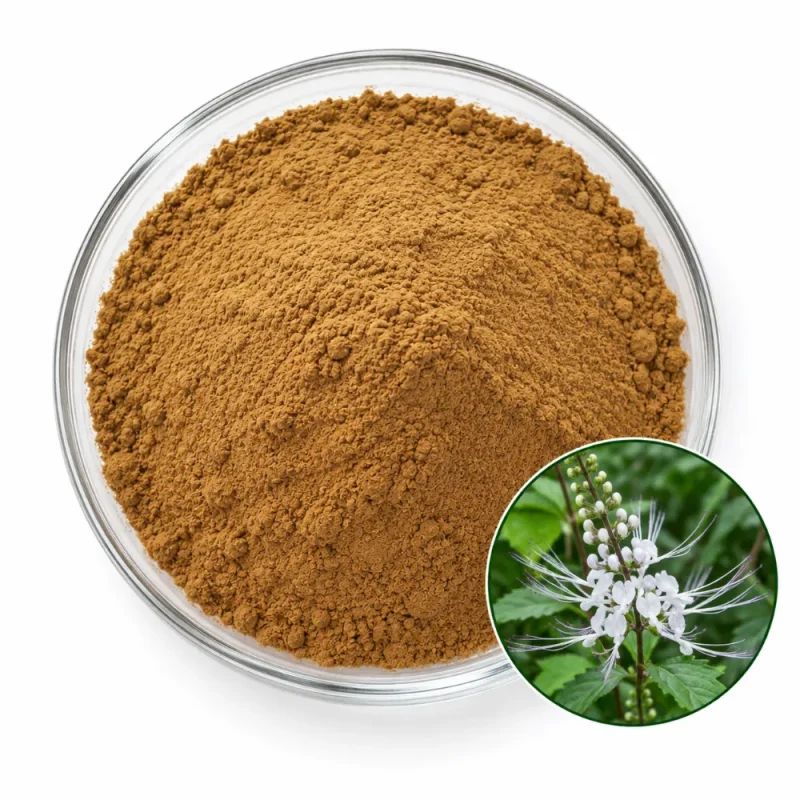
Sinensetin Standardization & Grades
Sinensetin is 5,6,7,3′,4′-pentamethoxyflavone, a flavone in which every hydroxyl group has been methylated. This makes it unusually lipophilic and stable, and it is one of the characteristic lipophilic flavones of the leaf of Orthosiphon stamineus Benth., with eupatorin and 3′-hydroxy-5,6,7,4′-tetramethoxyflavone as companions. The leaf also holds a polar fraction of rosmarinic acid, caffeic acid derivatives and potassium salts, which are not part of the grade.
| Grade | Assay & Method | Where It Fits |
|---|---|---|
| 0.1% Sinensetin | HPLC | Blends, high-inclusion powders |
| 1% Sinensetin | HPLC | Capsules and tablets, small fill weight |
The span is tenfold, so grade choice follows dose and carrier. At 1% the extract carries ten times the sinensetin of the 0.1% grade per gram, which allows a compact capsule. At 0.1% the powder keeps most of the leaf matrix and behaves like a leaf extract in blends. The same herb is also supplied as a 10:1 ratio extract without a marker figure, the Orthosiphon Stamineus Extract Powder, and as a purified flavone, Sinensetin 98%. Formulas that need sinensetin stated on the specification use this standardized grade.
The leaf is the only part used. Stems and flowering tops contain less of the flavone and are not part of this identity.
The leaf is harvested from the cultivated herb, which is grown in the humid tropics and cut several times a year. Young shoots and leaves carry the highest share of polymethoxylated flavones, while old woody stems carry almost none, so the proportion of stem in the dried herb controls how much of the lipophilic fraction reaches the extract. Orthosiphon stamineus extract is therefore defined by the leaf and by the sinensetin figure.


