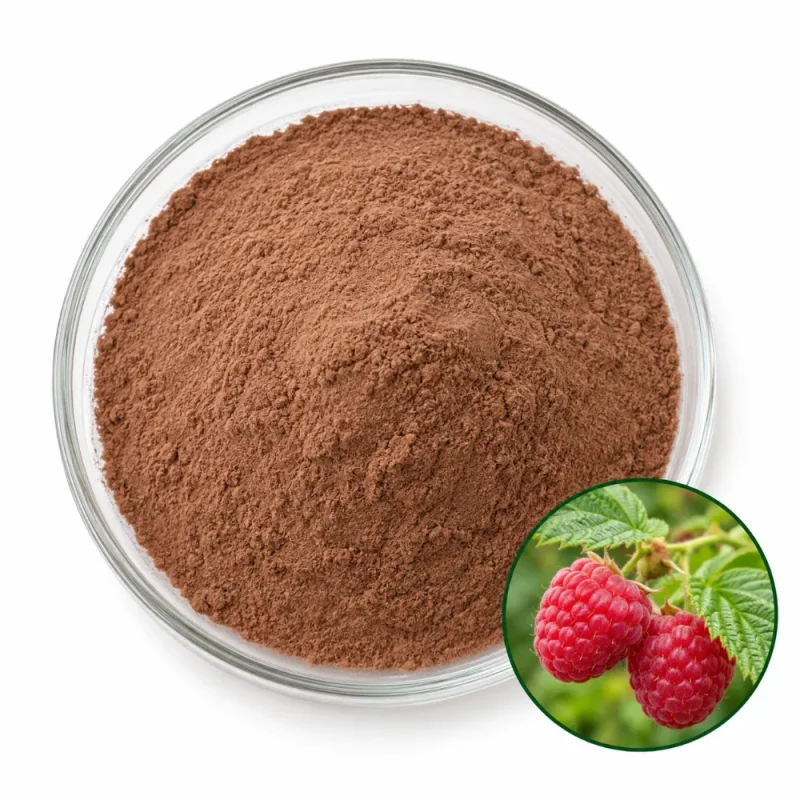
Raspberry Extract 10–40% Ellagic Acid

Made from the fruit of the red raspberry, Rubus idaeus L., of the family Rosaceae, raspberry extract is standardized to its ellagic acid. Ethanol extraction takes up the ellagitannins and free ellagic acid of the berry, and the concentrate is dried to a light brown powder.

Ellagic acid is measured by HPLC, with a primary grade of 40% and a lower grade of 10%. The powder is 80 mesh and insoluble in water. The 40% grade fits capsules and tablets, while the 10% grade is used in blends where a fruit-derived polyphenol profile is wanted at larger inclusion.

Raspberry Ellagic Acid Standardization & Grades

Ellagic acid is a flat, four-ring polyphenol formed when ellagitannins lose their sugar core and the released hexahydroxydiphenic acid closes into a lactone. In raspberry it is present mostly as the parent ellagitannins, chiefly sanguiin H-6 and lambertianin C, with a smaller free fraction. Raspberry extract is standardized to ellagic acid because it is the single, measurable end product of this family, and it makes lots comparable that would otherwise differ in their tannin chemistry.

The botanical entity is Rubus idaeus L., the European red raspberry, and the part is the fruit. Chinese raspberry (Rubus chingii) and black raspberry (Rubus occidentalis) are different species with different profiles.

GradeAssay & MethodWhere It Fits
10% Ellagic AcidHPLCBlends, larger inclusion
40% Ellagic AcidHPLCCapsules and tablets, small fill

The 40% grade carries four times the ellagic acid per gram, so a capsule reaches its target with a small fill. The 10% grade is bulkier and fits blends where a fruit polyphenol profile is wanted at larger inclusion. The same fruit is also supplied as Raspberry Extract Powder, a 10:1 ratio extract with no marker figure, and as Raspberry Powder and Freeze-Dried Raspberry Powder for whole-fruit formats.

Raspberry Ellagic Acid Analysis & Purity Risks

HPLC separates ellagic acid from the other polyphenols of the extract and reads it as a distinct peak against a reference standard, so the result is a specific compound and not a class equivalent. The basis matters, however. A free ellagic acid figure counts only the compound already present. A total figure follows acid hydrolysis, which releases ellagic acid from the ellagitannins and gives a higher number from the same powder. Two certificates are comparable only when they state the same basis, and neither can be converted into the other.

For identity, the chromatographic fingerprint is read beside the ellagic acid peak. Sanguiin H-6 and related ellagitannins mark a raspberry origin, and the anthocyanins of the berry, mainly cyanidin glycosides, show whether the fruit pigment pattern is present. Ellagic acid on its own does not identify the fruit, because several plants contain it.

Purity risks follow from the material class. Ellagic acid can be isolated from other tannin-rich sources, such as pomegranate husk and tara, so a high figure alone is not proof of raspberry origin and the accompanying fingerprint matters. Ripe berries, seeds and press residue carry different tannin levels, and the seed fraction is rich in ellagitannins. The fruit is the defined part, and a lot should be traceable to Rubus idaeus and not to a blend of berry species.

Sample preparation is demanding, because the compound dissolves poorly. The powder is dissolved in a polar organic solvent with sonication, filtered, and injected, and the sample is checked for precipitation before the run so that undissolved ellagic acid does not under-read the result.

Typical Specifications

Specification ItemProduct Information
Latin NameRubus idaeus
Plant PartFruit & Berry
ProcessingEthanol Extraction
Compound ClassPolyphenols
Common NameRaspberry, Red Raspberry
Ingredient TypeStandardized Extract
Marker Compound(s)Ellagic acid
Primary Grade40% Ellagic Acid (HPLC)
Available Grades10% · 40% Ellagic Acid (HPLC)
AppearanceLight Brown powder
Solubility / DispersibilityInsoluble in Water
Quality Parameters
Moisture (LOD)≤5.0%
Total Ash≤5.0%
Particle Size80 mesh
Heavy MetalsLead ≤2 ppm · Arsenic ≤1 ppm · Cadmium ≤1 ppm · Mercury ≤0.1 ppm
MicrobiologyTPC ≤1,000 cfu/g · Yeast & Mold ≤100 cfu/g · E. coli Negative · Salmonella Negative/25 g
Shelf Life24 months in unopened original packaging, cool and dry storage

Applications by Grade

40% Grade for Capsule Fills

The 40% grade reaches an ellagic acid target in a small fill, which suits two-piece capsules. The powder is insoluble and slightly static, so a flow agent and a dry room keep the hopper from bridging during filling.

10% Grade in Powder Blends

The 10% grade works in dry blends with other fruit extracts, where it adds ellagitannin character at larger inclusion. Sieve it with the carrier first, because the light brown powder clumps if the blend is damp, and mix in two stages so the small share spreads evenly.

40% Grade in Tablet Blends

Tablets of the 40% grade need a dry binder and a lubricant. The raspberry extract compacts well, but hardness and disintegration are checked after storage, since the polyphenol-rich solid absorbs moisture and darkens slowly. A film coat limits color transfer onto the punch faces.

10% Grade in Gummy Bases

Gummies take the 10% grade as a color- and flavor-contributing ingredient. Add it after the main cook, since long heating dulls the tone, and disperse it in a small portion of the syrup so that the insoluble particles do not speckle the gel.

40% Grade for Softgel Suspensions

In softgels the insoluble 40% grade is milled into an oil phase as a suspension. Particle size and viscosity are checked, because settling in the fill mass leads to uneven dosing across the batch, and a suspending agent is often added.

10% Grade for Stick-Pack Mixes

Stick-pack mixes use the 10% grade at a higher gram weight with a bulking carrier. The powder does not dissolve, so it is sold as a suspended mix to be stirred and is not suited to clear drinks. A thicker base such as a smoothie powder hides the grit and holds the particles.

Technical & Quality Considerations

Raspberry extract is a light brown powder with a faint fruity-astringent note. Ellagic acid is insoluble in water, so a drink made from the extract appears as a fine brown suspension and settles on standing, while the more soluble ellagitannins and anthocyanins color the liquid. Dispersion improves with wetting agents, milling and a viscous carrier. Heat has little effect on ellagic acid, but the anthocyanin color fades with heat, light and rising pH.

Polyphenols bind to proteins and metal ions. In blends with protein powders or iron-containing fillers, astringency rises and a darker complex can form, so stainless contact surfaces and low-iron carriers are the better choice. The powder takes up moisture, and sealed liners keep it free-flowing.

Ellagitannins in the powder also hydrolyze slowly in moist storage, releasing more free ellagic acid, which is almost insoluble and tends to precipitate. A lot that is held damp can therefore show a gritty texture when it is re-dissolved, even though the HPLC figure on the free basis has risen. Dry storage prevents this drift.

For scale-up, premix the extract with a small share of the carrier and check fill weight at each lot change, since the two grades differ widely in bulk. Compare the color of each lot with a retained sample, because berry pigments vary from pale tan to deep reddish brown.

Packaging & Commercial Supply

Essencefield supports product evaluation, formulation trials, commercial orders, and ongoing ingredient supply. Packaging, storage, and shipping arrangements are determined by product characteristics, order quantity, stability requirements, and destination-market needs.

Supply ItemGeneral Information
SampleAvailable upon request for formulation, testing, and supplier evaluation
Order Quantities100 g · 1 kg · 5 kg · 25 kg · 100 kg · 500 kg · Bulk
Sample Lead TimeTypically 5–7 days after sample confirmation
Production Lead TimeTypically 15–30 days after order and specification confirmation
PackagingSuitable protective inner packaging with bags, cartons, drums, or other appropriate outer packaging
StorageStore in tightly sealed, suitable protective packaging in a cool, dry environment. Protect from moisture, heat, and direct sunlight. Specific storage conditions follow the approved product specification.
DocumentationCOA · Product Specification · TDS · SDS · Applicable declarations (as applicable)

Final order quantities, lead times, packaging, documentation, and shipping arrangements are confirmed according to the selected product and commercial requirements.

Request Ingredient Specifications & Quote

Share your target specification, application, quantity, and documentation needs. We’ll help confirm suitable options, samples, and commercial supply details.