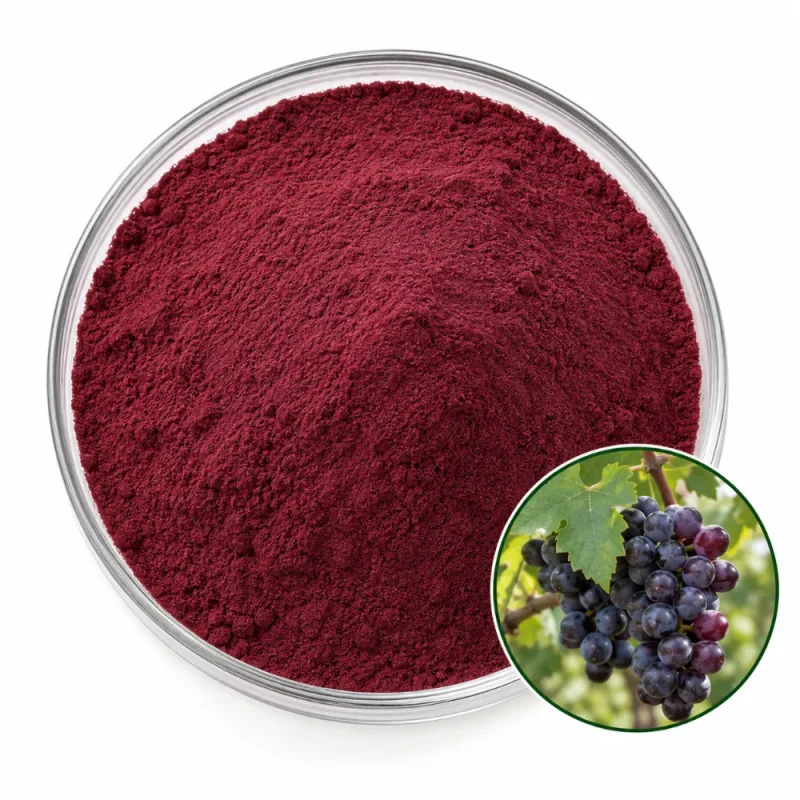
Red Wine Extract 30–50% Polyphenols

Red wine extract carries the polyphenols of the red wine grape, Vitis vinifera L., a species of the family Vitaceae, and the part is the fruit. Ethanol extraction concentrates the phenolic fraction, which is dried to a light brown powder that dissolves in water.

Total polyphenols are measured by UV spectrophotometry with the Folin-Ciocalteu reagent. The primary grade is 50% and the lower grade is 30%. The powder is 80 mesh, and the 50% grade suits capsules, tablets and effervescent formats.

Red Wine Polyphenol Standardization & Grades

Polyphenols are compounds with several phenolic hydroxyl groups. In red wine grapes they include anthocyanins from the skin, flavan-3-ols and procyanidins from skin and seed, flavonol glycosides, phenolic acids and stilbenes such as resveratrol. Red wine extract is standardized to total polyphenols because no single compound speaks for this mixture. The class figure is what lets a formulator compare one lot with another.

The botanical entity is Vitis vinifera L. The extract is a separate product from grape seed extract, which is standardized to oligomeric proanthocyanidins, and from grape skin extract, which is standardized to anthocyanins. Red wine extract covers the mixed profile that a wine-type grape fraction carries. The seed-based product is Grape Seed Extract 95% OPC / Proanthocyanidins, the pigment-based one is Grape Skin Extract 10–25% Anthocyanins, and the whole fruit is available as Grape Powder.

GradeAssay & MethodWhere It Fits
30% PolyphenolsUV (Folin-Ciocalteu)Drink powders, larger inclusion
50% PolyphenolsUV (Folin-Ciocalteu)Capsules, tablets, effervescent

The 50% grade carries two thirds more polyphenol per gram than the 30% grade, so a capsule or an effervescent tablet reaches its target at lower weight. The 30% grade is the bulkier powder and gives a milder astringency in a dissolved drink, which matters in powders that are tasted directly. Because the grades are expressed on the same reagent basis, a formulator can move between them by simple weight adjustment, without recalculating for a different compound.

Red Wine Polyphenol Analysis & Purity Risks

The Folin-Ciocalteu assay does not detect polyphenols as molecules. It measures the capacity of the sample to reduce a molybdenum-tungsten reagent, which turns blue, and the absorbance is read in the UV-visible range and calculated against a reference phenol, commonly gallic acid. The percentage is therefore an equivalent. The method is not specific, because other reducing substances such as ascorbic acid, certain sugars and some proteins also react and can inflate the figure.

An HPLC profile is read beside the total for identity. The anthocyanin pattern separates red wine grapes from white ones, and the presence of flavan-3-ol oligomers and phenolic acids completes the picture. A Folin-Ciocalteu total cannot be converted into an HPLC result for single compounds, and neither can be compared with a UV result for a different class such as total anthocyanins.

Purity risks follow from the material class. Grape raw material for wine varies by cultivar and growing season, and the proportions of skin, seed and stem material in the starting lot change the ratio of anthocyanins to tannins. Winemaking itself transforms the polyphenols. Anthocyanins condense with tannins into more stable pigments, so a fermented raw material gives a different pattern from fresh fruit.

The sulfite and ethanol history of the raw material is also relevant to a reducing-agent assay. Residual sulfur dioxide from winemaking would react in the same test and read as phenolic, which is why the sample is prepared from a dry powder and the blank is run in parallel.

Typical Specifications

Specification ItemProduct Information
Latin NameVitis vinifera
Plant PartFruit & Berry
ProcessingEthanol Extraction
Compound ClassPolyphenols
Common NameRed Wine Extract, Red Grape Polyphenols
Ingredient TypeStandardized Extract
Marker Compound(s)Total polyphenols (anthocyanins, flavan-3-ols, phenolic acids)
Primary Grade50% Polyphenols (UV, Folin-Ciocalteu)
Available Grades30% · 50% Polyphenols (UV, Folin-Ciocalteu)
AppearanceLight Brown powder
Solubility / DispersibilityWater Soluble
Quality Parameters
Moisture (LOD)≤5.0%
Total Ash≤5.0%
Particle Size80 mesh
Heavy MetalsLead ≤2 ppm · Arsenic ≤1 ppm · Cadmium ≤1 ppm · Mercury ≤0.1 ppm
MicrobiologyTPC ≤1,000 cfu/g · Yeast & Mold ≤100 cfu/g · E. coli Negative · Salmonella Negative/25 g
Shelf Life24 months in unopened original packaging, cool and dry storage

Applications by Grade

50% Grade for Capsule Fills

The 50% grade reaches a polyphenol target in a small fill, which suits two-piece capsules. The powder is hygroscopic and slightly sticky, so fill in a dry room and add a flow agent to keep it from bridging in the hopper. Check the fill weight at the start of each run.

30% Grade in Drink Powders

The 30% grade dissolves in cold water to a clear red-brown drink. Its astringency is softer than that of the 50% grade, and a fruit or berry flavor base covers the dry mouthfeel without additional sweetener. Add it to the water before any acid so that it wets without clumping.

50% Grade in Effervescent Tablets

Effervescent tablets use the 50% grade because the powder dissolves quickly and keeps the tablet small. The acid and carbonate system changes the pH of the solution, so color shifts from red-brown toward brown in the glass and is checked in stability tests.

30% Grade for Gummy Bases

Gummies take the 30% grade as a color- and flavor-contributing ingredient. Add it after the main cook and keep the gel pH within the range the pectin or gelatin base needs, since tannin-type material can slightly toughen a protein gel.

50% Grade in Tablet Blends

Tablets of the 50% grade need a dry binder and a lubricant. The extract compacts well, and a film coat protects the polyphenol-rich core against humidity and limits color transfer onto the punch faces. Tablet hardness is rechecked after storage.

30% Grade for Stick-Pack Mixes

Stick-pack mixes use the 30% grade at a higher gram weight with a bulking carrier. Keep the mix away from protein powders and milk-based carriers, because tannins bind protein and produce haze or flocculation when the powder is stirred into the drink.

Technical & Quality Considerations

Red wine extract is a light brown powder with a wine-like, fruity-astringent note. It is water soluble, and the solution is red-brown, with the shade moving toward purple at low pH and toward brown as pH rises. The anthocyanin and tannin fractions oxidize in light and oxygen, so the color deepens over time and clear packs are kept out of direct light.

Polyphenols bind iron and form dark complexes. Carbon-steel contact surfaces and iron-containing fillers darken the powder, so stainless equipment and low-iron carriers are the better choice. Tannins also complex with proteins, and a drink that mixes the extract with whey or casein can turn cloudy, which is a trial item for protein beverages.

The powder is hygroscopic and will cake in humid storage. Sealed liners, desiccant and cool storage keep it free flowing.

Heat treatment of a finished drink needs a trial. Pasteurization darkens the anthocyanin fraction and can precipitate part of the tannins as a fine sediment, which is why hot-fill lines test a small batch first. A retained sample of each lot allows hue to be compared, because the balance of red and brown tones moves with the raw grape lot, and the sample also gives a reference for the first stability check.

Packaging & Commercial Supply

Essencefield supports product evaluation, formulation trials, commercial orders, and ongoing ingredient supply. Packaging, storage, and shipping arrangements are determined by product characteristics, order quantity, stability requirements, and destination-market needs.

Supply ItemGeneral Information
SampleAvailable upon request for formulation, testing, and supplier evaluation
Order Quantities100 g · 1 kg · 5 kg · 25 kg · 100 kg · 500 kg · Bulk
Sample Lead TimeTypically 5–7 days after sample confirmation
Production Lead TimeTypically 15–30 days after order and specification confirmation
PackagingSuitable protective inner packaging with bags, cartons, drums, or other appropriate outer packaging
StorageStore in tightly sealed, suitable protective packaging in a cool, dry environment. Protect from moisture, heat, and direct sunlight. Specific storage conditions follow the approved product specification.
DocumentationCOA · Product Specification · TDS · SDS · Applicable declarations (as applicable)

Final order quantities, lead times, packaging, documentation, and shipping arrangements are confirmed according to the selected product and commercial requirements.

Request Ingredient Specifications & Quote

Share your target specification, application, quantity, and documentation needs. We’ll help confirm suitable options, samples, and commercial supply details.