
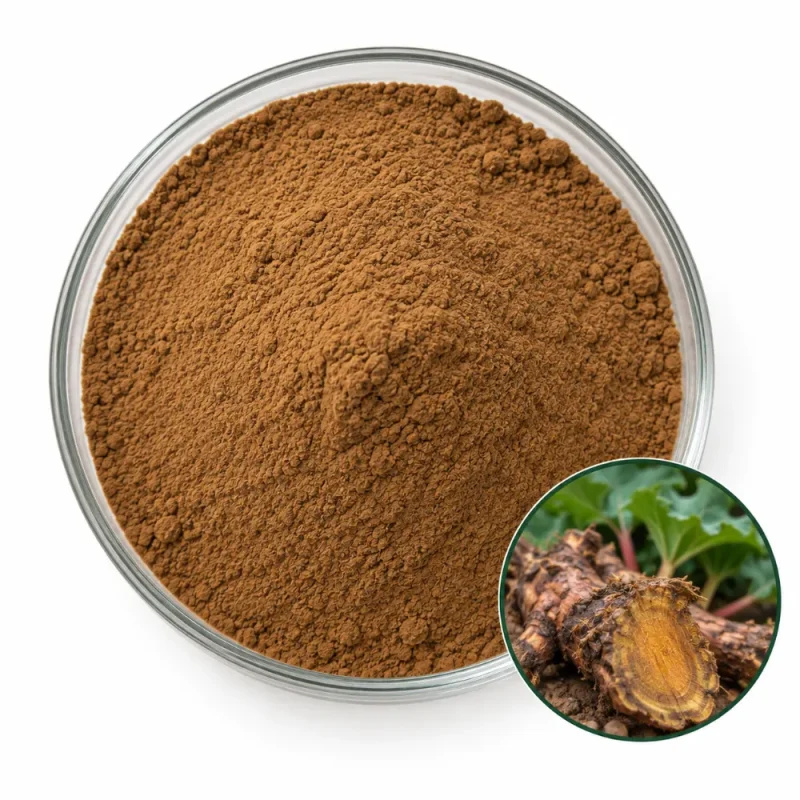
Anthraquinone Standardization & Grades
Anthraquinones are three-ring aromatic quinones that give rhubarb root its yellow-orange color. The main members are rhein, emodin, aloe-emodin, chrysophanol and physcion, and they occur both as free aglycones and as glycosides. The root also holds tannins and the dianthrone glycosides called sennosides. The grade reports total anthraquinones and not one compound. The botanical entity is Rheum palmatum L., a plant of the Polygonaceae, and the part used is the dried root and rhizome of the medicinal rhubarb.
The grade is a minimum, so lots reach or exceed the figure. The choice is between rhubarb materials, not between tiers. The root is also supplied as a 10:1 ratio extract, the Rhubarb Root Extract Powder, which carries no marker figure, and the purified anthraquinones are listed as Chrysophanol 98% and Physcion 98%. Danthron is a different compound of the same family that is mostly synthetic and is not a main constituent of the root. Culinary rhubarb, grown for its stalks, is a separate crop and not a source of this extract. Rhubarb extract at a minimum of 5% is a defined fraction of a root that holds many other constituents, and rhubarb extract of this kind is dosed by its anthraquinone figure, not by root weight. The name rhubarb alone does not tell which plant or which part was used.


