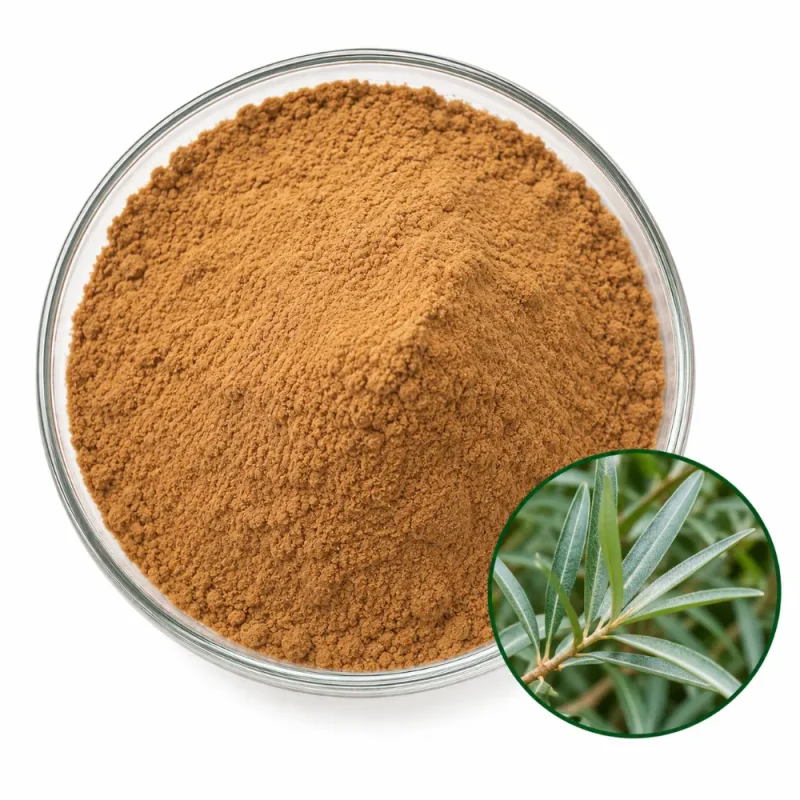
Sea Buckthorn Leaf Extract Powder

The narrow silver-green leaves of Hippophae rhamnoides give this sea buckthorn leaf extract its identity. Water extraction concentrates the soluble leaf fraction, and the liquor is dried to a green 10:1 powder. Berries, thorny twigs and seed material are not used, so the powder has none of the orange fruit pigments.

The 10:1 ratio carries no flavonoid percentage. The powder is green, ground to 80 mesh and water dispersible. The berry extract and the flavonoid-graded extract are separate products, and the leaf is a different raw material from the fruit even though both come from the same shrub.

Hippophae rhamnoides Leaf Identity & Plant Part

The shrub is Hippophae rhamnoides L., a thorny member of the oleaster family, Elaeagnaceae. The part used is the dried leaf, which is narrow, lance-shaped and silvery on the underside because of fine scales. Berries, branches and seeds are not added to this leaf extract.

Because leaf and berry share a common name, a specification that says only “sea buckthorn” can point to either raw material. The leaf carries flavonoid glycosides and tannin-type polyphenols, while the orange pigments and fruit acids belong to the berry. That separation is why the leaf extract looks green to brown and tastes more astringent than bitter-sour. The sea buckthorn leaf is also harvested on a different schedule from the fruit, since leaves are picked in the growing season while the berries wait for full ripeness, so the two raw materials seldom share a batch.

Buckthorn Leaf Extract vs Fruit & Standardized

FormWhat It IsChoose It When
10:1 Sea Buckthorn Leaf ExtractWater-extracted, concentrated and dried H. rhamnoides leafA dispersible leaf extract without a marker is wanted
Sea Buckthorn Berry Extract Powder10:1 water extract of the berryFruit identity and an orange tint are required
Sea Buckthorn Extract Powder10:1 water extract of the fruitFruit identity is required under the shorter name
Sea Buckthorn Extract 5–20% FlavonoidsExtract with a defined flavonoid rangeThe specification names a flavonoid figure

Read the 10:1 on a sea buckthorn leaf extract as the concentration of starting leaf in the powder. It gives no flavonoid number, and it should not be compared with the flavonoid range on the graded extract, which is a different grade and a different statement on the label. Leaf lots also vary with harvest season, which is why a ratio alone does not describe color or astringency.

Where fruit identity matters, the berry extract is the matching product. The leaf extract suits tea-style drink powders, capsule blends and herbal mixes that call for the green leaf by name, and it avoids the sourness that would come with the berry.

Typical Specifications

Specification ItemProduct Information
Latin NameHippophae rhamnoides
Plant PartLeaf & Herb
ProcessingWater Extraction
Common NameSea Buckthorn Leaf, Seaberry Leaf
Ingredient TypeRatio Extract
Extract Ratio10:1
AppearanceGreen powder
Solubility / DispersibilityWater Dispersible
Quality Parameters
Moisture (LOD)≤5.0%
Total Ash≤5.0%
Particle Size80 mesh
Heavy MetalsLead ≤2 ppm · Arsenic ≤1 ppm · Cadmium ≤1 ppm · Mercury ≤0.1 ppm
MicrobiologyTPC ≤1,000 cfu/g · Yeast & Mold ≤100 cfu/g · E. coli Negative · Salmonella Negative/25 g
Shelf Life24 months in unopened original packaging, cool and dry storage

Application Areas

Tea-Style Instant Drinks

Instant leaf drinks use the extract as a dissolvable alternative to loose leaf. It gives a pale green to brown infusion with a mild herbal note, and sweetener or lemon flavor is often added to soften the leaf’s astringency. A sea buckthorn leaf extract dissolves faster than steeped leaf and leaves no sediment of plant fragments.

Herbal Capsule Blends

Capsule fills combine the leaf extract with other leaf and root extracts. The powder is lighter and more hygroscopic than bark or root extracts, so blend humidity is controlled to avoid sticking at the filling station. Leaf extracts are also darker than berry extracts when mixed, which helps hide color differences between lots in an opaque capsule.

Green Powder Sticks

Single-serve sticks pair the extract with fruit powders or sweetener. Its green color holds best in neutral to mildly acidic mixes and turns olive in stronger acid, so citric acid is kept low. Packaging in an opaque pouch holds the green tone longer than clear film does.

Soft Chew Premixes

Chew premixes accept the leaf extract once the base has cooled. The green-brown tint suits herbal, mint or green-apple flavors, while the astringent edge limits dosage in mild bases. Trials with a cooled, finished chew base show quickly whether the leaf extract leaves a dry mouthfeel.

Formulation Notes

The powder is green with a grassy, slightly tea-like aroma and a mildly bitter, astringent taste. In water it gives a green liquid that turns amber over time. Leaf tannins react with iron, so stainless equipment is preferred, and long hold times at high temperature turn the green toward brown.

Premix the extract with part of the dry base before the main mix to prevent lumps. Soluble leaf solids attract moisture, and the powder cakes when its liner is left open. After opening, press out the air, close the liner tightly and store the container in a cool, dry area away from direct light. Sea buckthorn leaf extract, sea buckthorn leaf blends and the fruit extract should not share scoops, because orange fruit pigment contaminates the green leaf powder at very low levels. Because sea buckthorn leaf extract holds its color better in neutral mixes, a pH check of the final drink or capsule blend is part of the first trial.

Packaging & Commercial Supply

Essencefield supports product evaluation, formulation trials, commercial orders, and ongoing ingredient supply. Packaging, storage, and shipping arrangements are determined by product characteristics, order quantity, stability requirements, and destination-market needs.

Supply ItemGeneral Information
SampleAvailable upon request for formulation, testing, and supplier evaluation
Order Quantities100 g · 1 kg · 5 kg · 25 kg · 100 kg · 500 kg · Bulk
Sample Lead TimeTypically 5–7 days after sample confirmation
Production Lead TimeTypically 15–30 days after order and specification confirmation
PackagingSuitable protective inner packaging with bags, cartons, drums, or other appropriate outer packaging
StorageStore in tightly sealed, suitable protective packaging in a cool, dry environment. Protect from moisture, heat, and direct sunlight. Specific storage conditions follow the approved product specification.
DocumentationCOA · Product Specification · TDS · SDS · Applicable declarations (as applicable)

Final order quantities, lead times, packaging, documentation, and shipping arrangements are confirmed according to the selected product and commercial requirements.

Request Ingredient Specifications & Quote

Share your target specification, application, quantity, and documentation needs. We’ll help confirm suitable options, samples, and commercial supply details.