
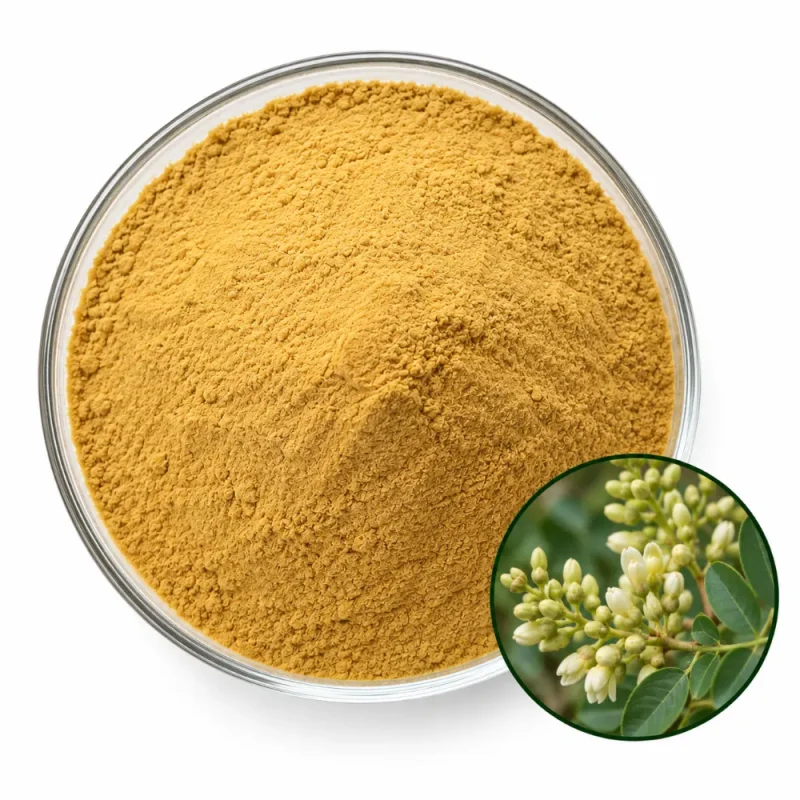
Rutin Standardization & Grades
Rutin is quercetin carrying the disaccharide rutinose at the 3-position: one rhamnose unit joined to one glucose unit. It is the dominant flavonoid of sophora flower buds, which is why this plant became the classic commercial source. At 95% the Sophora japonica powder is much closer to an isolated compound than to a botanical extract, and the remainder consists of related flavonoids such as quercetin, kaempferol glycosides and isorhamnetin glycosides. The botanical entity is Sophora japonica L., and the part used is the flower.
The page carries a single grade, so the decision is about format, particle behavior and solubility. Rutin crystallizes readily and has a low solubility in cold water, so the powder is best viewed as a crystalline ingredient, closer to a purified compound than a plant extract. Compounds from the same chemical family are the aglycones Quercetin 98% and Quercetin Dihydrate 99%, and the related flavonol Kaempferol 98%.
The difference between rutin and quercetin is a matter of the sugar. Rutin is the glycoside, quercetin the aglycone left after the rutinose is removed, and the two behave differently in solubility, taste and stability. Buyers who compare quotes should check that the compound named is rutin and that the part and species are stated, because rutin also comes from buckwheat and from Dimorphandra pods.
A rutin percentage must also state its basis. The figure can be expressed on an anhydrous or an as-is basis, which changes the number by a few points. This is why the HPLC value is read against a reference standard of defined form.


