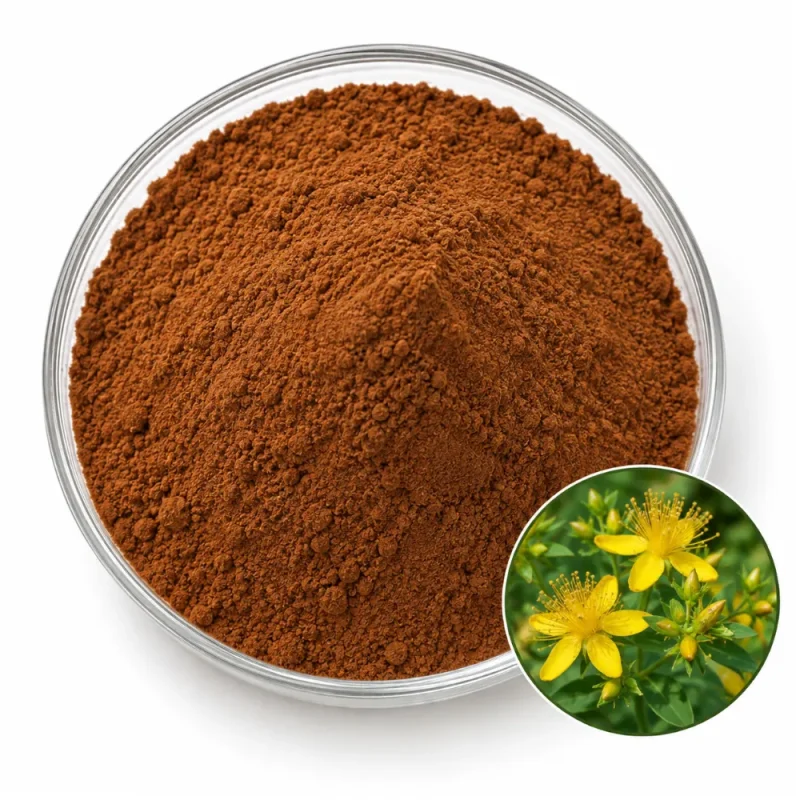
St. John’s Wort Extract 0.3% Hypericins

St. John’s Wort extract is prepared from the flowering tops of Hypericum perforatum, the yellow-flowered perennial of Eurasian roadsides, and not from the roots or from the ornamental Hypericum species. Ethanol extraction takes up the pigments of the glandular dots, and the liquor is dried to a light brown powder.

The grade is 0.3% hypericins by HPLC. The powder is 80 mesh and insoluble in water. A single grade is supplied, which suits capsules, tablets and oil-based fills that need a defined pigment fraction from the herb in a fine powder.

Hypericin Standardization & Grades

Hypericins are naphthodianthrones, red polycyclic pigments that sit in the dark glandular dots that give the leaves of the plant their perforated look. The group is led by hypericin and pseudohypericin. The herb also holds flavonoids such as hyperoside and rutin, the prenylated phloroglucinol hyperforin and the biflavone amentoflavone, and these are separate compound classes. The grade names the hypericins and not the other classes. The botanical entity is Hypericum perforatum L., a plant of the Hypericaceae, and the part used is the aerial herb in flower.

The grade is a single level at 0.3%, so there is no tier to choose between. The choice is between marker classes: hypericins, flavonoids or hyperforin each define a different St. John’s Wort product. The herb is also supplied as a 10:1 ratio extract, the St. John’s Wort Extract Powder, which carries no marker figure, and the purified compounds are listed as Hyperoside 98% and Hypericin. The data for this product lists hyperforin as a secondary marker, and it is described here without a figure. St. John’s Wort extract at 0.3% hypericins is therefore a pigment-defined product, and St. John’s Wort extract standardized to flavonoids or to hyperforin would be a different ingredient. The plant is a yellow-flowered perennial.

Hypericin Analysis & Purity Risks

The hypericin figure is measured by HPLC. The pigments absorb visible light strongly and fluoresce, so a visible-light or fluorescence detector gives a selective signal. Hypericin and pseudohypericin are quantified against reference standards and reported together as the hypericin total. A colorimetric total or a UV total would count other pigments and cannot be converted into an HPLC result.

Hypericin is sensitive to light, which is why sample preparation matters. The powder is dissolved in an alcohol diluent in subdued light, filtered and injected promptly, because the pigments degrade on exposure and give a falling signal. The extract is also prone to adsorb to glass and some filter materials, so the procedure should be fixed and repeated in the same way for each lot.

The chromatogram shows hypericin and pseudohypericin beside the flavonoids and hyperforin. Hyperforin is unstable and degrades in light and in air, and its level falls in stored extracts, so a comparison of lots at the same hypericin figure can still show different hyperforin levels. The pattern is part of the identity of a lot.

Purity risks are botanical. The genus Hypericum has about five hundred species, and the glandular dots of Hypericum perforatum are used to separate it from other yellow-flowered relatives. Only the flowering aerial parts are used. A stated species, the aerial herb as the part and the pigment and flavonoid pattern are the first identity checks. St. John’s Wort is also easy to mistake for other yellow-flowered herbs when it is cut and dried, so the glandular dots on the leaf and a pigment fingerprint support a visual or botanical check.

Typical Specifications

Specification ItemProduct Information
Latin NameHypericum perforatum
Plant PartLeaf & Herb
ProcessingEthanol Extraction
Compound ClassQuinones
Common NameSt. John’s Wort, Hypericum
Ingredient TypeStandardized Extract
Marker Compound(s)Hypericins (naphthodianthrone pigments, hypericin and pseudohypericin)
Primary Grade0.3% Hypericins (HPLC)
AppearanceLight Brown powder
Solubility / DispersibilityInsoluble in Water
Quality Parameters
Moisture (LOD)≤5.0%
Total Ash≤5.0%
Particle Size80 mesh
Heavy MetalsLead ≤2 ppm · Arsenic ≤1 ppm · Cadmium ≤1 ppm · Mercury ≤0.1 ppm
MicrobiologyTPC ≤1,000 cfu/g · Yeast & Mold ≤100 cfu/g · E. coli Negative · Salmonella Negative/25 g
Shelf Life24 months in unopened original packaging, cool and dry storage

Applications by Grade

Single Grade for Compact Capsules

The single grade fills capsules and tablets with a defined pigment fraction. The light brown powder is insoluble in water and slightly sticky, so a glidant helps hopper flow, and an opaque capsule or bottle protects the pigments from light.

Herb Extract in Tablet Blends

Tablets need an absorbent filler and a dry binder, because the lipophilic fraction softens compacts. A light-protective film coat keeps the pigments stable, and a compression trial on the full blend shows the hardness after storage.

Herb Extract in Softgel Fills

Softgel fills carry the powder as a milled suspension in oil, where hyperforin and the pigments can degrade under light. Use an opaque or amber shell and an oxygen-barrier pack to slow the loss of the lipophilic compounds.

Herb Extract in Oil Suspensions

For st. john’s wort, oil-based drops and liquid fills accept the powder as a fine dispersion. The light brown solid does not dissolve in oil, so settle the suspension with a viscosity builder, and test the fill for sediment and color change after storage.

Herb Extract in Dry Botanical Blends

Dry blends combine the powder with other herb extracts. Pre-blend it with part of the carrier, and keep the blend in a light-proof container, since the pigments of St. John’s Wort fade and the color of the blend shifts over time.

Herb Extract in Film-Coated Tablets

Film-coated tablets use an opaque coat to isolate the pigments from light and air. Check the coat for pinholes, which allow light to reach the core, and test the pigment figure after storage in the final pack.

Technical & Quality Considerations

The extract is a light brown powder with a faint, resinous, herbal odor and a bitter, astringent taste. It is insoluble in water, so water-based systems hold St. John’s Wort extract only as a fine suspension that settles without stirring. The pigments are sensitive to light, and hyperforin is sensitive to light and air, so light and oxygen are the main stability risks for the lot.

Work under reduced light where practical, and fold the extract into a portion of the carrier before the final mix. Fill capsules in a cool room, because warm air softens the resinous fraction.

Protect the drum from light and oxygen with a sealed, opaque liner, and store it in a cool place. An oxygen scavenger or a nitrogen headspace in the pack slows the loss of the labile compounds. Compare each lot with a retained sample for color, odor and the pigment and flavonoid pattern. Clean the line with a solvent wash after a run, since the resin builds up on contact parts and stains the equipment. A retained sample from each lot, tested again near the end of shelf life, shows whether the packaging holds the hypericin figure, which falls on light exposure, and the color of the powder. St. John’s Wort extract keeps best in a sealed, opaque container in a cool store.

Packaging & Commercial Supply

Essencefield supports product evaluation, formulation trials, commercial orders, and ongoing ingredient supply. Packaging, storage, and shipping arrangements are determined by product characteristics, order quantity, stability requirements, and destination-market needs.

Supply ItemGeneral Information
SampleAvailable upon request for formulation, testing, and supplier evaluation
Order Quantities100 g · 1 kg · 5 kg · 25 kg · 100 kg · 500 kg · Bulk
Sample Lead TimeTypically 5–7 days after sample confirmation
Production Lead TimeTypically 15–30 days after order and specification confirmation
PackagingSuitable protective inner packaging with bags, cartons, drums, or other appropriate outer packaging
StorageStore in tightly sealed, suitable protective packaging in a cool, dry environment. Protect from moisture, heat, and direct sunlight. Specific storage conditions follow the approved product specification.
DocumentationCOA · Product Specification · TDS · SDS · Applicable declarations (as applicable)

Final order quantities, lead times, packaging, documentation, and shipping arrangements are confirmed according to the selected product and commercial requirements.

Request Ingredient Specifications & Quote

Share your target specification, application, quantity, and documentation needs. We’ll help confirm suitable options, samples, and commercial supply details.