
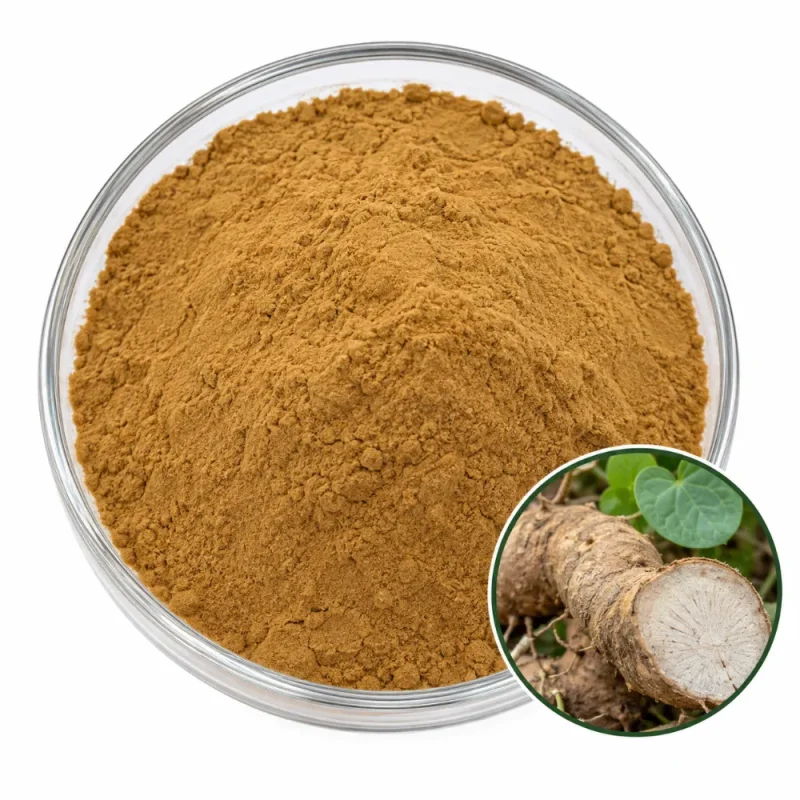
Stephania Alkaloid Standardization & Grades
The root of Stephania tetrandra holds bisbenzylisoquinoline alkaloids, a family of large, two-unit molecules joined through ether bridges. The two main members are tetrandrine and fangchinoline, which differ only in one substituent: tetrandrine carries a methoxy group where fangchinoline has a phenolic hydroxyl. Stephania tetrandra extract is standardized to total alkaloids because the class covers this pair and their minor relatives, and because the figure shows how far the root has been concentrated.
The botanical entity is Stephania tetrandra S.Moore, and the part is the root. The same root is supplied as a 10:1 ratio extract with no marker figure, Stephania Tetrandra Extract Powder. The two principal alkaloids are available as single compounds, Tetrandrine 98% and Fangchinoline 98%.
| Grade | Assay & Method | Where It Fits |
|---|---|---|
| 10% Total Alkaloids | Total alkaloids | Blends, larger inclusion |
| 50% Total Alkaloids | Total alkaloids | Capsules and tablets, small fill |
The 50% grade carries five times the alkaloid load per gram, so a capsule or tablet reaches its target with a small charge. The 10% grade is bulkier, lighter in color and more tolerant of blending errors, and it is the form most used in Stephania tetrandra extract blends. A formulator can scale between the two by weight, since both are expressed on the same basis.
The extract is made from root that has been washed, sliced, dried and extracted. Alkaloids are taken up at acidic or neutral pH and then concentrated and purified. Higher alkaloid strengths come from additional partition and crystallization steps that remove the starch, sugars and tannins of the root.


