
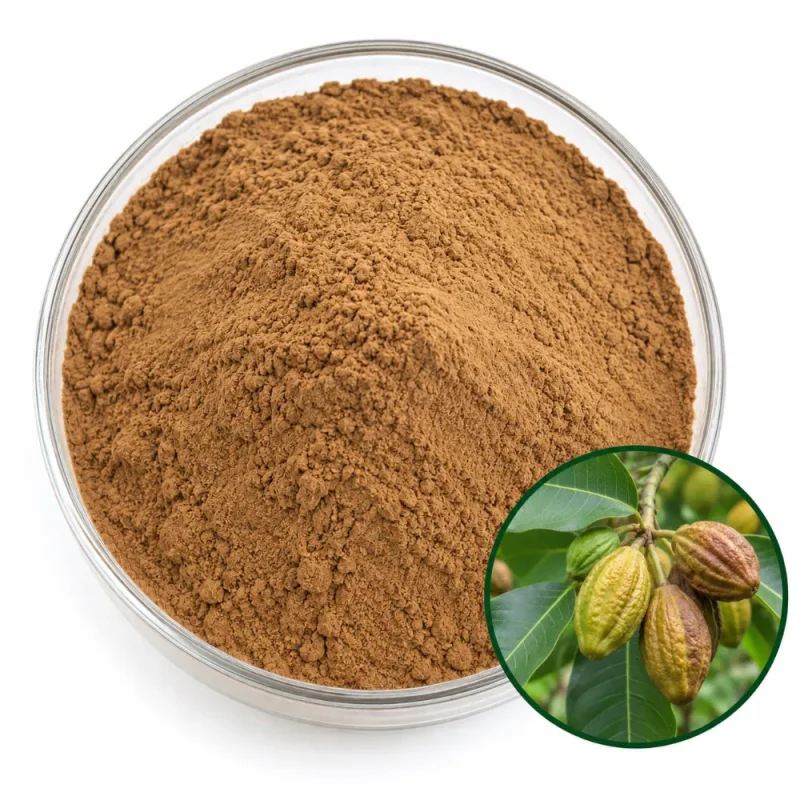
Haritaki Tannin Standardization & Grades
Tannins are polyphenols that bind proteins. The fruit of Terminalia chebula is among the richest sources of hydrolyzable tannins, led by chebulagic acid and chebulinic acid, with gallic acid, ellagic acid and corilagin. These are esters of gallic and ellagic acid with a glucose core, and they break down to the simple acids on heating and storage. Terminalia chebula extract is standardized to tannins because the class dominates the chemistry of the fruit and can be read by a repeatable UV method.
The botanical entity is Terminalia chebula Retz., and the part is the mature dried fruit. Leaves and bark are not used. Haritaki is one of the three fruits of triphala, with bibhitaki and amla, which come from different trees. The same fruit is supplied as a 10:1 ratio extract with no marker figure, Chebulic Myrobalan Extract Powder, as the milled fruit, Haritaki Powder, and within the three-fruit blend Triphala Extract Powder.
| Grade | Assay & Method | Where It Fits |
|---|---|---|
| 20% Tannins | UV | Drink powders, bulk blends |
| 50% Tannins | UV | Capsules and tablets, small fill |
The 50% grade carries two and a half times the tannin load of the 20% grade per gram, so a capsule or tablet reaches its target with a small charge. The 20% grade is bulkier and less sharply astringent in a dissolved drink. Both grades are read on the same UV basis, so scaling between them is a matter of weight.
The extract is made from dried fruit that is deseeded, crushed, extracted, filtered and concentrated. The seed kernel carries little tannin, and removing it concentrates the fruit wall, which is the tannin-rich tissue.


