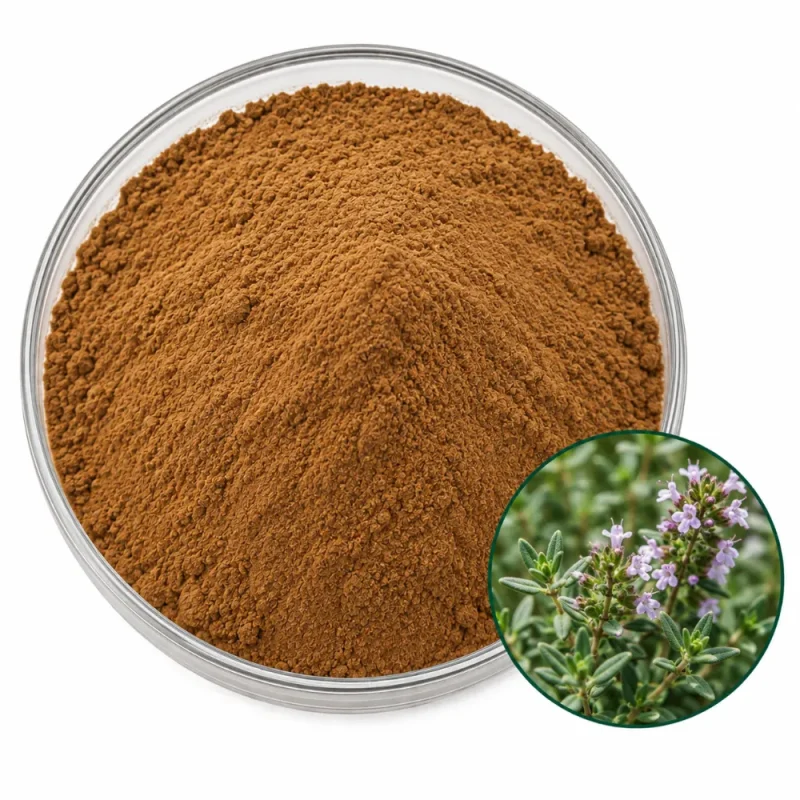
Thyme Extract 1–20% Rosmarinic Acid / Thymol

Thyme extract is prepared from the aerial parts of garden thyme, Thymus vulgaris L., a small aromatic shrub of the family Lamiaceae. Ethanol extraction concentrates the phenolic acids and volatile phenols of the herb, and the concentrate is dried to a light brown powder.

Rosmarinic acid and thymol are the two markers, each read by HPLC, with a grade range of 1–20%. The powder is 80 mesh and slightly soluble in water. The 20% grade suits capsules and tablets, while the 1% grade suits herbal blends and larger-inclusion formats.

Rosmarinic Acid and Thymol Standardization & Grades

Rosmarinic acid and thymol are very different compounds that share one plant. Rosmarinic acid is a caffeic acid ester, polar and non-volatile, and it travels with the phenolic fraction of the leaf. Thymol is a monoterpene phenol, the main component of the essential oil of common thyme chemotypes, with carvacrol, p-cymene and gamma-terpinene as companions. The extract carries both markers because they describe two halves of the herb: its phenolic acids and its aromatic oil.

The botanical entity is Thymus vulgaris L., and the part is the aerial herb, with leaves and flowering tops. Wild thyme (Thymus serpyllum) and lemon thyme are other species with different oil compositions. The same herb is supplied as a 10:1 ratio extract with no marker figure, Thyme Extract Powder, and as the milled herb, Thyme Powder.

GradeAssay & MethodWhere It Fits
1% Rosmarinic Acid / ThymolHPLCHerbal blends, larger inclusion
20% Rosmarinic Acid / ThymolHPLCCapsules and tablets, small fill

The two markers are measured as separate HPLC peaks, and the figure on a certificate names the compound that it refers to. They are not added to each other. The 20% grade carries twenty times the marker load per gram of the 1% grade, so a capsule reaches its target with a small fill. The 1% grade keeps more of the leaf’s character and fits blends in which the herbal aroma is welcome.

The extract is made from dried herb that is rubbed free of stems, extracted and concentrated. Thymol is volatile, so drying and concentration conditions are kept gentle, and the finished powder keeps a smaller aromatic fraction than the herb it came from.

Thyme Marker Analysis & Purity Risks

An HPLC assay separates rosmarinic acid and thymol in one run or in two, and reads each peak against its own reference standard. The results are specific compounds, not class equivalents, and each is stated on the dry basis. A rosmarinic acid figure and a thymol figure cannot be combined, and neither can be converted into a UV total polyphenol result.

The two markers behave differently in the sample and in the process. Rosmarinic acid dissolves in aqueous alcohol and is stable at moderate temperature. Thymol is lipophilic and volatile, so it is lost to open air, to heat and to vacuum drying, and a sample left uncovered loses it before it can be injected. The thymol figure therefore depends on sample handling more than the rosmarinic acid figure does.

For identity, the fingerprint shows the flavone glycosides of luteolin and apigenin and the pattern of the phenolic acids. Many Lamiaceae herbs contain rosmarinic acid, so thymol and the flavone pattern, not the acid alone, tie the extract to thyme.

Purity risks follow from the material class. Thyme chemotypes differ widely in oil composition, some carrying thymol and others linalool, geraniol or carvacrol as the main phenol. The thymol chemotype is the defined source. Lots mixed with oregano or savory, which also contain carvacrol and thymol, show a different ratio of the two phenols. The aerial herb is the defined part, and woody stems dilute both markers.

Harvest timing also matters for the pair. Thyme cut at full flower holds the most oil, while a late cut has more woody stem and less thymol. Rosmarinic acid is less sensitive to the cut, which is why the ratio between the two markers can differ between lots of Thyme extract and is read from the chromatogram instead of being assumed.

Typical Specifications

Specification ItemProduct Information
Latin NameThymus vulgaris
Plant PartLeaf & Herb
ProcessingEthanol Extraction
Compound ClassPolyphenols
Common NameThyme, Garden Thyme
Ingredient TypeStandardized Extract
Marker Compound(s)Rosmarinic acid; thymol
Primary Grade20% Rosmarinic Acid / Thymol (HPLC)
Available Grades1% · 20% Rosmarinic Acid / Thymol (HPLC)
AppearanceLight Brown powder
Solubility / DispersibilitySlightly Soluble in Water
Quality Parameters
Moisture (LOD)≤5.0%
Total Ash≤5.0%
Particle Size80 mesh
Heavy MetalsLead ≤2 ppm · Arsenic ≤1 ppm · Cadmium ≤1 ppm · Mercury ≤0.1 ppm
MicrobiologyTPC ≤1,000 cfu/g · Yeast & Mold ≤100 cfu/g · E. coli Negative · Salmonella Negative/25 g
Shelf Life24 months in unopened original packaging, cool and dry storage

Applications by Grade

20% Grade for Capsule Fills

The 20% grade of this thyme extract reaches its marker target in a small capsule fill. The powder carries a warm, medicinal scent and clings to equipment, so a flow agent and a dry filling room keep the hopper from bridging, and a check weight at the start of each run confirms the fill.

1% Grade in Herbal Blends

The 1% grade blends with other leaf extracts in dry herbal mixes. The thyme aroma is part of the blend character, and the extract is mixed with part of the carrier first, so that the small share spreads evenly through a large batch. A sealed mixer limits aroma loss.

20% Grade in Tablet Blends

Tablets of the 20% grade need a dry binder and a glidant. A film coat masks the strong thyme odor and limits moisture pickup. Hardness is rechecked after storage because the resinous solid softens in humid air, and the tablet surface can turn tacky.

1% Grade for Lozenge Bases

Lozenges and pastille bases use the 1% grade as a flavor-contributing ingredient. Add it late in the cook to keep the aromatic notes, and test the color against a retained batch, because sugar cooking darkens the brown tone.

20% Grade for Softgel Suspensions

The 20% grade is milled into an oil phase for softgel fills. Thymol dissolves well in oil, while rosmarinic acid stays in suspension, so the fill mass is checked for settling and viscosity before encapsulation.

1% Grade for Tea-Style Granules

Granules for hot water take the 1% grade as a dissolved-and-suspended ingredient. The thyme note carries well in hot drinks, and a light haze is normal given the slight solubility of the extract. A little sugar rounds off the bitter edge.

Technical & Quality Considerations

Thyme extract is a light brown powder with a warm, spicy, medicinal scent and a bitter taste. It is slightly soluble in water, and the solution is hazy, because rosmarinic acid dissolves partly and the oil-soluble fraction stays in suspension. Rosmarinic acid, as an ester, hydrolyzes in strong acid or alkali at higher temperature, and the free caffeic acid formed changes the profile.

Thymol is volatile and slowly leaves a powder that is stored warm or in open containers, so the aroma of an old lot is weaker. Sealed, low-headspace liners and cool storage keep it. Phenolic compounds bind iron, which darkens the powder on contact with carbon steel, so stainless surfaces and low-iron fillers are the better choice.

The powder gains moisture gradually and begins to lump in damp rooms. Compare each lot with a retained sample for color and aroma, since the scent is the first sign of aging, and run a new check weight when the line changes between the two grades, because they differ widely in bulk.

Packaging & Commercial Supply

Essencefield supports product evaluation, formulation trials, commercial orders, and ongoing ingredient supply. Packaging, storage, and shipping arrangements are determined by product characteristics, order quantity, stability requirements, and destination-market needs.

Supply ItemGeneral Information
SampleAvailable upon request for formulation, testing, and supplier evaluation
Order Quantities100 g · 1 kg · 5 kg · 25 kg · 100 kg · 500 kg · Bulk
Sample Lead TimeTypically 5–7 days after sample confirmation
Production Lead TimeTypically 15–30 days after order and specification confirmation
PackagingSuitable protective inner packaging with bags, cartons, drums, or other appropriate outer packaging
StorageStore in tightly sealed, suitable protective packaging in a cool, dry environment. Protect from moisture, heat, and direct sunlight. Specific storage conditions follow the approved product specification.
DocumentationCOA · Product Specification · TDS · SDS · Applicable declarations (as applicable)

Final order quantities, lead times, packaging, documentation, and shipping arrangements are confirmed according to the selected product and commercial requirements.

Request Ingredient Specifications & Quote

Share your target specification, application, quantity, and documentation needs. We’ll help confirm suitable options, samples, and commercial supply details.