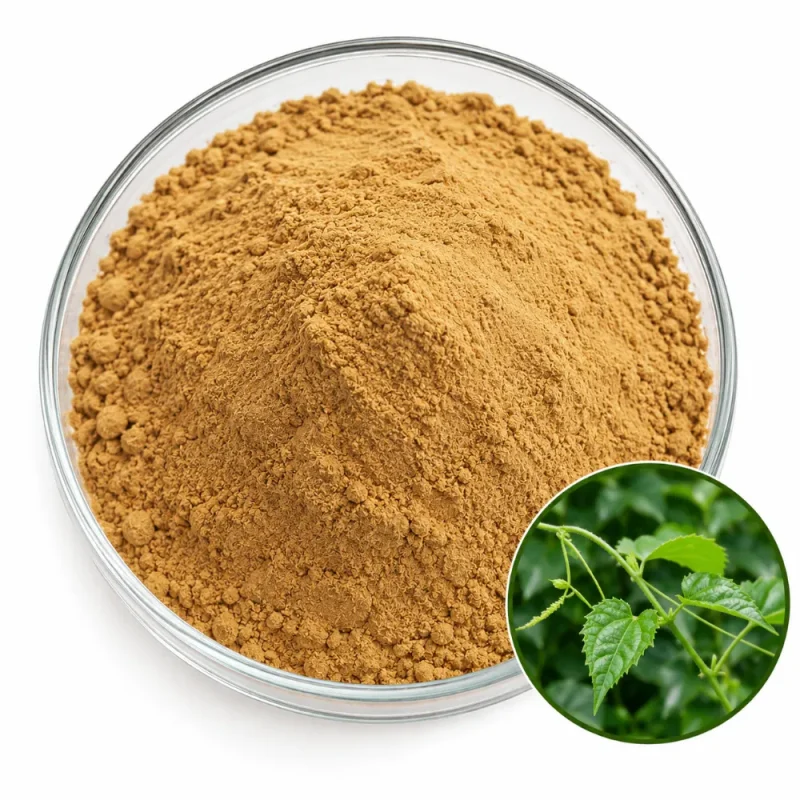
Vine Tea Extract 20–80% DHM

Tender leaves of Ampelopsis grossedentata, the teng cha or vine tea of southern China, supply this extract, which does not use the root of Ampelopsis japonica or leaves of true tea. Ethanol extraction concentrates the dihydroflavonol dihydromyricetin, and the liquor is dried to a light yellow powder.

The primary grade is 80% DHM by HPLC, with 20% as the lower end of the range. The powder is 80 mesh and slightly soluble in water. The 80% grade serves capsules and tablets with a small fill weight, while the 20% grade suits tea-style drink mixes and blends that keep more of the leaf matrix.

DHM Standardization & Grades

DHM stands for dihydromyricetin, also known as ampelopsin, a dihydroflavonol that differs from the flavonol myricetin by one saturated bond in the middle ring. That small difference makes it less colored, more prone to oxidation and more stable in acid than in neutral solution. It is the dominant flavonoid of vine tea leaf and the standardization target, because it is abundant and resolved cleanly by HPLC. The botanical entity is Ampelopsis grossedentata (Hand.-Mazz.) W.T.Wang, and the part used is the leaf.

GradeAssay & MethodWhere It Fits
20% DHMHPLCTea-style drink mixes and blends
80% DHMHPLCCapsules and tablets with small fill

Grade choice follows dose, fill weight and the amount of leaf matrix a formula should carry. The 80% grade holds four times the DHM load per gram of the 20% grade, so a capsule reaches its target with a much smaller fill. The 20% grade keeps more of the other leaf flavonoids and the sweetish, slightly bitter character of the tea, and it dissolves better in hot water. Siblings from the same plant are the unstandardized Vine Tea Extract Powder and the purified Dihydromyricetin (DHM) 98%.

Buyers who compare vine tea extract quotes should check the species and the compound name. DHM, ampelopsin and dihydromyricetin refer to one compound, while myricetin is a different molecule and the root of a related Ampelopsis species is a separate drug. A named species, the leaf as the stated part and an HPLC method make the figure comparable.

GBIF treats the plant as a synonym of Nekemias grossedentata, so searches for either name refer to the same vine. The name Ampelopsis grossedentata is kept here because it remains the common trade and pharmacopoeial name.

DHM Analysis & Purity Risks

Both grades are measured by HPLC, which separates DHM from myricetin, myricitrin and the other flavonoids of the leaf on a reversed-phase column with acidified mobile phase, identifies the peak by retention time and UV spectrum, and quantifies it against a reference standard. A UV total flavonoid reading counts all flavonoids together and is not comparable with the HPLC value for DHM.

The fingerprint of vine tea leaf shows DHM as the dominant peak, followed by myricitrin, myricetin and a few minor flavonoids. DHM oxidizes in neutral and alkaline solution and at high temperature, giving myricetin-type and brown degradation products, so a lot with a large myricetin peak and a small DHM peak has seen harsh or alkaline processing.

DHM dissolves poorly in cold water and much better in hot water, which creates a sampling issue: a solution prepared warm and injected cold can crystallize in the vial. A validated method uses acidified solvent, defined temperature and prompt injection to avoid the loss.

Purity risks follow from the botany. Roots and stems of other Ampelopsis species, such as Ampelopsis japonica, are sold under related names but have a different chemistry, and general flavonoid extracts can mimic a total flavonoid reading. A named species, the leaf as the stated part and a chromatographic fingerprint protect identity better than a percentage alone.

Typical Specifications

Specification ItemProduct Information
Latin NameAmpelopsis grossedentata
Plant PartLeaf & Herb
ProcessingEthanol Extraction
Compound ClassFlavonoids, Polyphenols
Common NameVine Tea, Teng Cha, Dihydromyricetin Extract
Ingredient TypeStandardized Extract
Marker Compound(s)Dihydromyricetin (DHM, ampelopsin) of Ampelopsis grossedentata leaf
Primary Grade80% DHM (HPLC)
Available Grades20% · 80% DHM (HPLC)
AppearanceLight Yellow powder
Solubility / DispersibilitySlightly Soluble in Water
Quality Parameters
Moisture (LOD)≤5.0%
Total Ash≤5.0%
Particle Size80 mesh
Heavy MetalsLead ≤2 ppm · Arsenic ≤1 ppm · Cadmium ≤1 ppm · Mercury ≤0.1 ppm
MicrobiologyTPC ≤1,000 cfu/g · Yeast & Mold ≤100 cfu/g · E. coli Negative · Salmonella Negative/25 g
Shelf Life24 months in unopened original packaging, cool and dry storage

Applications by Grade

80% Grade for Compact Capsules

The 80% grade delivers a DHM target in a very small capsule fill. The light yellow powder is fine and slightly electrostatic, so a flow agent and a dry filling room help the hopper feed evenly, and capsule weights should be checked at the start of each run.

80% Grade in Tablet Blends

Tablets of the high grade need a dry binder and an absorbent, since the fine powder compresses with some elastic rebound. A compression trial on the full blend and a hardness check after storage show whether the tablets keep their strength, and a film coat protects the yellow tint.

20% Grade for Tea-Style Drink Mixes

At 20% the extract is dosed by weight in instant tea mixes, where it gives a pale gold color and a lightly sweet, bitter taste. Dissolve it in hot water, then cool, and add a little citric acid, which keeps the flavonoid stable and the liquid clearer.

20% Grade for Dry Herbal Blends

Dry herbal blends use the lower grade beside other leaf powders, where its fine particles disperse into the tea. Pre-mix it with a bulking agent so the electrostatic powder does not cling to mixer walls, and avoid alkaline fillers, which darken the blend.

80% Grade in Acidified Drink Sticks

Sticks with a sour flavor system suit the high grade, because DHM is most stable in acid. The powder is only slightly soluble, so recommend warm water and stirring, and expect a pale yellow, faintly hazy solution that clears when warmed.

Technical & Quality Considerations

The extract is a light yellow powder with a faint leafy odor and a mild bitter taste. It is slightly soluble in water, so cold water gives a hazy suspension and hot water dissolves it much better, although the solution may become cloudy on cooling as DHM crystallizes. A low pH and a short hold at temperature give the clearest result.

DHM is unstable in neutral and alkaline conditions, where it oxidizes to colored products, and metal ions such as iron and copper speed the change. Use stainless steel, acidify water-based systems and avoid long holds at high temperature. At production scale, sieve the powder before dosing, since the fine particles carry static charge, and pre-mix vine tea extract with a portion of the carrier.

Moisture and light also matter. Keep the drum closed, cool and dry, and compare each lot with a retained sample for color. A shift from light yellow toward brown indicates oxidation and is a sign to check storage conditions. Clean equipment between this powder and pale products, since the yellow tint is visible at low carryover.

A vine tea extract is checked by dissolving a sample in hot, slightly acidic water. A clear, pale gold solution is typical, while a brown, cloudy one points to oxidized DHM. Keep a retained sample of each vine tea extract lot, and compare the DHM and myricitrin peaks of later lots with it, because a rising myricetin peak shows that DHM is breaking down.

Packaging & Commercial Supply

Essencefield supports product evaluation, formulation trials, commercial orders, and ongoing ingredient supply. Packaging, storage, and shipping arrangements are determined by product characteristics, order quantity, stability requirements, and destination-market needs.

Supply ItemGeneral Information
SampleAvailable upon request for formulation, testing, and supplier evaluation
Order Quantities100 g · 1 kg · 5 kg · 25 kg · 100 kg · 500 kg · Bulk
Sample Lead TimeTypically 5–7 days after sample confirmation
Production Lead TimeTypically 15–30 days after order and specification confirmation
PackagingSuitable protective inner packaging with bags, cartons, drums, or other appropriate outer packaging
StorageStore in tightly sealed, suitable protective packaging in a cool, dry environment. Protect from moisture, heat, and direct sunlight. Specific storage conditions follow the approved product specification.
DocumentationCOA · Product Specification · TDS · SDS · Applicable declarations (as applicable)

Final order quantities, lead times, packaging, documentation, and shipping arrangements are confirmed according to the selected product and commercial requirements.

Request Ingredient Specifications & Quote

Share your target specification, application, quantity, and documentation needs. We’ll help confirm suitable options, samples, and commercial supply details.