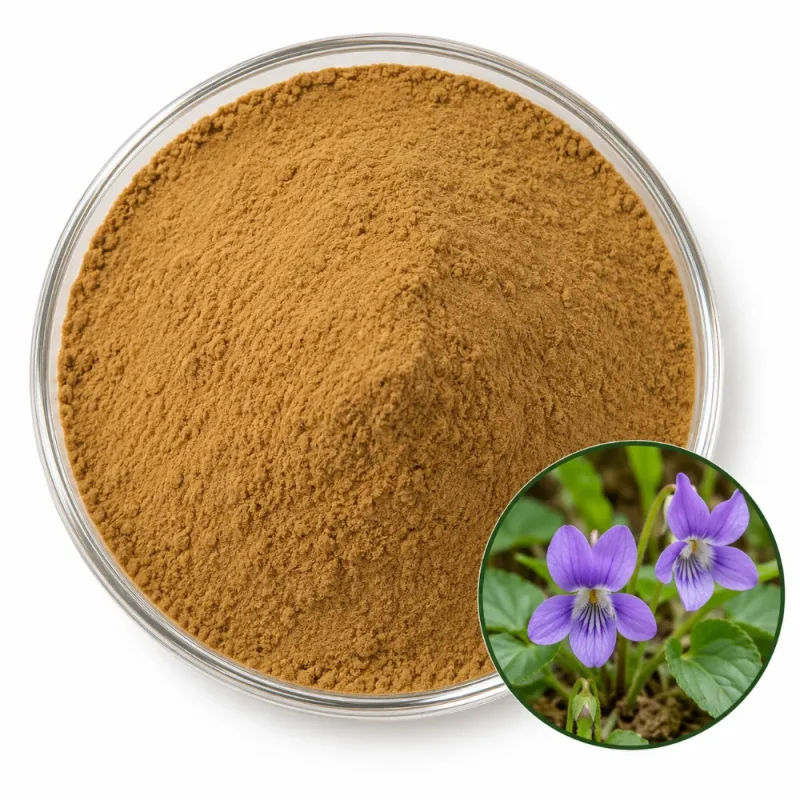
Viola Yedoensis Extract 5–20% Total Flavonoids

Viola yedoensis extract is prepared from the aerial parts of Viola yedoensis Makino, the plant sold in Chinese medicine as zi hua di ding, a small perennial herb of the family Violaceae. Ethanol extraction concentrates the flavonoid fraction of the herb, and the concentrate is dried to a light brown powder.

Total flavonoids are measured by UV spectrophotometry, with a primary grade of 20% and a lower grade of 5%. The powder is 80 mesh and slightly soluble in water. The 20% grade suits capsules and tablets, while the 5% grade suits blends and larger-inclusion formats.

Viola Flavonoid Standardization & Grades

Flavonoids are phenolic compounds built on a diphenylpropane skeleton. The herb of Viola yedoensis is rich in flavone C-glycosides, among them violanthin and isoorientin, which have the sugar attached directly to carbon and not through oxygen. It also carries coumarins such as aesculetin and dimeric coumarins, terpenoids and phenolic acids. More than a hundred compounds have been isolated from the plant. Viola yedoensis extract is standardized to total flavonoids because the class is prominent, stable and measurable by a routine UV method.

The botanical entity is Viola yedoensis Makino, and the part is the aerial herb. Zi hua di ding is a name shared by several unrelated small herbs in Chinese practice, and Viola yedoensis is the one named on the specification. The same herb is supplied as a 10:1 ratio extract with no marker figure, Viola Yedoensis Extract Powder.

GradeAssay & MethodWhere It Fits
5% Total FlavonoidsUVBlends, larger inclusion
20% Total FlavonoidsUVCapsules and tablets, small fill

The 20% grade carries four times the flavonoid load per gram, so a capsule or a tablet reaches its target with a small charge. The 5% grade is bulkier and keeps more of the herb’s own character. Both are read on the same UV basis, so scaling between them is a matter of weight.

The extract is made from dried herb that is cleaned of roots and weeds, cut and extracted. The concentrate is filtered and dried, and the process leaves behind the cellulose and chlorophyll-rich fiber that make up most of the herb mass.

Viola Flavonoid Analysis & Purity Risks

A UV total flavonoid assay uses a complexing reagent, typically an aluminum salt, which reacts with flavonoid hydroxyl and carbonyl groups and shifts their absorbance. The absorbance of the complex is read at a fixed wavelength and calculated against a reference flavonoid. The percentage is an equivalent tied to that reference, and it counts the flavonoid class as a whole.

The method does not distinguish between individual compounds. C-glycoside flavones, free flavones and phenolic acids can all respond, and the coumarins of the herb may add background absorbance. A UV total cannot be converted into an HPLC figure for violanthin or isoorientin, and the HPLC fingerprint is read beside the total to confirm the pattern of the flavone C-glycosides.

Chlorophyll can disturb the reading as well. Green pigment from the leaf absorbs in the red region, and a poorly cleaned extract shows a drifting baseline. The sample is therefore prepared with a clean-up step and a reagent blank, so that the green tint is not counted as flavonoid.

Purity risks follow from the material class. The aerial parts of Viola yedoensis are the defined part. Other violets and unrelated herbs are traded as zi hua di ding, among them species of Corydalis, and they carry different compounds. Roots and old, brown herb dilute the flavonoid fraction.

A further check concerns coumarins. Viola yedoensis extract carries coumarins that absorb in the UV range and can mimic flavonoid response in a simple colorimetric test, so a lot with a high coumarin share can read higher than its flavone load. The HPLC fingerprint, read at more than one wavelength, shows the balance of flavone C-glycosides to coumarins for each lot.

Typical Specifications

Specification ItemProduct Information
Latin NameViola yedoensis
Plant PartLeaf & Herb
ProcessingEthanol Extraction
Compound ClassFlavonoids, Polyphenols
Common NameChinese Violet, Zi Hua Di Ding
Ingredient TypeStandardized Extract
Marker Compound(s)Total flavonoids (flavone C-glycosides)
Primary Grade20% Total Flavonoids (UV)
Available Grades5% · 20% Total Flavonoids (UV)
AppearanceLight Brown powder
Solubility / DispersibilitySlightly Soluble in Water
Quality Parameters
Moisture (LOD)≤5.0%
Total Ash≤5.0%
Particle Size80 mesh
Heavy MetalsLead ≤2 ppm · Arsenic ≤1 ppm · Cadmium ≤1 ppm · Mercury ≤0.1 ppm
MicrobiologyTPC ≤1,000 cfu/g · Yeast & Mold ≤100 cfu/g · E. coli Negative · Salmonella Negative/25 g
Shelf Life24 months in unopened original packaging, cool and dry storage

Applications by Grade

20% Grade for Capsule Fills

The 20% grade reaches its flavonoid target in a small capsule fill. The powder is fine and mildly sticky once it has taken up humidity, so a dry filling room and a flow agent keep the hopper from bridging, and a check weight at the start of each run confirms the fill.

5% Grade in Dry Blends

The 5% grade of Viola yedoensis extract blends with other herb extracts in dry mixes where flavonoids are one marker among several. Sieve it with the carrier first, and mix in two steps, so that the small share spreads evenly through the batch.

20% Grade in Tablet Blends

Tablets of the 20% grade need a dry binder and a glidant. A film coat hides the brown core and limits moisture pickup. Hardness is rechecked after storage because the phenolic solid takes up moisture, softens in humid air and loses edge strength.

5% Grade for Herbal Tea Granules

Granules for hot water take the 5% grade with a soluble carrier. The flavonoid glycosides dissolve better in hot water than in cold, and a faint haze is normal given the slight solubility. A mild herbal base suits the grassy note of the herb.

20% Grade for Softgel Suspensions

The slightly soluble 20% grade is milled into an oil phase for softgel fills. Particle size and viscosity are checked before encapsulation, because settling in the fill mass causes uneven dosing across the batch, and a suspending agent is added.

5% Grade for Stick-Pack Mixes

Stick-pack mixes use the 5% grade at higher gram weight with a bulking carrier. The powder only partly dissolves, so the mix is stirred into a thick base, where the particles stay suspended and the grassy note is hidden by other flavors.

Technical & Quality Considerations

Viola yedoensis extract is a light brown to greenish-brown powder with a mild herbal scent. It is slightly soluble in water, and the solution is hazy, with the glycosides partly dissolved and the less polar fraction in suspension. Flavone C-glycosides are chemically stable, since the carbon bond resists acid and enzymatic hydrolysis far better than an oxygen bond does, which is why the pattern survives hot processes well.

The aglycone and coumarin fractions are more sensitive. Coumarins fluoresce and can oxidize slowly in light, so opaque liners protect the lot. Phenolic hydroxyl groups bind iron, and the powder darkens on contact with carbon steel, so stainless surfaces and low-iron fillers are the better choice.

Slow moisture uptake in humid rooms leaves the powder clumped. Desiccant liners and cool storage maintain flow. Judge each lot against a retained sample for color, since greener lots keep more chlorophyll, and take a new check weight when the line changes between the two grades, because they differ widely in bulk.

Packaging & Commercial Supply

Essencefield supports product evaluation, formulation trials, commercial orders, and ongoing ingredient supply. Packaging, storage, and shipping arrangements are determined by product characteristics, order quantity, stability requirements, and destination-market needs.

Supply ItemGeneral Information
SampleAvailable upon request for formulation, testing, and supplier evaluation
Order Quantities100 g · 1 kg · 5 kg · 25 kg · 100 kg · 500 kg · Bulk
Sample Lead TimeTypically 5–7 days after sample confirmation
Production Lead TimeTypically 15–30 days after order and specification confirmation
PackagingSuitable protective inner packaging with bags, cartons, drums, or other appropriate outer packaging
StorageStore in tightly sealed, suitable protective packaging in a cool, dry environment. Protect from moisture, heat, and direct sunlight. Specific storage conditions follow the approved product specification.
DocumentationCOA · Product Specification · TDS · SDS · Applicable declarations (as applicable)

Final order quantities, lead times, packaging, documentation, and shipping arrangements are confirmed according to the selected product and commercial requirements.

Request Ingredient Specifications & Quote

Share your target specification, application, quantity, and documentation needs. We’ll help confirm suitable options, samples, and commercial supply details.