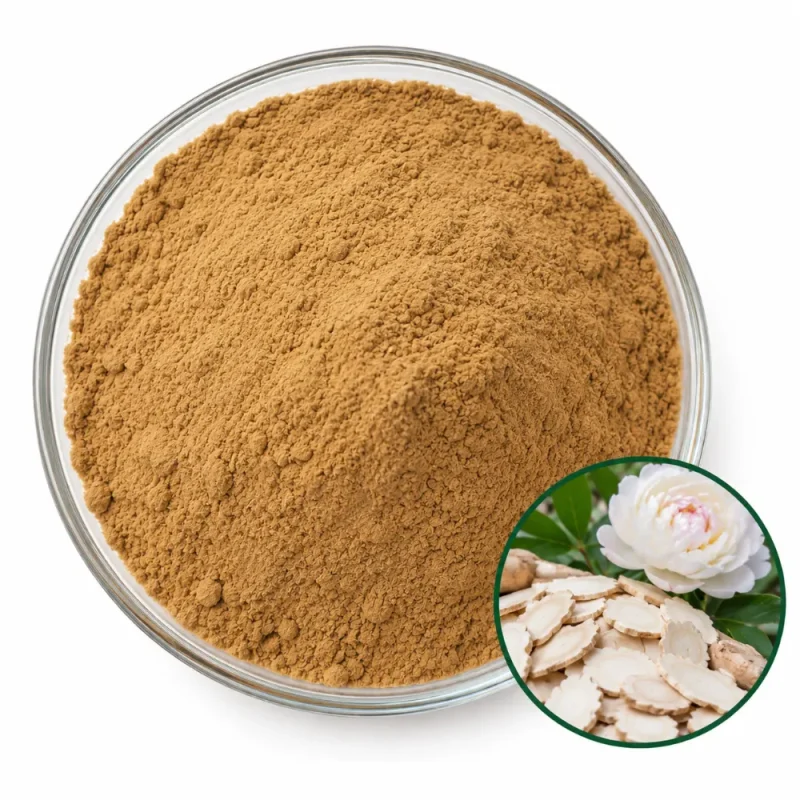
White Peony Extract 8–20% Paeoniflorin

White peony extract is prepared from the root of Paeonia lactiflora Pall., the Chinese herbaceous peony of the family Paeoniaceae, and is standardized to paeoniflorin. Ethanol extraction concentrates the monoterpene glycosides of the root, and the concentrate is dried to a light brown powder that dissolves in water.

Paeoniflorin is measured by HPLC, with a primary grade of 20% and a lower grade of 8%. The powder is 80 mesh. The 20% grade suits capsules and tablets, while the 8% grade suits drink powders and bulk blends.

Paeoniflorin Standardization & Grades

Paeoniflorin is a pinane-type monoterpene glycoside with a cage-like ring system, a glucose unit and a benzoyl group. It is the principal glycoside of the root of Paeonia lactiflora, and it sits beside albiflorin, oxypaeoniflorin, gallotannins, benzoic acid and starch. White peony extract is standardized to paeoniflorin because the compound is the defining marker of the root, and a laboratory can follow it by HPLC against a reference standard.

The botanical entity is Paeonia lactiflora Pall., and the part is the root. White peony and red peony both come from this species and differ in how the root is processed: white peony root is peeled and boiled before drying, while red peony is dried with its skin. The moutan bark of the tree peony (Paeonia suffruticosa) is a different plant with a different marker, paeonol. The same root is supplied as a 10:1 ratio extract with no marker figure, White Peony Root Extract Powder, as milled root, White Peony Root Powder and Red Peony Root Powder, and as the single compound Paeoniflorin 98%.

GradeAssay & MethodWhere It Fits
8% PaeoniflorinHPLCDrink powders, bulk blends
20% PaeoniflorinHPLCCapsules and tablets, small fill

The 20% grade carries two and a half times the paeoniflorin per gram of the 8% grade, so a capsule or tablet reaches its target with a smaller charge. The 8% grade is bulkier, and it dissolves with the sugars and tannins of the root, which gives a milder, slightly sweet and astringent drink.

Paeoniflorin Analysis & Purity Risks

An HPLC assay separates paeoniflorin from albiflorin, which is a close isomer, and from oxypaeoniflorin and the benzoyl derivatives, and reads it as a distinct peak against a reference standard. The reading refers to one named glycoside, not to a class, and it is stated per gram of dry powder. A paeoniflorin figure cannot be compared with a total glycoside value or with a UV total polyphenol figure.

Albiflorin and paeoniflorin differ only in the position of one bond, and they elute close together. A method without enough resolving power merges them and overstates the figure, so the column and gradient are fixed and the resolution between the two peaks is checked at each run.

For identity, the fingerprint is read beside the main peak. Gallotannin peaks and the pattern of monoterpene glycosides distinguish Paeonia lactiflora from the tree peony, whose bark carries paeonol and little paeoniflorin, and from other herbaceous peonies. Paeoniflorin is sensitive to heat and to alkaline conditions, and it degrades during long, hot extraction.

Purity risks follow from the material class. The root is the defined part. Peeling and boiling shift the composition, since boiling removes water-soluble material, and roots dried at high temperature lose paeoniflorin to hydrolysis. Several peony species are sold as white peony in different regions. A lot made from the wrong species or from aged root shows a lower paeoniflorin peak and a different tannin profile.

Processing history leaves a mark on the powder. A root that was boiled before drying has lost some water-soluble material and carries less starch, and a root that was sliced and dried raw keeps more. White peony extract made from boiled, dried root therefore gives a cleaner, paler solution, and the drying record of the root is kept with each lot.

Typical Specifications

Specification ItemProduct Information
Latin NamePaeonia lactiflora
Plant PartRoot & Rhizome
ProcessingEthanol Extraction
Compound ClassTerpenoids
Common NameWhite Peony, Bai Shao
Ingredient TypeStandardized Extract
Marker Compound(s)Paeoniflorin
Primary Grade20% Paeoniflorin (HPLC)
Available Grades8% · 20% Paeoniflorin (HPLC)
AppearanceLight Brown powder
Solubility / DispersibilityWater Soluble
Quality Parameters
Moisture (LOD)≤5.0%
Total Ash≤5.0%
Particle Size80 mesh
Heavy MetalsLead ≤2 ppm · Arsenic ≤1 ppm · Cadmium ≤1 ppm · Mercury ≤0.1 ppm
MicrobiologyTPC ≤1,000 cfu/g · Yeast & Mold ≤100 cfu/g · E. coli Negative · Salmonella Negative/25 g
Shelf Life24 months in unopened original packaging, cool and dry storage

Applications by Grade

20% Grade for Capsule Fills

The 20% grade reaches its paeoniflorin target in a small capsule fill. The powder is fine and hygroscopic, so a dry filling room and a flow agent keep the hopper from bridging, and a check weight at the start of each run confirms the fill.

8% Grade in Drink Powders

The 8% grade dissolves in cold water to a clear light brown drink with a mild, slightly bitter-sweet taste. Floral, fruity or malt flavor bases suit it, and the finished drink is held at a neutral to mildly acidic pH, which keeps paeoniflorin stable.

20% Grade in Tablet Blends

Tablets of the 20% grade need a dry binder and a lubricant. A coating layer keeps moisture out and masks the brown core. The press is run at moderate speed, since compression heat can degrade the glycoside in a thin tablet and darken its surface.

8% Grade for Gummy Bases

Gummies take the 8% grade as a larger-inclusion ingredient. Add it after the main cook, because long heating and alkaline conditions break down paeoniflorin, and check the gel pH, which should stay near neutral to mildly acidic.

20% Grade for Stick-Pack Mixes

Stick-pack mixes use the 20% grade at low gram weight in a bulking carrier. The powder dissolves, and the bitterness is noticeable at higher doses, so a sweetener or fruit flavor is chosen with the dose in mind.

8% Grade for Instant Granules

Instant granules for hot or cold water carry the 8% grade with a soluble carrier. Water below boiling is used for the infusion, since prolonged boiling reduces paeoniflorin, and the granule is dried gently during production.

Technical & Quality Considerations

White peony extract is a light brown powder with a faint, sweet-woody scent and a mildly bitter, astringent taste. It is water soluble, and the solution is clear to slightly hazy brown. Paeoniflorin is stable at neutral and mildly acidic pH, but it hydrolyzes in strong acid and in alkaline solution, and long heating accelerates both. A drink pasteurized at moderate temperature loses less than a retort-sterilized one.

The gallotannins of the root bind iron, so the powder darkens on contact with carbon steel, and stainless surfaces and low-iron fillers are preferred. They also bind protein, and a drink with whey or casein can turn cloudy, so a protein-compatibility trial is run before a formula is fixed.

The powder takes up moisture and cakes in humid storage. Sealed liners with desiccant and cool storage keep the flow steady. Compare each lot with a retained sample for color and taste, and take a new check weight whenever the filling line changes between the two grades, since they differ widely in bulk.

Packaging & Commercial Supply

Essencefield supports product evaluation, formulation trials, commercial orders, and ongoing ingredient supply. Packaging, storage, and shipping arrangements are determined by product characteristics, order quantity, stability requirements, and destination-market needs.

Supply ItemGeneral Information
SampleAvailable upon request for formulation, testing, and supplier evaluation
Order Quantities100 g · 1 kg · 5 kg · 25 kg · 100 kg · 500 kg · Bulk
Sample Lead TimeTypically 5–7 days after sample confirmation
Production Lead TimeTypically 15–30 days after order and specification confirmation
PackagingSuitable protective inner packaging with bags, cartons, drums, or other appropriate outer packaging
StorageStore in tightly sealed, suitable protective packaging in a cool, dry environment. Protect from moisture, heat, and direct sunlight. Specific storage conditions follow the approved product specification.
DocumentationCOA · Product Specification · TDS · SDS · Applicable declarations (as applicable)

Final order quantities, lead times, packaging, documentation, and shipping arrangements are confirmed according to the selected product and commercial requirements.

Request Ingredient Specifications & Quote

Share your target specification, application, quantity, and documentation needs. We’ll help confirm suitable options, samples, and commercial supply details.