
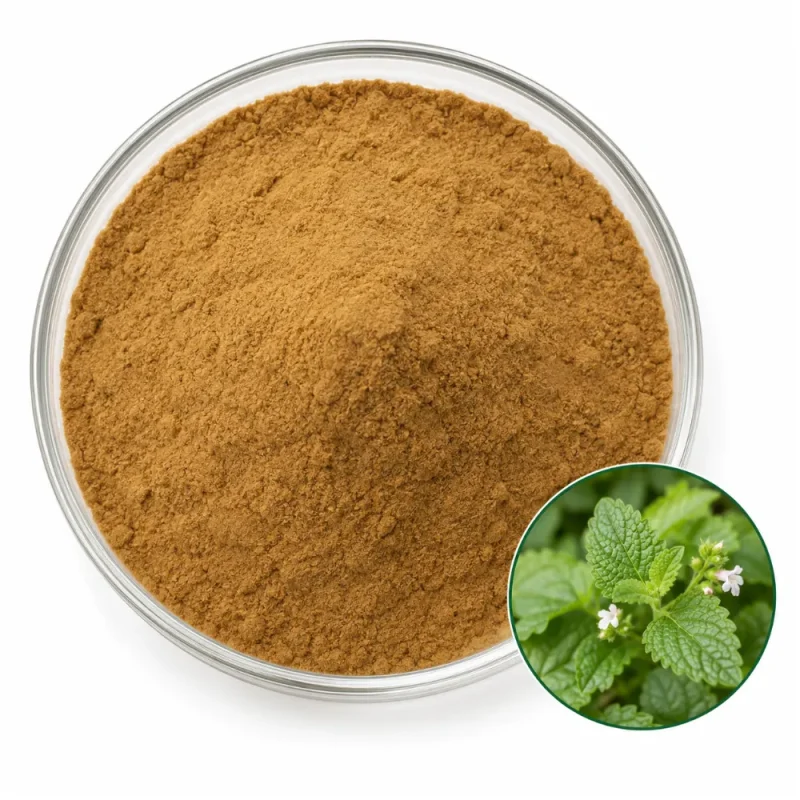
Rosmarinic Acid Standardization & Grades
Rosmarinic acid is an ester of caffeic acid with a phenyl-lactic acid, and it is the main phenolic acid of the leaf of lemon balm. It occurs across the mint family, in rosemary, sage, oregano and other herbs, so it is a chemical class marker and not a marker of one species. The lemon scent of the fresh herb comes from the volatile oil, with citral and citronellal as principal members, and the oil is largely lost in extraction, drying and spray processing. The botanical entity is Melissa officinalis L., a plant of the Lamiaceae, and the part used is the leaf.
| Grade | Assay & Method | Where It Fits |
|---|---|---|
| 5% Rosmarinic Acid | HPLC | Tea-style blends and drink powders |
| 10% Rosmarinic Acid | HPLC | Capsules and tablets with small fill |
For lemon balm, for lemon balm, the two grades differ by a factor of two. For lemon balm, the 10% grade is a marker concentrate that supplies a defined load from a small fill. The 5% grade is closer to the leaf, with more of the flavonoid glycosides, sugars and chlorophyll-derived solids, so lemon balm extract at this level suits tea-style blends and drink powders. The leaf is also supplied as a 10:1 ratio extract, the Lemon Balm Extract Powder, as a milled leaf, the Lemon Balm Leaf Powder, and the marker is listed as the purified compound Rosmarinic Acid 98%. Lemon balm extract at 10% is the more concentrated of the two grades, and lemon balm extract at 5% is the fuller one. Lemon balm is a perennial herb with soft, crinkled leaves.


