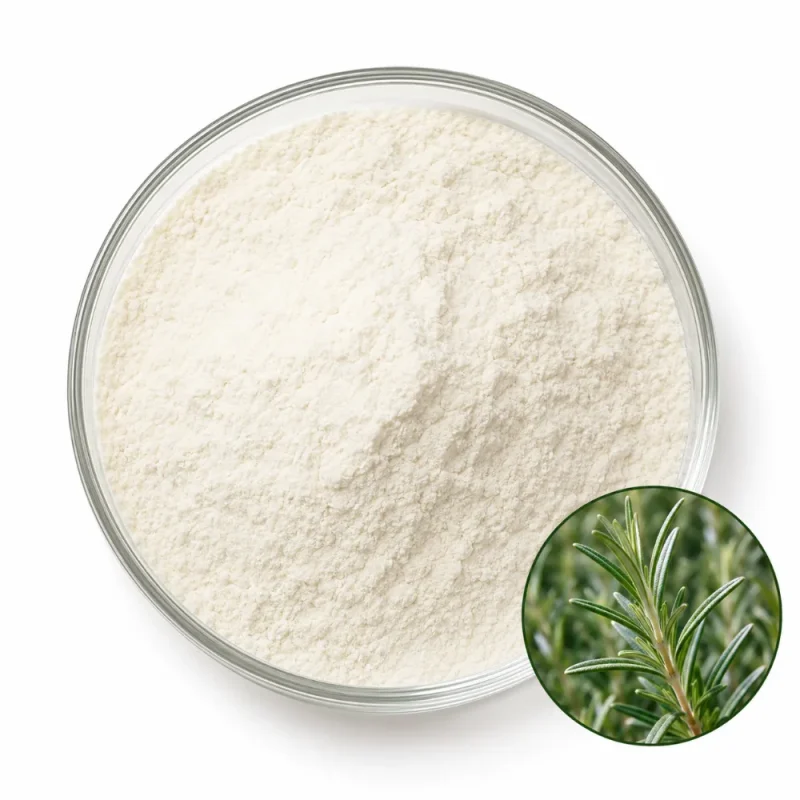
Rosmarinic Acid 98%

Caffeic acid esterified with 3,4-dihydroxyphenyllactic acid gives rosmarinic acid, and this rosmarinic acid is isolated from the leaf of Salvia rosmarinus, rosemary, by ethanol extraction and purification. It is a polyphenolic acid with two catechol rings, supplied as a light brown powder that is slightly soluble in water.

The primary grade is 98% rosmarinic acid by HPLC, with a 95% grade also supplied, in Food / Dietary Supplement Grade. Rosemary leaf also holds the diterpenes carnosic acid and carnosol, which are a different class, so buyers should check which rosemary compound a specification actually names.

Rosmarinic Acid Chemical Identity

Rosmarinic acid has the molecular formula C18H16O8 and a molecular weight of 360.3. It is built from two phenylpropanoid units: caffeic acid supplies one catechol ring and a double bond, while 3,4-dihydroxyphenyllactic acid supplies the second ring and the free carboxyl group. The molecule has one stereocenter, the (R) form is natural, and the trans double bond of the caffeoyl portion is the stable one.

The natural source is the leaf of Salvia rosmarinus Spenn., the species formerly called Rosmarinus officinalis. Rosmarinic acid is not unique to rosemary. It occurs across the mint family, including sage, lemon balm, basil and perilla, so the botanical source and plant part belong beside the name. Rosemary is supplied in several forms: Rosemary Extract 5–20% Carnosic Acid, the 10:1 Rosemary Extract Powder and the milled Rosemary Powder. The carnosic acid extract is defined by a lipophilic diterpene and not by this water-soluble phenolic acid, and the two are not interchangeable.

Typical Specifications

Specification ItemProduct Information
Natural SourceSalvia rosmarinus leaf
Plant PartLeaf & Herb
ProcessingEthanol Extraction & Purification
Compound ClassPolyphenols
Chemical Name (IUPAC)(2R)-3-(3,4-dihydroxyphenyl)-2-[(E)-3-(3,4-dihydroxyphenyl)prop-2-enoyl]oxypropanoic acid
CAS Number20283-92-5
Molecular FormulaC18H16O8
Molecular Weight360.3
PubChem CID5281792
InChIKeyDOUMFZQKYFQNTF-WUTVXBCWSA-N
SMILESC1=CC(=C(C=C1CC(C(=O)O)OC(=O)C=CC2=CC(=C(C=C2)O)O)O)O
Purity98% (HPLC)
Available Grades95% · 98% (HPLC)
GradeFood / Dietary Supplement Grade
AppearanceLight Brown powder
Solubility / DispersibilitySlightly Soluble in Water
Quality Parameters
Moisture (LOD)≤5.0%
Total Ash≤5.0%
Heavy MetalsLead ≤2 ppm · Arsenic ≤1 ppm · Cadmium ≤1 ppm · Mercury ≤0.1 ppm
MicrobiologyTPC ≤1,000 cfu/g · Yeast & Mold ≤100 cfu/g · E. coli Negative · Salmonella Negative/25 g
Shelf Life24 months in unopened original packaging, cool and dry storage

Rosmarinic Acid Purity Grades & Impurities

GradeAssay & MethodWhere It Fits
95% Rosmarinic AcidHPLCDrink powders and dry blends
98% Rosmarinic AcidHPLCCapsules and reference-grade blends

The HPLC assay measures the rosmarinic acid peak against a reference standard, normally with detection in the ultraviolet range where the caffeoyl chromophore absorbs strongly. The percentage compares that peak with all other detected peaks, so it does not account for water, ash or components that do not absorb, and it should be read together with the moisture and ash limits.

The related substances of a leaf-derived caffeic ester are caffeic acid, which forms by hydrolysis, and the isomers and oxidation products of rosmarinic acid itself. Methyl and other ester derivatives of rosmarinic acid can form when the extraction solvent is an alcohol under acidic conditions. Lithospermic acid-type dimers and salvianolic acids are larger relatives that are found in the mint family and that appear in small amounts in some preparations. Rosemary diterpenes are removed in purification and should not appear at a significant level at this grade.

The 95% and 98% grades differ in how much of such companion material is left. The lower grade has more caffeic acid and oxidation by-products and a browner color, while the higher grade is cleaner and lighter. Both are sensitive to oxidation, since two catechol rings are exposed, and a lot stored warm or wet will darken before the HPLC peak falls noticeably.

The solvent used in the HPLC sample preparation can change the result. Rosmarinic acid reacts slowly with methanol under acidic conditions to give the methyl ester, which elutes at a different time, so a sample left in acidified methanol may show a falling main peak and a growing neighbor. Laboratories that prepare samples fresh, in a neutral or weakly acidic water-alcohol mixture, and read them promptly report more reproducible figures between sites.

Rosmarinic Acid Solubility & Delivery

Rosmarinic acid is slightly soluble in cold water and dissolves more readily in warm water, ethanol and methanol. It is acidic, and the solution is mildly acidic, so it dissolves better as the pH rises, although the catechol rings then become more prone to oxidation. The molecule is moderately polar, with a logP near the middle of the scale, so it partitions into aqueous ethanol and does not dissolve well in pure oils.

For delivery, the main concerns are dissolution speed and oxidation. A fine powder wets slowly in cold water, so formulators dissolve it in warm water or aqueous ethanol before dilution. In solution, a mildly acidic pH, a chelating agent and low oxygen content protect the catechol groups, and iron or copper contact darkens the liquid within hours. In dry blends, the powder is moderately hygroscopic, and a desiccant in the pack plus a closed container keep it free flowing. Co-solvents such as glycerin or propylene glycol help in liquid concentrates.

The color of a rosmarinic acid solution is a useful warning. Fresh solutions are pale yellow-brown, and a deepening toward red-brown signals oxidation of the catechol rings and polymerization to colored products. A freshly made solution is stored cold and used within a short period, and a stock that will be kept longer is acidified and protected from light, with the headspace limited so that little air remains in the container.

Application Areas

Capsules at Low Inclusion

Capsules take rosmarinic acid at low to moderate inclusion. The light brown powder is moderately cohesive and takes up a little moisture, so a flow agent and a dry filling room give an even fill weight.

Warm-Dissolved Drink Powders

Drink powders dissolve the acid in warm water before the base is cooled. Keep the drink mildly acidic, include a chelating agent if the water is hard, and avoid contact with iron-containing minerals that darken the liquid.

Tablet Blends

Tablets press rosmarinic acid with a dry binder and a lubricant. The catechol rings react with trace metals in some fillers, so a compatibility trial of the blend shows early color change before the batch is scaled.

Rosemary Reference Blends

Rosemary formulators use the 98% grade to build blends with carnosic acid extract and the milled leaf. Each ingredient is weighed separately in steps, and the HPLC traces are filed so the contribution of each can be traced to its lot.

Packaging & Commercial Supply

Essencefield supports product evaluation, formulation trials, commercial orders, and ongoing ingredient supply. Packaging, storage, and shipping arrangements are determined by product characteristics, order quantity, stability requirements, and destination-market needs.

Supply ItemGeneral Information
SampleAvailable upon request for formulation, testing, and supplier evaluation
Order Quantities100 g · 1 kg · 5 kg · 25 kg · 100 kg · 500 kg · Bulk
Sample Lead TimeTypically 5–7 days after sample confirmation
Production Lead TimeTypically 15–30 days after order and specification confirmation
PackagingSuitable protective inner packaging with bags, cartons, drums, or other appropriate outer packaging
StorageStore in tightly sealed, suitable protective packaging in a cool, dry environment. Protect from moisture, heat, and direct sunlight. Specific storage conditions follow the approved product specification.
DocumentationCOA · Product Specification · TDS · SDS · Applicable declarations (as applicable)

Final order quantities, lead times, packaging, documentation, and shipping arrangements are confirmed according to the selected product and commercial requirements.

Request Ingredient Specifications & Quote

Share your target specification, application, quantity, and documentation needs. We’ll help confirm suitable options, samples, and commercial supply details.