Lutein

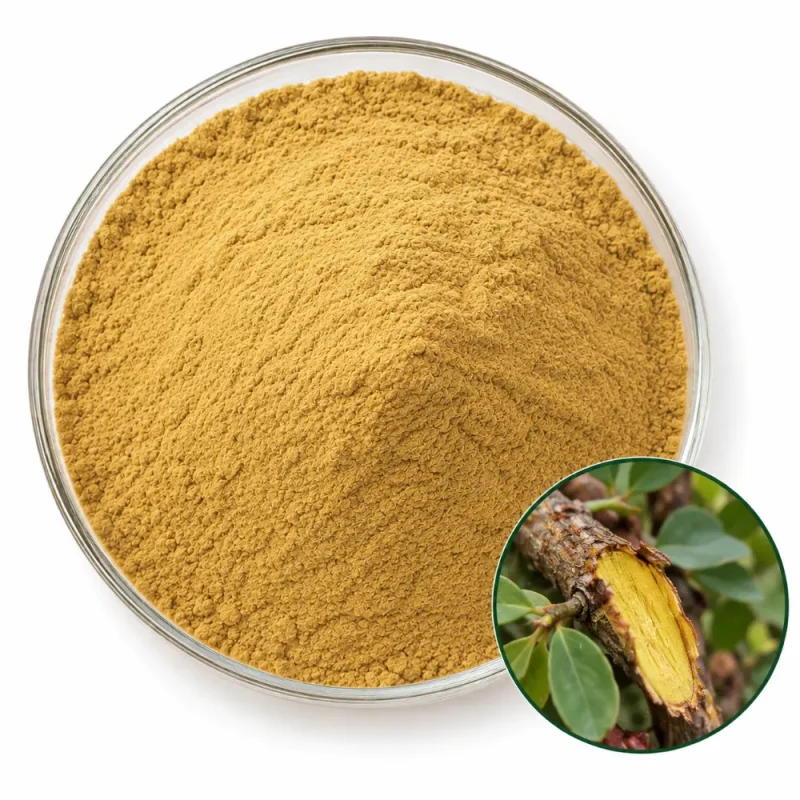
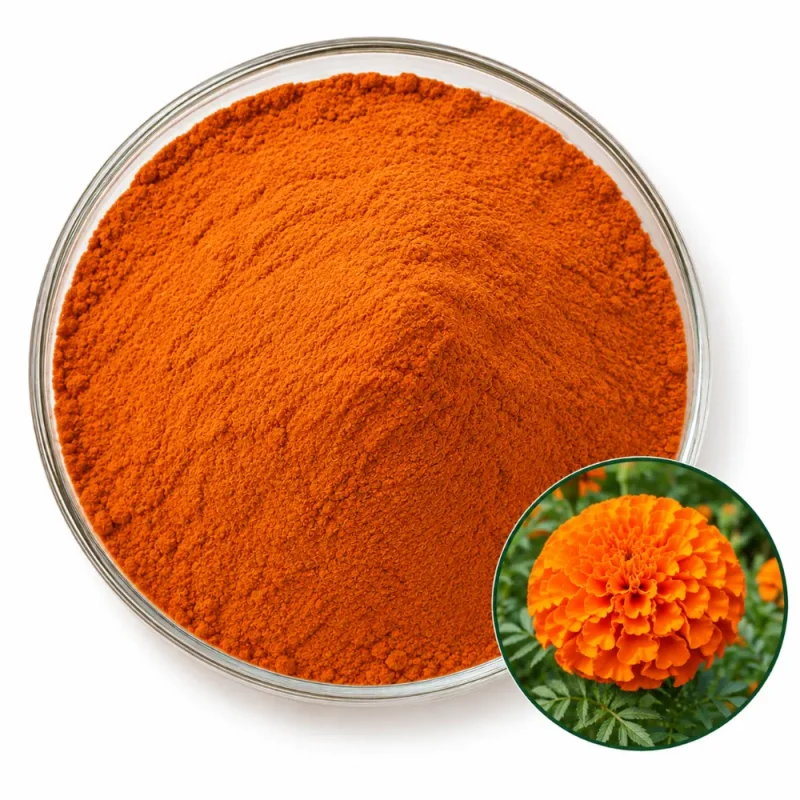
Free lutein is the yellow xanthophyll pigment of the marigold flower, and this lutein is isolated from Tagetes erecta petals by solvent extraction and purification. In the flower the pigment is stored mainly as fatty-acid esters, and the free alcohol form is obtained after the esters are released, which gives an orange-yellow crystalline powder.

The primary grade is 90% lutein by HPLC, with an 80% grade also supplied, in Food / Dietary Supplement Grade. The powder is insoluble in water and fat-soluble. Both grades are carotenoid crystals, which is why they sit below the 90–98% range of most plant compounds.

Lutein Chemical Identity

Lutein has the molecular formula C40H56O2 and a molecular weight of 568.9. It is a dihydroxy carotenoid with two end rings, one a beta ring and one an epsilon ring, joined by a conjugated polyene chain of nine double bonds. The chain absorbs blue light and gives the orange-yellow color, and the two hydroxyls on the end rings make lutein a xanthophyll and not a carotene.

The natural source is the flower of Tagetes erecta L., the Aztec marigold, whose petals are the established commercial source of the pigment. The petals carry lutein as esters, and the free compound is obtained by hydrolysis and crystallization. Zeaxanthin is a close structural relative that differs only in the position of one double bond, and the two co-occur in the crude extract. Marigold is also supplied as Marigold Extract 10–20% Lutein, the 10:1 Marigold Extract Powder and the milled Marigold Flower Powder. Those are mixed materials, while lutein here is the crystalline pigment.

The route from flower to crystal explains several properties. Marigold petals are dried and milled, and the oleoresin is extracted with a solvent. Alkali then cleaves the fatty-acid esters, freeing the lutein, and the free pigment is crystallized and washed. Free lutein is less stable than the esterified form in the flower, because the esters protect the hydroxyl groups, which is why the crystals are packed away from air and light and are not stored as loose powder.

Typical Specifications

Specification ItemProduct Information
Natural SourceTagetes erecta flower
Plant PartFlower
ProcessingSolvent Extraction & Purification
Compound ClassCarotenoids
Chemical Name (IUPAC)(1R)-4-[(1E,3E,5E,7E,9E,11E,13E,15E,17E)-18-[(1R,4R)-4-hydroxy-2,6,6-trimethylcyclohex-2-en-1-yl]-3,7,12,16-tetramethyloctadeca-1,3,5,7,9,11,13,15,17-nonaenyl]-3,5,5-trimethylcyclohex-3-en-1-ol
CAS Number127-40-2
Molecular FormulaC40H56O2
Molecular Weight568.9
PubChem CID5281243
InChIKeyKBPHJBAIARWVSC-RGZFRNHPSA-N
SMILESCC1=C(C(CC(C1)O)(C)C)C=CC(=CC=CC(=CC=CC=C(C)C=CC=C(C)C=CC2C(=CC(CC2(C)C)O)C)C)C
Purity90% (HPLC)
Available Grades80% · 90% (HPLC)
GradeFood / Dietary Supplement Grade
AppearanceOrange-Yellow powder
Solubility / DispersibilityInsoluble in Water
Quality Parameters
Moisture (LOD)≤5.0%
Total Ash≤5.0%
Heavy MetalsLead ≤2 ppm · Arsenic ≤1 ppm · Cadmium ≤1 ppm · Mercury ≤0.1 ppm
MicrobiologyTPC ≤1,000 cfu/g · Yeast & Mold ≤100 cfu/g · E. coli Negative · Salmonella Negative/25 g
Shelf Life24 months in unopened original packaging, cool and dry storage

Lutein Purity Grades & Impurities

GradeAssay & MethodWhere It Fits
80% LuteinHPLCOil suspensions and beadlet feedstock
90% LuteinHPLCCapsule fills and color-critical blends

A carotenoid crystal grade is a content figure by HPLC against a reference, and the balance is not inert. The principal companion is zeaxanthin, which is a regioisomer of lutein and elutes close to it, so the method must resolve the two. Other carotenoids of the flower, such as beta-carotene and cryptoxanthin, appear as smaller peaks, and cis-isomers of lutein appear when the pigment has met heat or light.

Residues of the extraction and saponification steps are the other class of impurity. Fatty acids released from the esters and traces of the oil carrier are looked for, because incompletely purified crystals feel greasy and clump. Oxidation is the stability risk of the grade. The polyene chain bleaches in air and light, and a lot that has faded from orange-yellow toward pale yellow has lost pigment even when its HPLC content was high at release.

Natural lutein from marigold carries the (3R,3’R,6’R) configuration, whereas a synthetic route can give other stereoisomers. Naming the botanical source and the part tells a buyer which origin the crystals have, and the 80% and 90% grades are chosen by content, not by origin.

The difference between the two grades is the share of non-lutein material. The 80% crystals carry more zeaxanthin and other carotenoids, plus a little residual fat, and so they look slightly duller and feel less crystalline. The 90% grade is cleaner and produces a brighter, more consistent shade in finished color systems. A buyer who formulates by pigment strength can use either grade and adjust the inclusion, while a buyer who matches a color standard usually prefers the higher grade.

Lutein Solubility & Delivery

Lutein does not dissolve in water, and it dissolves poorly even in edible oils, where it tends to crystallize out on storage. The rigid, linear shape packs tightly, so the crystals resist wetting. Fat-soluble does not mean easy to dissolve, and formulators work with fine dispersions and not with true solutions at any practical concentration.

Delivery approaches in principle are micronized crystals suspended in oil, emulsions, spray-dried beadlets with a protective matrix and cyclodextrin or protein complexes. All of them aim to shield the polyene chain from oxygen and light. Antioxidants such as tocopherol in the oil phase slow bleaching, and low-oxygen, opaque packaging protects the color on the shelf. Acid, heat and prolonged light all accelerate loss, so thermal steps should be short and carried out under inert gas where the process allows.

Crystal habit matters for dispersion. Needle-like crystals produced by slow crystallization are harder to wet than fine, rounded particles, and they settle faster in an oil base. Milling reduces the size, but over-milling heats the pigment and raises the share of cis-isomers, which shifts the shade. Formulators therefore agree a particle-size target with the supplier, test one lot as a pilot, and record the milling conditions with the batch.

Application Areas

Softgel Suspensions in Oil

Softgels carry micronized lutein suspended in an oil with tocopherol. The suspension is checked for settling before encapsulation, and the fill is kept dark and cool because even small light exposure fades the orange-yellow tone.

Capsule Fills at the 90% Grade

The 90% grade fills capsules at a small weight. The crystals are sticky and static, so anti-static scoops, a cool room and a flow agent give an even fill, and amber or opaque capsules slow fading on the shelf.

Beadlet and Dry Blend Feedstock

The 80% grade is milled and encapsulated in a protective matrix to make dispersible beadlets. Particle size sets the beadlet color, so the crystals are sieved and sampled at every lot change to keep the shade consistent.

Emulsion and Color Systems

Beverage emulsions and oil-phase colors use lutein after dispersion in a carrier oil with an emulsifier. Hue depends on particle size and on how well the pigment is shielded, so a light-exposure trial of the finished emulsion comes before scale-up.

Packaging & Commercial Supply

Essencefield supports product evaluation, formulation trials, commercial orders, and ongoing ingredient supply. Packaging, storage, and shipping arrangements are determined by product characteristics, order quantity, stability requirements, and destination-market needs.

Supply ItemGeneral Information
SampleAvailable upon request for formulation, testing, and supplier evaluation
Order Quantities100 g · 1 kg · 5 kg · 25 kg · 100 kg · 500 kg · Bulk
Sample Lead TimeTypically 5–7 days after sample confirmation
Production Lead TimeTypically 15–30 days after order and specification confirmation
PackagingSuitable protective inner packaging with bags, cartons, drums, or other appropriate outer packaging
StorageStore in tightly sealed, suitable protective packaging in a cool, dry environment. Protect from moisture, heat, and direct sunlight. Specific storage conditions follow the approved product specification.
DocumentationCOA · Product Specification · TDS · SDS · Applicable declarations (as applicable)

Final order quantities, lead times, packaging, documentation, and shipping arrangements are confirmed according to the selected product and commercial requirements.

Request Ingredient Specifications & Quote

Share your target specification, application, quantity, and documentation needs. We’ll help confirm suitable options, samples, and commercial supply details.