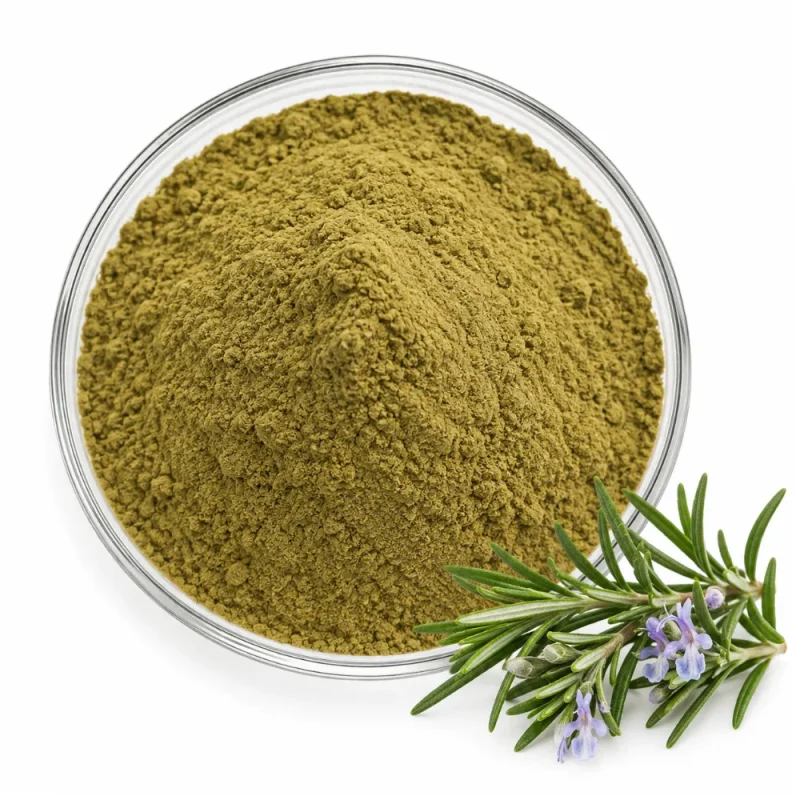
Rosemary Extract 5–20% Carnosic Acid

Rosemary extract is prepared from the leaves of Salvia rosmarinus, the evergreen Mediterranean shrub formerly called Rosmarinus officinalis, and not from the stems or the essential oil. Ethanol extraction takes up the diterpene phenols of the leaf, and the liquor is dried to a light brown powder.

The grade range is 5–20% carnosic acid by HPLC, and the primary grade is the 20% end. The powder is 80 mesh and insoluble in water. The 5% grade suits dry blends and oil-phase premixes, while the 20% grade carries a high marker load for compact capsules and tablets.

Carnosic Acid Standardization & Grades

Carnosic acid is a phenolic diterpene of the abietane type, a molecule with a three-ring skeleton and two adjacent hydroxyl groups on an aromatic ring. It is fat soluble and a strong antioxidant in oils and fats. It is the standardization target because it is the main diterpene of rosemary leaf and because a pure reference exists. The botanical entity is Salvia rosmarinus Spenn., a shrub of the Lamiaceae, and the part used is the leaf. The leaf also holds rosmarinic acid, a different, more polar phenolic acid, which the data for this product lists as a secondary marker.

GradeAssay & MethodWhere It Fits
5% Carnosic AcidHPLCDry blends and oil-phase premixes
20% Carnosic AcidHPLCCapsules and tablets with small fill

The two grades differ by a factor of four. The 20% grade is a diterpene concentrate that supplies a defined load from a small fill. The 5% grade holds more of the rosmarinic acid, flavonoids and plant solids of the leaf, so rosemary extract at this level is bulkier and suits dry blends and oil-phase premixes. The leaf is also supplied as a 10:1 ratio extract, the Rosemary Extract Powder, as a milled leaf, the Rosemary Powder, and the water-soluble phenolic acid as the purified compound Rosmarinic Acid 98%. Carnosic acid and rosmarinic acid are different markers, and a grade names one or both. Rosemary leaves are needle-like and leathery, and the fat-soluble diterpenes sit in the leaf resin.

Carnosic Acid Analysis & Purity Risks

The two grades are each read by HPLC against a carnosic acid reference standard. The catechol ring absorbs ultraviolet light, so a UV detector gives a clean peak. A colorimetric polyphenol total would count the water-soluble phenolic acids as well, and it cannot be converted into an HPLC carnosic acid result. The data for this product lists rosmarinic acid and multi-marker grades as secondary information, and these appear as separate peaks.

Carnosic acid is the least stable of the rosemary phenolics. It oxidizes in air and light to carnosol, which is a lactone, and further to rosmanol and other products, so a chromatogram that shows a high carnosol peak beside a lowered carnosic acid peak tells of oxidation during drying or storage. The ratio of the two is therefore part of the fingerprint.

Sample preparation must protect the analyte. The powder is dissolved in an alcohol diluent that contains a mild acid, shielded from light and injected promptly, because carnosic acid degrades on standing in solution. A prepared sample left in light shows a falling peak.

Purity risks follow from the plant and the name. Rosemary is sold under the older name Rosmarinus officinalis and the current name Salvia rosmarinus for the same species. Rosemary oil and rosemary leaf powder are different materials, and a leaf extract without carnosic acid and carnosol is not a typical rosemary extract. A stated species, the leaf as the plant part and the diterpene pattern are the first checks.

Typical Specifications

Specification ItemProduct Information
Latin NameSalvia rosmarinus
Plant PartLeaf & Herb
ProcessingEthanol Extraction
Compound ClassTerpenoids
Common NameRosemary
Ingredient TypeStandardized Extract
Marker Compound(s)Carnosic acid (phenolic abietane diterpene)
Primary Grade20% Carnosic Acid (HPLC)
Available Grades5% · 20% Carnosic Acid (HPLC)
AppearanceLight Brown powder
Solubility / DispersibilityInsoluble in Water
Quality Parameters
Moisture (LOD)≤5.0%
Total Ash≤5.0%
Particle Size80 mesh
Heavy MetalsLead ≤2 ppm · Arsenic ≤1 ppm · Cadmium ≤1 ppm · Mercury ≤0.1 ppm
MicrobiologyTPC ≤1,000 cfu/g · Yeast & Mold ≤100 cfu/g · E. coli Negative · Salmonella Negative/25 g
Shelf Life24 months in unopened original packaging, cool and dry storage

Applications by Grade

20% Grade for Compact Capsules

The 20% grade delivers a diterpene load from a small fill, which suits capsules and tablets. The light brown powder is fat soluble, cohesive and slightly resinous, so a glidant helps hopper flow, and a cool, dry room limits smearing.

20% Grade in Tablet Blends

Tablets of the 20% grade need an absorbent filler and a dry binder, because the resinous fraction softens compacts and sticks to punches. Coat the tablet against oxygen, and check hardness and odor after storage in a warm room.

5% Grade in Dry Blends

Dry blends use the 5% grade with other herbs and spices. The powder is insoluble in water and gives a grainy dispersion, so pre-blend it with part of the carrier and expect a pronounced herbal, camphor-like note in the finished blend.

5% Grade in Oil-Phase Premixes

Oil-phase premixes carry the 5% grade as a fine dispersion, where the fat-soluble phenols can sit beside the oil. Keep the oil temperature low and the blend away from air, since carnosic acid oxidizes quickly when it is warm.

5% Grade in Softgel Fills

Softgel fills accept the 5% grade as a milled suspension in oil. The lipophilic solid disperses readily, and particle size and a suspending agent decide whether the fill stays uniform. A nitrogen blanket during filling slows oxidation.

20% Grade in Stick Packs

Stick packs carry the 20% grade at a small fill with a flow agent. The powder is insoluble in water and gives a hazy, herbal suspension, so use a suspension aid, seal the pack against oxygen, and note the strong rosemary taste.

Technical & Quality Considerations

The extract is a light brown powder with a strong, resinous, camphor-like rosemary odor and a bitter, pungent taste. The diterpene phenols are fat soluble and oxidize in air, light and heat, so oxygen exposure is the main stability risk for the lot.

For production, sieve the powder before blending to break up soft agglomerates, and add a glidant, since the resinous particles cling to hoppers and filling machines. Fill capsules in a cool room, because warm air softens the resinous fraction and the powder will smear on the pins.

Protect the drum from oxygen and light with a sealed liner, and store it in a cool place. An oxygen scavenger or a nitrogen headspace in the pack slows the loss of carnosic acid. Compare each lot with a retained sample for color, odor and the carnosic acid and carnosol peaks. Clean the line with a solvent wash after a run, since the resin builds up on contact parts and carries the odor into the next product. A retained sample from each lot, tested again near the end of shelf life, shows whether the packaging holds the carnosic acid figure, which falls first when oxygen reaches the powder.

Rosemary extract is a strong-smelling, resinous powder, and a sample tested in the blend before scale-up shows whether the camphor-like note carries into the other ingredients or the finished capsule.

Packaging & Commercial Supply

Essencefield supports product evaluation, formulation trials, commercial orders, and ongoing ingredient supply. Packaging, storage, and shipping arrangements are determined by product characteristics, order quantity, stability requirements, and destination-market needs.

Supply ItemGeneral Information
SampleAvailable upon request for formulation, testing, and supplier evaluation
Order Quantities100 g · 1 kg · 5 kg · 25 kg · 100 kg · 500 kg · Bulk
Sample Lead TimeTypically 5–7 days after sample confirmation
Production Lead TimeTypically 15–30 days after order and specification confirmation
PackagingSuitable protective inner packaging with bags, cartons, drums, or other appropriate outer packaging
StorageStore in tightly sealed, suitable protective packaging in a cool, dry environment. Protect from moisture, heat, and direct sunlight. Specific storage conditions follow the approved product specification.
DocumentationCOA · Product Specification · TDS · SDS · Applicable declarations (as applicable)

Final order quantities, lead times, packaging, documentation, and shipping arrangements are confirmed according to the selected product and commercial requirements.

Request Ingredient Specifications & Quote

Share your target specification, application, quantity, and documentation needs. We’ll help confirm suitable options, samples, and commercial supply details.