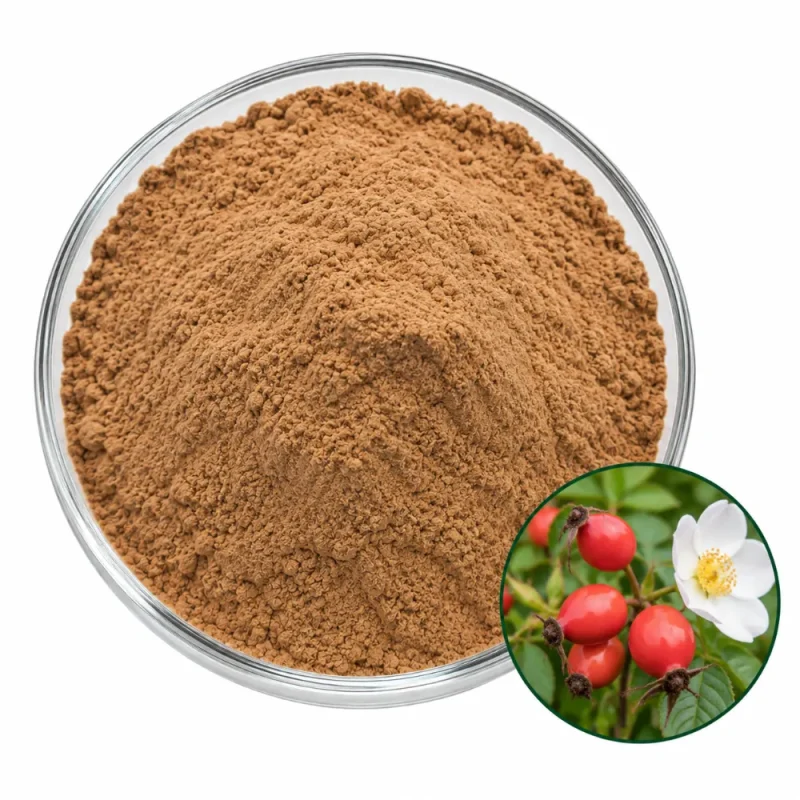
Cherokee Rose Fruit Extract Powder

Cherokee rose fruit extract starts from the ripe hips of Rosa laevigata Michx., a climbing evergreen rose, and not from the garden rose or the common dog rose. Water extraction concentrates the soluble fraction of the hip flesh, and the liquor is dried into a light brown powder.

The extract ratio is 10:1, the powder is milled to 80 mesh, and it is water dispersible. It is a plain ratio extract with no marker figure, so the only quantity that defines the product is the ratio, and the fruit alone is the starting material.

Cherokee Rose Fruit Identity & Plant Part

Rosa laevigata Michx. is a climbing evergreen rose native to southern China and Taiwan, grown in the southern United States, where it is known as the Cherokee rose. The part used is the fruit, the pear-shaped hip covered in stiff bristles that is cleaned of its seeds and hairs before use. Flowers, leaves and roots are not used. The fruit is sometimes confused with the hips of Rosa canina and with the chestnut rose, Rosa roxburghii, which is a different species with its own trade name. The hips hold sugars, organic acids, tannins, flavonoids and polysaccharides. These are named as families only, because no constituent figure is claimed.

The fruit is also known as jin ying zi, and the name Cherokee rose describes the plant rather than the part.

What 10:1 Means for Cherokee Rose Fruit

The 10:1 ratio means ten parts of dried hip stand behind each part of extract. It does not describe vitamin, acid or tannin content, and hips from different harvests can differ widely in sugar and acid levels. The water extract carries the sweet and sour soluble fraction and leaves the seeds and bristles out of the powder. Buyers choose a Cherokee rose fruit ratio extract when they want a fruit-derived, dispersible powder with a sweet-sour taste and a mild, fruity profile, and they do not need a single-compound specification.

Typical Specifications

Specification ItemProduct Information
Latin NameRosa laevigata
Plant PartFruit & Berry
ProcessingWater Extraction
Common NameCherokee Rose Hip
Ingredient TypeRatio Extract
Extract Ratio10:1
AppearanceLight Brown powder
Solubility / DispersibilityWater Dispersible
Quality Parameters
Moisture (LOD)≤5.0%
Total Ash≤5.0%
Particle Size80 mesh
Heavy MetalsLead ≤2 ppm · Arsenic ≤1 ppm · Cadmium ≤1 ppm · Mercury ≤0.1 ppm
MicrobiologyTPC ≤1,000 cfu/g · Yeast & Mold ≤100 cfu/g · E. coli Negative · Salmonella Negative/25 g
Shelf Life24 months in unopened original packaging, cool and dry storage

Application Areas

Gummies with Sweet-Sour Taste

Cherokee rose fruit extract powder blends into gummy mass after the cooking step. Its sweet-sour taste and brown tint suit fruit flavor systems based on apple, pear or citrus, where the color becomes part of the design and does not need to be masked.

Capsules for Fruit Extract Blends

In capsules the Cherokee rose fruit extract is filled alone or beside other fruit and herb extracts. Because the soluble sugars and acids pull moisture from air, fill soon after opening the drum and keep humidity low in the filling room to hold flow.

Fruit-Based Drink Powders

In drink powders the extract dissolves readily into a brown-amber liquid with a fruity, slightly acidic taste. Pair it with a sweetener and a citrus or honey flavor and mix thoroughly, since fine fruit fibers may settle in a still drink.

Chewable Tablets

Chewable tablets take the Cherokee rose fruit extract with a dry binder and sweetener, where the fruity acidity supports the flavor. A coat or lined blister helps against softening in humid markets, and compression force should be tested because sugary powders can stick to punches.

Formulation Notes

The powder is light brown with a fruity, mildly caramel-like smell and a sweet-sour taste. In water it makes an amber to brown dispersion that is mostly clear, with a faint haze from insoluble fruit matter. The sugar and organic acid content makes it more hygroscopic than most root or herb extracts.

Weigh the powder in a low-humidity room and do not leave a drum open on the line. When blending with dry acids or carbonates, check for early reaction in the presence of humidity, because fruit acids can start fizzing in a sealed pouch. Keep the container sealed and cool.

The extract has no strong aroma to protect, so heat during mixing is less of a concern than for herb extracts. Color can deepen slowly on storage, which is expected for sugar-rich fruit material.

Packaging & Commercial Supply

Essencefield supports product evaluation, formulation trials, commercial orders, and ongoing ingredient supply. Packaging, storage, and shipping arrangements are determined by product characteristics, order quantity, stability requirements, and destination-market needs.

Supply ItemGeneral Information
SampleAvailable upon request for formulation, testing, and supplier evaluation
Order Quantities100 g · 1 kg · 5 kg · 25 kg · 100 kg · 500 kg · Bulk
Sample Lead TimeTypically 5–7 days after sample confirmation
Production Lead TimeTypically 15–30 days after order and specification confirmation
PackagingSuitable protective inner packaging with bags, cartons, drums, or other appropriate outer packaging
StorageStore in tightly sealed, suitable protective packaging in a cool, dry environment. Protect from moisture, heat, and direct sunlight. Specific storage conditions follow the approved product specification.
DocumentationCOA · Product Specification · TDS · SDS · Applicable declarations (as applicable)

Final order quantities, lead times, packaging, documentation, and shipping arrangements are confirmed according to the selected product and commercial requirements.

Request Ingredient Specifications & Quote

Share your target specification, application, quantity, and documentation needs. We’ll help confirm suitable options, samples, and commercial supply details.