Echinacea purpurea Polysaccharide Identity
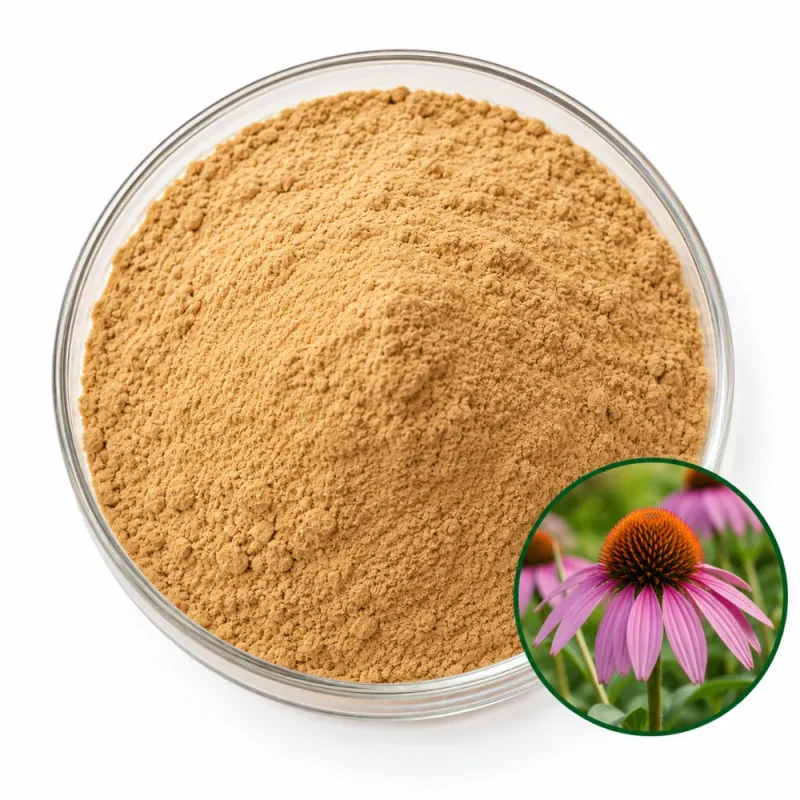
Echinacea purpurea polysaccharide powder is made from the aerial parts of Echinacea purpurea (L.) Moench, the purple coneflower: leaf, stem and flowering top. Echinacea purpurea root is not used. Two other species, Echinacea angustifolia and Echinacea pallida, are sold under the same family name but differ in chemistry, and they are not part of this material.
The water-soluble polymers described for this herb fall into a few groups. Arabinogalactan-proteins are branched, protein-bearing chains rich in arabinose and galactose, and a 4-O-methylglucuronoarabinoxylan is a second well-known component. Rhamnogalacturonan-type and xyloglucan fragments are also reported. Chain length and protein content differ between preparations, so the name covers a family of related polymers.
The phenolic and lipophilic constituents of the herb, such as cichoric acid and the alkylamides, are separate compounds. Hot-water extraction followed by ethanol precipitation keeps large polymers and discards much of the phenolic fraction, while alkylamides stay out because they dissolve in lipid and not in water.
Aerial parts are cut at flowering, dried and sorted before extraction, and the proportions of leaf, stem and flower head change between lots. Because the carbohydrate fraction is concentrated by purification, Echinacea purpurea polysaccharide is much less sensitive to that proportion than the whole herb or its phenolic extract.
Related Echinacea products define different parts of the plant. Echinacea Powder is the milled herb, Echinacea Purpurea Extract Powder is a ratio extract, and Echinacea Extract 4% Polyphenols is defined by a phenolic assay.