Rye Beta-Glucan Identity
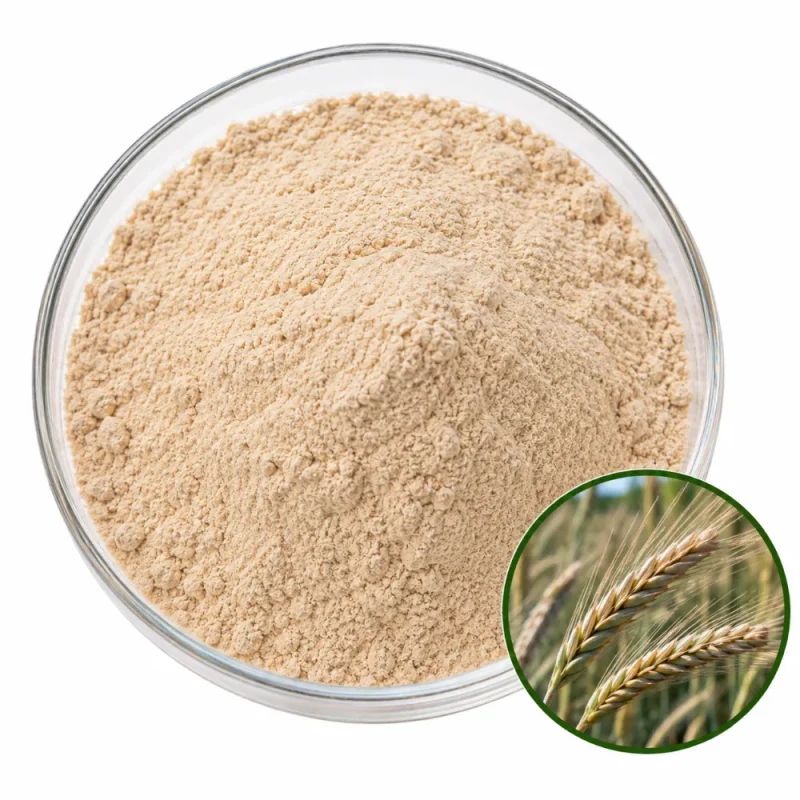
Rye beta-glucan powder is made from the grain of Secale cereale L., the cereal rye. The glucan sits in the cell walls of the starchy endosperm and in the aleurone layer, and the purified powder is built from it. Rye is known for a high content of dietary fiber, but most of that fiber is not glucan, and this product is defined by the glucan itself.
Rye’s cell walls are dominated by arabinoxylan, a branched xylose polymer that is the main pentosan of the grain and is far more abundant than β-glucan. The β-glucan of rye is the same mixed-linkage type as in barley and oats, with β-(1→4) runs of three or four units separated by single β-(1→3) bonds. Because arabinoxylan co-extracts with it, purification must separate the two.
Extraction in warm water, enzyme treatment to remove starch and arabinoxylan, and ethanol precipitation produce a fraction in which the glucan is the majority component. The result is a fiber concentrate that behaves differently from rye flour, in which the glucan is a small share of a starch-rich mass.
Rye is also sold as a milled grain. Rye Powder is the ground kernel, specified as a food powder and not by a glucan assay, and it is a different product from this one.
Rye is harvested as a winter or spring crop and the grain is cleaned and dried before milling. The glucan content of the grain varies with variety and season, which is why the finished powder is specified by an assay and not by the grain it starts from.