Astragalus Polysaccharide Identity
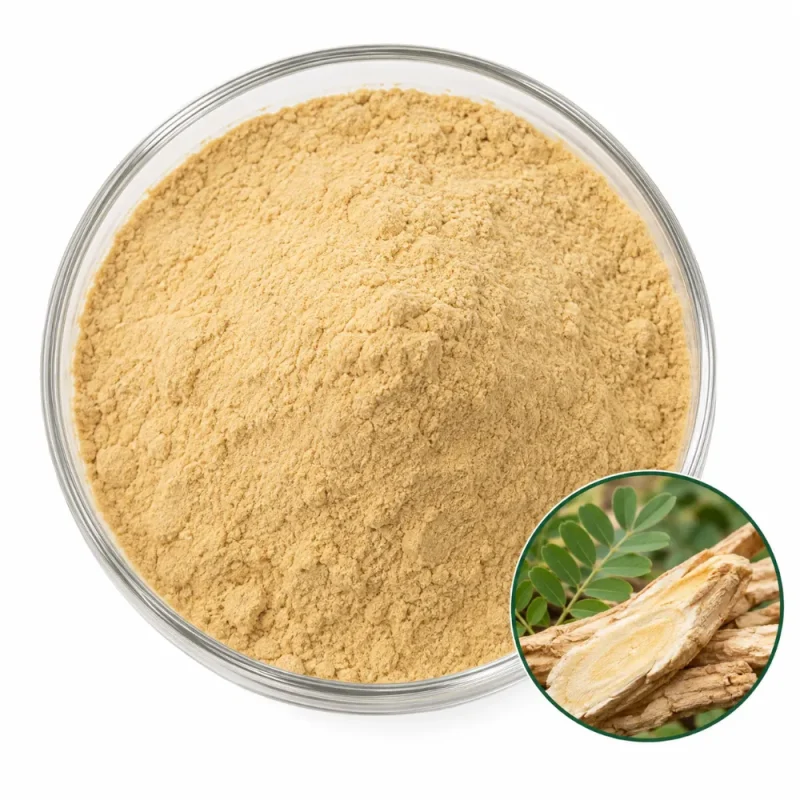
The source is the root of Astragalus membranaceus (Fisch.) Bunge, a perennial legume of the family Fabaceae. Current taxonomic databases treat the name as a synonym of Astragalus mongholicus, and pharmacopeial sources describe huang qi as the root of A. membranaceus or of its variety mongholicus. This ingredient is listed under the name Astragalus membranaceus, and the root of the plant is the only part used. Astragalus membranaceus polysaccharide is therefore a root-derived carbohydrate fraction, and stems, leaves, pods and seeds do not enter the material. The genus contains thousands of species, and North American locoweeds are not the source of this ingredient.
The root is rich in starch, which matters for a polysaccharide product. Literature on astragalus describes two main groups of polymers in the root: glucans built on an α-(1→4) backbone, which are starch-like, and acidic heteropolysaccharides carrying arabinose, galactose, rhamnose and uronic acids. Water extraction recovers both groups together with free sugars, so purification has to remove the small sugars and reduce the starch to leave a polysaccharide-led solid. The saponins and isoflavones of the root are separate chemistry and are mostly left behind.
The same plant is available in other forms: Astragalus Root Extract Powder is a 10:1 ratio extract with no content figure, Astragalus Root Powder is the milled root, and Astragalus Extract 20–50% Polysaccharides is a separate extract sold in a graded range.