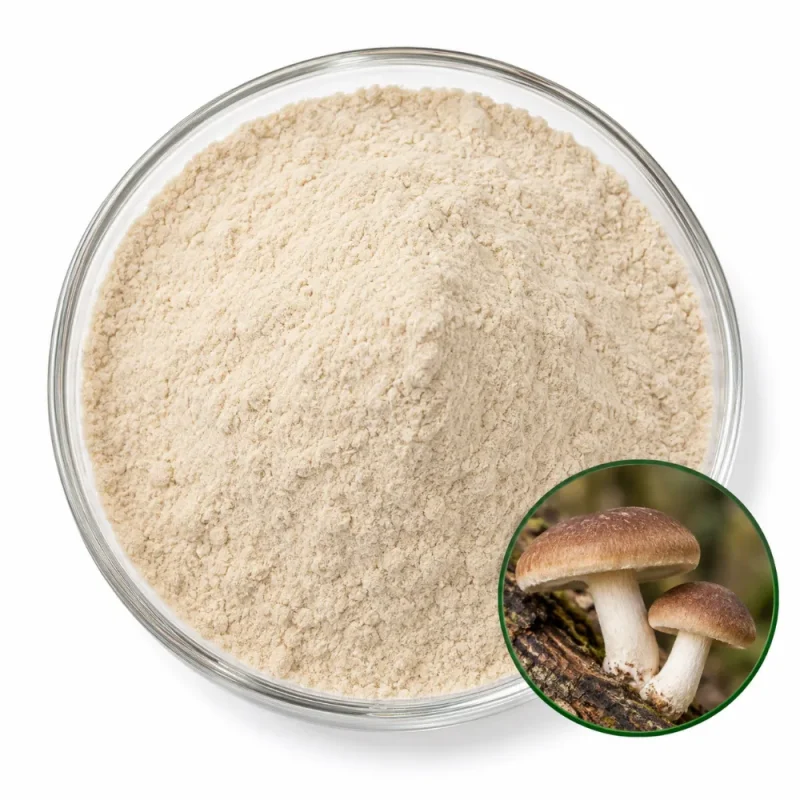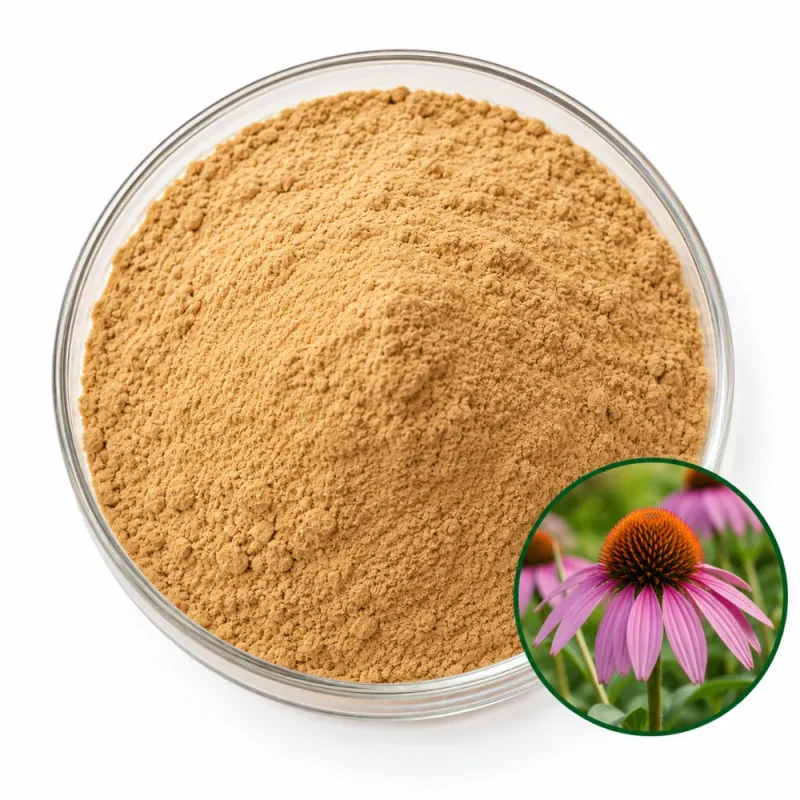
Echinacea purpurea Polysaccharide Powder

Made from the aerial parts of Echinacea purpurea, this polysaccharide powder holds the water-soluble carbohydrate fraction of the herb and not its phenolic or alkylamide fractions. The fraction is purified and dried to a fine light yellow powder that dissolves in water.

Polysaccharide content is ≥30% by UV-Vis (phenol–sulfuric, as glucose), moisture and total ash are each ≤5.0%, and the powder is milled to 80 mesh. It is supplied to brands developing dietary supplements, functional beverages and functional foods, and the method is stated with the figure.

Echinacea purpurea Polysaccharide Identity

Echinacea purpurea polysaccharide powder is made from the aerial parts of Echinacea purpurea (L.) Moench, the purple coneflower: leaf, stem and flowering top. Echinacea purpurea root is not used. Two other species, Echinacea angustifolia and Echinacea pallida, are sold under the same family name but differ in chemistry, and they are not part of this material.

The water-soluble polymers described for this herb fall into a few groups. Arabinogalactan-proteins are branched, protein-bearing chains rich in arabinose and galactose, and a 4-O-methylglucuronoarabinoxylan is a second well-known component. Rhamnogalacturonan-type and xyloglucan fragments are also reported. Chain length and protein content differ between preparations, so the name covers a family of related polymers.

The phenolic and lipophilic constituents of the herb, such as cichoric acid and the alkylamides, are separate compounds. Hot-water extraction followed by ethanol precipitation keeps large polymers and discards much of the phenolic fraction, while alkylamides stay out because they dissolve in lipid and not in water.

Aerial parts are cut at flowering, dried and sorted before extraction, and the proportions of leaf, stem and flower head change between lots. Because the carbohydrate fraction is concentrated by purification, Echinacea purpurea polysaccharide is much less sensitive to that proportion than the whole herb or its phenolic extract.

Related Echinacea products define different parts of the plant. Echinacea Powder is the milled herb, Echinacea Purpurea Extract Powder is a ratio extract, and Echinacea Extract 4% Polyphenols is defined by a phenolic assay.
Polysaccharide Content & Test Method

The content figure is polysaccharides ≥30% by UV-Vis, a total-carbohydrate measurement. In the phenol–sulfuric reaction, hot sulfuric acid hydrolyses the polymer, phenol turns the released sugars into a colored product, and absorbance is read against glucose. The number is a glucose equivalent and counts any component that releases sugar under those conditions.

Echinacea purpurea aerial parts raise a specific question: how much of that sugar belongs to the arabinogalactan-proteins and how much to free sugars or pectin. A crude herb extract contains small sugars, and the ethanol step in purification removes most of them before drying. The 30% figure belongs to the dried powder, not to the extract before precipitation.

Because the arabinogalactan-proteins carry protein, a Kjeldahl nitrogen value and a carbohydrate value can be reported for the same sample, and they are not additive. A gravimetric precipitate weight would include protein and tannin, and an enzymatic assay is built for one linkage. Only the UV-Vis value is stated for this grade, and it makes no claim about cichoric acid or alkylamide content.

Typical Specifications

Specification ItemProduct Information
Latin NameEchinacea purpurea
Plant PartLeaf & Herb
ProcessingWater Extraction & Purification
Common NamePurple coneflower (Echinacea)
Ingredient TypePolysaccharide Extract
Polysaccharide TypeArabinogalactan-proteins and arabinoxylan-type heteropolysaccharides
ContentPolysaccharides ≥30% (UV-Vis, as glucose)
AppearanceLight Yellow powder
Solubility / DispersibilityWater Soluble
Quality Parameters
Moisture≤5.0% (LOD)
Total Ash≤5.0%
Particle Size80 mesh
Heavy MetalsLead ≤2 ppm · Arsenic ≤1 ppm · Cadmium ≤1 ppm · Mercury ≤0.1 ppm
MicrobiologyTPC ≤1,000 cfu/g · Yeast & Mold ≤100 cfu/g · E. coli Negative · Salmonella Negative/25 g
Shelf Life24 months in unopened original packaging, cool and dry storage

Echinacea purpurea Polysaccharide Solution Behavior

Echinacea purpurea polysaccharide dissolves in water to a light yellow, clear to faintly hazy solution. The branched, protein-bearing chains are compact, so viscosity stays modest at normal use levels and the solution pours easily. Cold water dissolves it more slowly than warm, and sifting the powder into the vortex avoids lumps.

Echinacea purpurea polysaccharide is heat-tolerant at neutral and mildly acidic pH, so it survives hot-fill and pasteurization. The protein part can undergo Maillard browning when the solution is heated with reducing sugars for a long time, and the effect shows as a darker tint in sweetened ready-to-drink formats.

Polyphenols from tea, fruit or herbal bases can bind the protein portion and produce haze, so mixtures with strongly tannic extracts are worth testing at the intended concentration. The mild, slightly grassy aroma of the herb is largely removed during purification and is faint in solution.

Enzymes in unpasteurized juice bases can cut the glycosidic chains and reduce viscosity over time, so an enzyme-inactivated base is preferred for any Echinacea purpurea polysaccharide formula. No viscosity or molecular weight values are stated for this grade.

Application Areas

Capsules Beside Phenolic Extracts

Echinacea purpurea polysaccharide pairs with a polyphenol extract in one capsule to cover the water-soluble polymer and phenolic fractions of the herb. The two powders differ in density, so a pre-blend with a flow agent keeps the fill weight steady.

Lozenge and Drop Bases

Cooked hard-candy and soft-lozenge bases can carry the powder when it is added after the syrup cools. The mild flavor does not clash with menthol or citrus, and the pale tint is invisible in amber bases, which keeps the finished lozenge consistent from the first batch to scale-up.

Single-Dose Sachets

Stick packs of the polysaccharide with soluble fiber dissolve into a light-yellow drink in cold water. A laminate with a moisture barrier keeps the hygroscopic powder from caking before use, and a short pre-blend with sweetener helps each sachet empty without leaving residue.

Herbal Tea Powders

Instant tea granules with this ingredient dissolve completely in hot water and add body. Strongly tannic teas can cloud, so tea type and strength should be matched in the trial, and the cup should be checked after it cools to drinking temperature.

Functional Beverage Shots

Small-volume shots tolerate the polysaccharide at modest inclusion, and an acidic base keeps the solution clear. Check color after hot filling, because the protein part browns slowly with sugar, and compare the shot against an unsweetened control for clarity.

Packaging & Commercial Supply

Essencefield supports product evaluation, formulation trials, commercial orders, and ongoing ingredient supply. Packaging, storage, and shipping arrangements are determined by product characteristics, order quantity, stability requirements, and destination-market needs.

Supply ItemGeneral Information
SampleAvailable upon request for formulation, testing, and supplier evaluation
Order Quantities100 g · 1 kg · 5 kg · 25 kg · 100 kg · 500 kg · Bulk
Sample Lead TimeTypically 5–7 days after sample confirmation
Production Lead TimeTypically 15–30 days after order and specification confirmation
PackagingSuitable protective inner packaging with bags, cartons, drums, or other appropriate outer packaging
StorageStore in tightly sealed, suitable protective packaging in a cool, dry environment. Protect from moisture, heat, and direct sunlight. Specific storage conditions follow the approved product specification.
DocumentationCOA · Product Specification · TDS · SDS · Applicable declarations (as applicable)

Final order quantities, lead times, packaging, documentation, and shipping arrangements are confirmed according to the selected product and commercial requirements.

Request Ingredient Specifications & Quote

Share your target specification, application, quantity, and documentation needs. We’ll help confirm suitable options, samples, and commercial supply details.