Laminarin Identity
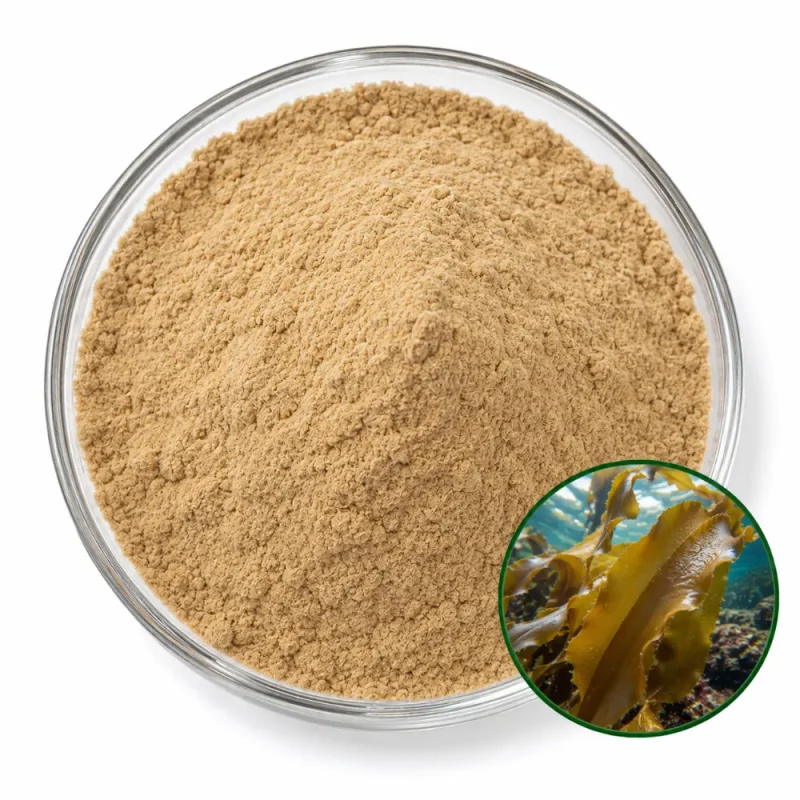
Laminarin powder comes from Laminaria digitata (Huds.) J.V.Lamour., the oarweed or tangle, a brown seaweed whose frond, called the thallus, is the source. Laminarin is the storage glucan of brown algae. It accumulates in the fronds through summer and into autumn and is drawn down in winter and spring, so the season of harvest affects how much glucan the seaweed holds.
The molecule is a short chain of glucose units joined by β-(1→3) bonds, with β-(1→6) branches along the chain. The chains are small compared with cereal glucans, a few thousand daltons, and they come in two types: one ends in a glucose unit and the other in the sugar alcohol mannitol. The degree of branching decides solubility, and the laminarin of Laminaria digitata is the cold-water-soluble type, unlike less branched forms from some other kelp species.
Laminarin is a glucan, not a sulfated fucoidan, and it is not the same as the alginate that makes up much of kelp’s structure. Extraction in warm, mildly acid water, followed by removal of alginate and fucoidan, leaves laminarin in solution, and it is then concentrated and dried. Free mannitol, which is abundant in kelp, is also removed as far as possible.
Laminarin differs from other β-glucans in the catalog by linkage and solubility: paramylon is linear and insoluble, cereal glucans carry mixed β-(1→3) and β-(1→4) bonds, and yeast glucan is a particulate. Brown algae also accumulate arsenic from seawater, which is why the metal limits matter for seaweed ingredients.