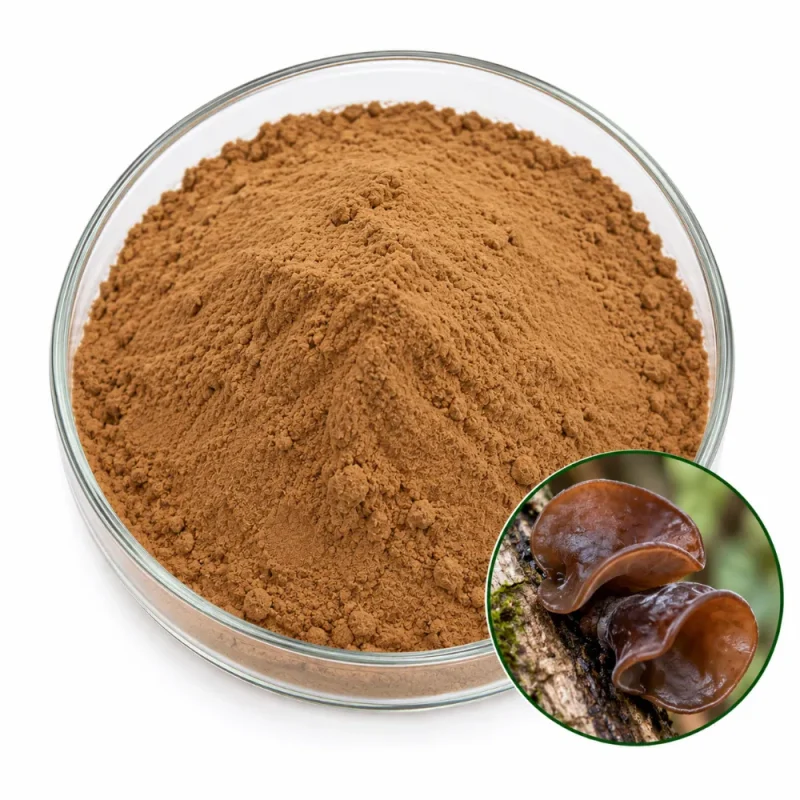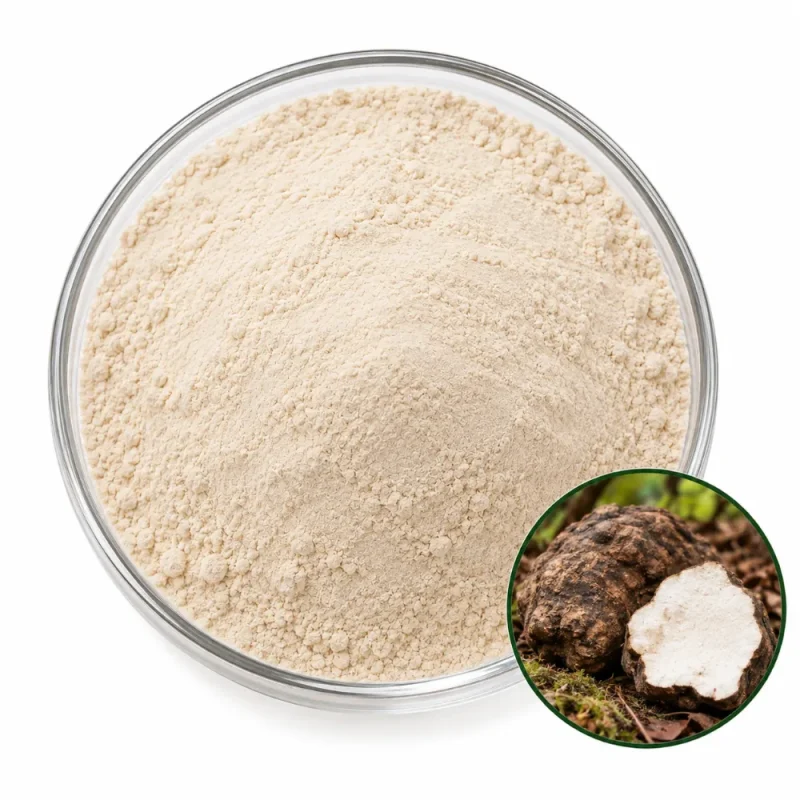
Poria cocos Polysaccharide Identity
Poria cocos polysaccharide powder is made from the sclerotium of Poria cocos F.A.Wolf, known as fuling or hoelen, a fungus that grows underground on the roots and stumps of pine. Current databases treat the name as a synonym of Wolfiporia cocos, and the two names refer to the same organism. The part used is the sclerotium, a dense mass of fungal tissue, and not a fruiting body.
In Chinese trade Poria cocos sclerotium is cut into parts: a white inner part, a reddish outer part, the peel and a piece with the pine root still embedded. Each has its own use, and the white inner tissue is the most carbohydrate-rich. The specification here covers the fungus as a source and not a particular cut.
The dominant carbohydrate of dry Poria cocos sclerotium is a β-(1→3)-glucan with some β-(1→6) branches, called pachyman. Pachymaran is the name given to the β-(1→3)-glucan fraction prepared from it. These chains are long and tightly associated, which is why they do not dissolve in water but swell and disperse as fine particles, and why the powder behaves as an insoluble fiber and not as a viscous gum.
The fungus is better known to analysts for its triterpene acids, such as pachymic acid, which dissolve in organic solvents and are separate compounds from the glucan. Pachymic Acid 98% is the purified triterpene, Poria cocos Powder is the milled sclerotium, and Poria Cocos Extract Powder is a ratio extract.