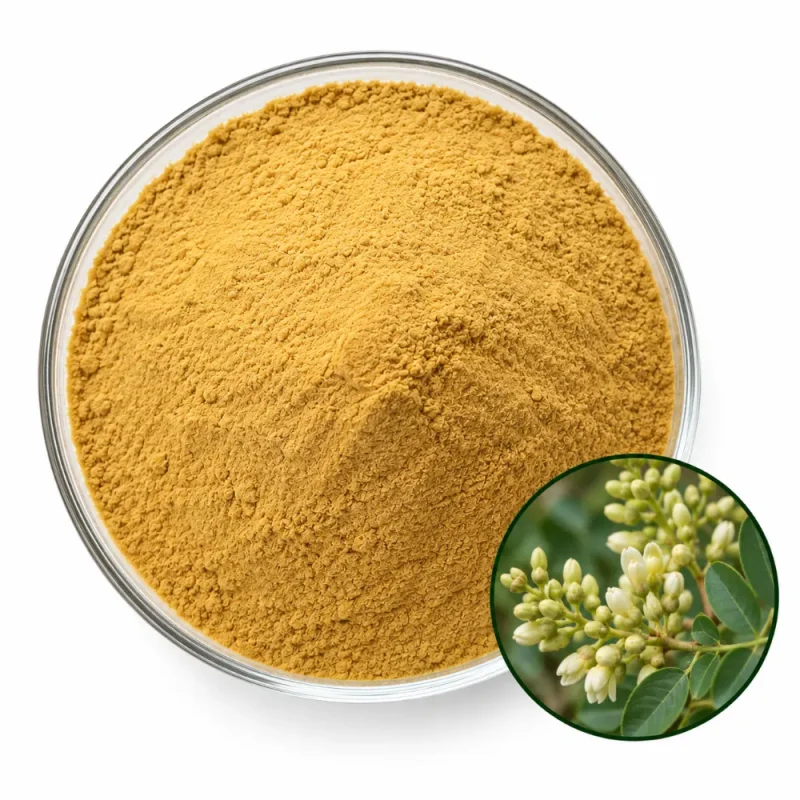
Sophora japonica Extract 95% Rutin

A near-pure flavonol glycoside is obtained from the flowers and flower buds of Sophora japonica, the Japanese pagoda tree known as huai hua, and not from the root of Sophora flavescens or from buckwheat, another commercial rutin source. Extraction and crystallization concentrate the rutin in this Sophora japonica extract, and the product is dried to a light yellow powder.

The grade is 95% rutin by HPLC, supplied as an 80 mesh powder that is slightly soluble in water. It is meant for capsules, tablets, powder sticks and premixes in which rutin must be quantified as the named compound and not as a general flavonoid group.

Rutin Standardization & Grades

Rutin is quercetin carrying the disaccharide rutinose at the 3-position: one rhamnose unit joined to one glucose unit. It is the dominant flavonoid of sophora flower buds, which is why this plant became the classic commercial source. At 95% the Sophora japonica powder is much closer to an isolated compound than to a botanical extract, and the remainder consists of related flavonoids such as quercetin, kaempferol glycosides and isorhamnetin glycosides. The botanical entity is Sophora japonica L., and the part used is the flower.

The page carries a single grade, so the decision is about format, particle behavior and solubility. Rutin crystallizes readily and has a low solubility in cold water, so the powder is best viewed as a crystalline ingredient, closer to a purified compound than a plant extract. Compounds from the same chemical family are the aglycones Quercetin 98% and Quercetin Dihydrate 99%, and the related flavonol Kaempferol 98%.

The difference between rutin and quercetin is a matter of the sugar. Rutin is the glycoside, quercetin the aglycone left after the rutinose is removed, and the two behave differently in solubility, taste and stability. Buyers who compare quotes should check that the compound named is rutin and that the part and species are stated, because rutin also comes from buckwheat and from Dimorphandra pods.

A rutin percentage must also state its basis. The figure can be expressed on an anhydrous or an as-is basis, which changes the number by a few points. This is why the HPLC value is read against a reference standard of defined form.

Rutin Analysis & Purity Risks

The marker is measured by HPLC, which separates rutin from quercetin, isoquercitrin and the other flavonoids on a reversed-phase column, identifies the peak by retention time and UV spectrum, and quantifies it against a reference standard. A UV total flavonoid reading counts all flavonoids together and cannot name rutin, so it is not comparable with the HPLC result.

For a 95% product, the chromatogram should be clean, with rutin as a single dominant peak and a few small neighbors. The size of the quercetin peak is informative, because rutin loses its sugar under acid or enzymatic conditions and a large quercetin peak shows that the material has been hydrolyzed. Isoquercitrin, the glucoside of quercetin, appears as an intermediate when hydrolysis is partial.

Because rutin dissolves slowly, sample preparation needs warm methanol or a dimethyl sulfoxide mixture and a defined sonication time. An incomplete dissolution gives a low and variable result, so the preparation protocol is as important as the column itself.

Purity risks follow from the raw material. Rutin from Sophora japonica buds, buckwheat and Dimorphandra is chemically the same molecule, so the HPLC figure alone does not show the botanical origin. Species, the flower part and the minor flavonoid pattern provide that information. Quercetin or other flavonoid additions would change the minor peaks, which is why the full chromatogram is read, not only the rutin value.

Typical Specifications

Specification ItemProduct Information
Latin NameSophora japonica
Plant PartFlower
ProcessingEthanol Extraction
Compound ClassFlavonoids, Polyphenols
Common NameSophora, Japanese Pagoda Tree Flower, Huai Hua
Ingredient TypeStandardized Extract
Marker Compound(s)Rutin (quercetin-3-O-rutinoside of Sophora japonica flowers)
Primary Grade95% Rutin (HPLC)
AppearanceLight Yellow powder
Solubility / DispersibilitySlightly Soluble in Water
Quality Parameters
Moisture (LOD)≤5.0%
Total Ash≤5.0%
Particle Size80 mesh
Heavy MetalsLead ≤2 ppm · Arsenic ≤1 ppm · Cadmium ≤1 ppm · Mercury ≤0.1 ppm
MicrobiologyTPC ≤1,000 cfu/g · Yeast & Mold ≤100 cfu/g · E. coli Negative · Salmonella Negative/25 g
Shelf Life24 months in unopened original packaging, cool and dry storage

Applications by Grade

Rutin Capsules With Small Fill

The 95% grade delivers a rutin target in a small capsule fill. The light yellow powder is fine and crystalline, so it flows better than most plant extracts, though static can cause bridging, and fill weights should be checked at the start of each run.

Rutin Tablet Blends

Tablets compress well with rutin because the crystalline particles pack tightly, but the compacts can be brittle. Use a dry binder with some plasticity, run a compression trial on the full blend and check friability after storage.

Powder Sticks With Co-Solvents

Rutin dissolves poorly in cold water, so sticks rely on dispersion, a warm drinking temperature or co-ingredients that raise solubility. The powder gives a pale yellow suspension that settles on standing, and stirring just before drinking restores uniformity.

Flavonoid Premixes With Vitamin C

Premixes often pair rutin with ascorbic acid in dry blends, since the two are widely combined in formulation. Keep the premix dry, because moisture promotes oxidation of both, and a desiccant in the pack protects the pale yellow tone.

Softgel Dispersions

In an oil-based softgel, the 95% grade is suspended as fine crystals. Mill the Sophora japonica powder to a fine size and stir during encapsulation, since the crystalline rutin settles faster than a plant extract and can change the dose from one capsule to the next.

Technical & Quality Considerations

The powder is light yellow with little odor and a slightly bitter taste. It is slightly soluble in water, dissolving mainly in hot water, and it tends to recrystallize as a fine yellow sediment on cooling. Rutin dissolves better in alkaline solution, though that also speeds oxidation and darkens the color, so alkaline systems are not recommended for storage.

Rutin is stable as a dry crystalline powder but is sensitive to light, high temperature and acid hydrolysis, which release quercetin and rutinose. Iron and other metal ions form dark complexes with the catechol group. Rutin is a crystalline glycoside that stays stable as long as it is kept dry and dark.

At production scale, pre-mix the powder with a portion of the carrier, because crystalline rutin can stratify from lighter excipients. Compare each lot with a retained sample for color and particle size, keep the drum closed and away from light and clean equipment between rutin and pale products since the yellow tint is easily transferred.

A Sophora japonica extract at this purity should look like a clean, light yellow crystalline powder with a single dominant rutin peak. Check the solution color in warm methanol, where a deep orange tint points to degradation, and keep a retained sample of each Sophora japonica extract lot. A growing quercetin peak shows that the glycoside is hydrolyzing, which is the main change to watch during storage.

Packaging & Commercial Supply

Essencefield supports product evaluation, formulation trials, commercial orders, and ongoing ingredient supply. Packaging, storage, and shipping arrangements are determined by product characteristics, order quantity, stability requirements, and destination-market needs.

Supply ItemGeneral Information
SampleAvailable upon request for formulation, testing, and supplier evaluation
Order Quantities100 g · 1 kg · 5 kg · 25 kg · 100 kg · 500 kg · Bulk
Sample Lead TimeTypically 5–7 days after sample confirmation
Production Lead TimeTypically 15–30 days after order and specification confirmation
PackagingSuitable protective inner packaging with bags, cartons, drums, or other appropriate outer packaging
StorageStore in tightly sealed, suitable protective packaging in a cool, dry environment. Protect from moisture, heat, and direct sunlight. Specific storage conditions follow the approved product specification.
DocumentationCOA · Product Specification · TDS · SDS · Applicable declarations (as applicable)

Final order quantities, lead times, packaging, documentation, and shipping arrangements are confirmed according to the selected product and commercial requirements.

Request Ingredient Specifications & Quote

Share your target specification, application, quantity, and documentation needs. We’ll help confirm suitable options, samples, and commercial supply details.