
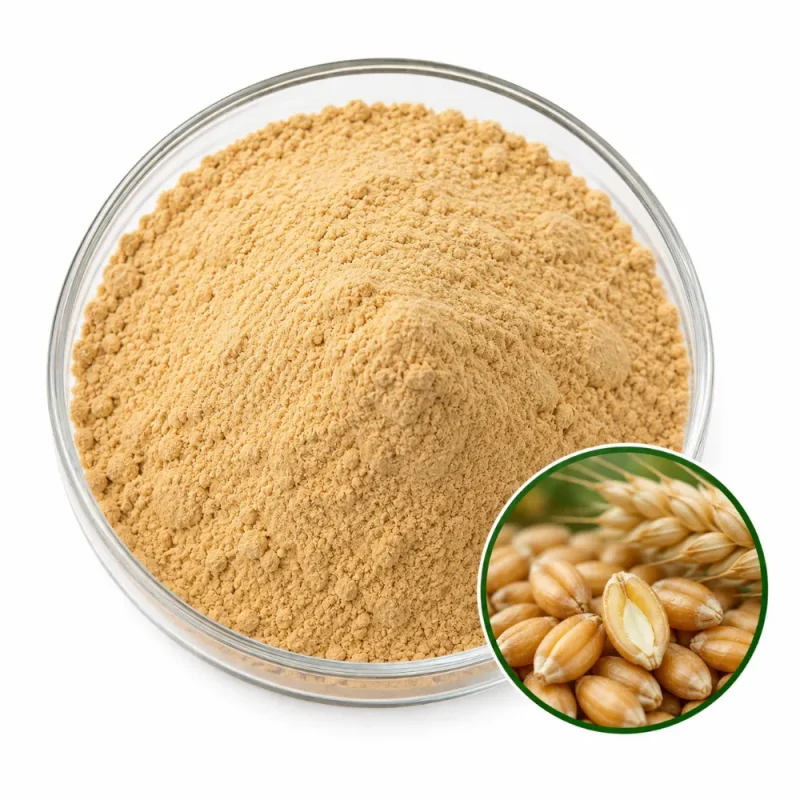
Spermidine Standardization & Grades
Spermidine is an aliphatic polyamine, a small molecule with three nitrogen atoms spaced along a flexible chain. It occurs in all living cells and is concentrated in the germ of cereals, where it sits beside spermine and putrescine. Wheat germ is among the richest common food sources. The free base is hygroscopic and air sensitive, and it is often handled as a salt, with the trihydrochloride the usual commercial form. Wheat germ extract is standardized to spermidine because the compound is the defining polyamine of the germ and can be quantified against a reference standard.
The botanical entity is Triticum aestivum L., and the part is the germ, not the whole kernel and not the young green plant. Wheat germ, wheat bran and milled wheat are three different fractions of the grain, and wheat grass is another material altogether. The same germ is supplied as a 10:1 ratio extract with no marker figure, Wheat Germ Extract Powder, as a hydrolyzed protein fraction, Wheat Germ Peptide Powder, and as the single compound Spermidine.
| Grade | Assay & Method | Where It Fits |
|---|---|---|
| 0.1% Spermidine | HPLC | Drink powders, bulk blends |
| 1% Spermidine | HPLC | Capsules and tablets, lower fill |
The 1% grade carries ten times the spermidine per gram, so a capsule or tablet reaches its target with a smaller charge. The 0.1% grade is bulky and behaves like a concentrated germ extract in blends. The extract is made from stabilized germ, which is heat treated to inactivate lipase, defatted, extracted and concentrated.


