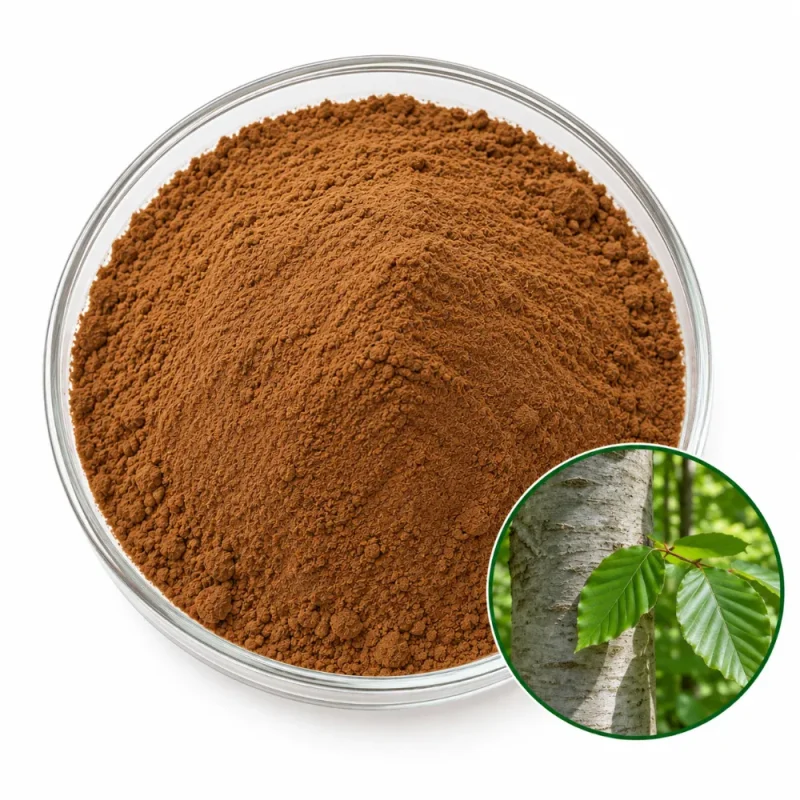
Beech Bark Extract Powder

The bark of Fagus sylvatica, the European beech, is the starting material for this beech bark extract, and the nuts, leaves and wood are not used. Water extraction concentrates the soluble bark fraction, and the liquor is dried into a light brown powder that disperses in water.

A 10:1 ratio sets the concentration, no marker percentage is attached, and the powder is milled to 80 mesh. No standardized extract, powder or isolated compound of this species is listed alongside it, so this ratio extract is the single beech bark ingredient, with no declared tannin or phenolic figure.

Fagus sylvatica Identity & Plant Part

The botanical entity is Fagus sylvatica L., the common or European beech, a large deciduous forest tree of the Fagaceae family found across central and western Europe. The part used is the bark. Beechnuts, leaves, buds and the wood are not part of this ingredient.

Beech materials come from several sources, and the name needs its qualifier. The nuts, called beechnuts or mast, are an edible seed. Beech wood is the source of distilled products such as beechwood tar and creosote, which are chemically unrelated to a water extract of bark. American beech, Fagus grandifolia, is a separate species from North America.

Beech bark is rich in phenolic compounds and tannins, which are the constituents that determine its astringency and the deep tone of its extracts.

Beech bark is thin, smooth and gray, which sets it apart from the deeply furrowed oak and chestnut barks that are also tannin-rich and are sometimes sold under loose names. The Latin name and the part keep the identity of a beech bark extract clear.

What 10:1 Means for Beech Bark

A 10:1 ratio records how much beech bark went into the extract. It is not a content figure for tannins, phenolic acids or any other constituent, and no such figure is attached to this product. The 10:1 figure expresses concentration alone and has to be read together with the bark and the water medium.

Tannins dissolve readily in hot water, so a water extract of bark leans toward the tannin side of the chemistry and leaves lignified fiber behind. The dried powder is therefore a concentrated phenolic fraction, far more astringent than the ground bark by weight, and it belongs to a bark-extract category that is judged by identity and handling.

Typical Specifications

Specification ItemProduct Information
Latin NameFagus sylvatica
Plant PartBark & Stem
ProcessingWater Extraction
Common NameEuropean Beech Bark
Ingredient TypeRatio Extract
Extract Ratio10:1
AppearanceLight Brown powder
Solubility / DispersibilityWater Dispersible
Quality Parameters
Moisture (LOD)≤5.0%
Total Ash≤5.0%
Particle Size80 mesh
Heavy MetalsLead ≤2 ppm · Arsenic ≤1 ppm · Cadmium ≤1 ppm · Mercury ≤0.1 ppm
MicrobiologyTPC ≤1,000 cfu/g · Yeast & Mold ≤100 cfu/g · E. coli Negative · Salmonella Negative/25 g
Shelf Life24 months in unopened original packaging, cool and dry storage

Application Areas

Tannin Bark Capsule Fills

Hard capsules hold beech bark extract after a flow aid is worked into the blend. The tannin-rich powder disperses without dissolving, so disintegration on the finished fill is worth testing, and a dense bark extract makes fill weight an early check on the capsule line.

Herbal Infusion-Style Mixes

Bark-based drinks are a recognized herbal format, so infusion-style instant mixes suit beech bark extract. It disperses to a hazy tan-brown cup with an astringent edge that sweeteners and warm spice flavors soften. Warm spice and caramel flavors balance the dry feel that beech bark tannins leave in the cup.

Compressed Tablet Cores

Beech bark extract is compressed with microcrystalline cellulose plus a disintegrant. Tannins darken in the presence of iron, so metal contact surfaces are checked early, and a film coat keeps the brown core clean and moisture out.

Sachet Powder Blends

Sachets pair the extract with a flavored dispersible base. A matched particle size across the components stops the dense brown powder from sifting to the bottom of the pack during filling and transport. Heat-sealed sachets protect the tannin-bearing powder from humidity, and unit packs keep each dose uniform in color.

Formulation Notes

The powder is light brown with a mild woody aroma and a dry, astringent, slightly bitter taste. In water it disperses to a hazy tan liquid that deepens in color on standing in air.

Tannins bind proteins, so test dairy-style mixes at bench scale, since the astringency and cloudiness can increase. Tannins also darken with iron, so avoid iron contact surfaces. A short premix with a flowing carrier stops bridging at the hopper, and the liner should be resealed after each draw, since a damp bark extract cakes.

Beech bark extract also keeps best away from strong odors, because tannin-rich powders pick up neighboring smells.

Packaging & Commercial Supply

Essencefield supports product evaluation, formulation trials, commercial orders, and ongoing ingredient supply. Packaging, storage, and shipping arrangements are determined by product characteristics, order quantity, stability requirements, and destination-market needs.

Supply ItemGeneral Information
SampleAvailable upon request for formulation, testing, and supplier evaluation
Order Quantities100 g · 1 kg · 5 kg · 25 kg · 100 kg · 500 kg · Bulk
Sample Lead TimeTypically 5–7 days after sample confirmation
Production Lead TimeTypically 15–30 days after order and specification confirmation
PackagingSuitable protective inner packaging with bags, cartons, drums, or other appropriate outer packaging
StorageStore in tightly sealed, suitable protective packaging in a cool, dry environment. Protect from moisture, heat, and direct sunlight. Specific storage conditions follow the approved product specification.
DocumentationCOA · Product Specification · TDS · SDS · Applicable declarations (as applicable)

Final order quantities, lead times, packaging, documentation, and shipping arrangements are confirmed according to the selected product and commercial requirements.

Request Ingredient Specifications & Quote

Share your target specification, application, quantity, and documentation needs. We’ll help confirm suitable options, samples, and commercial supply details.