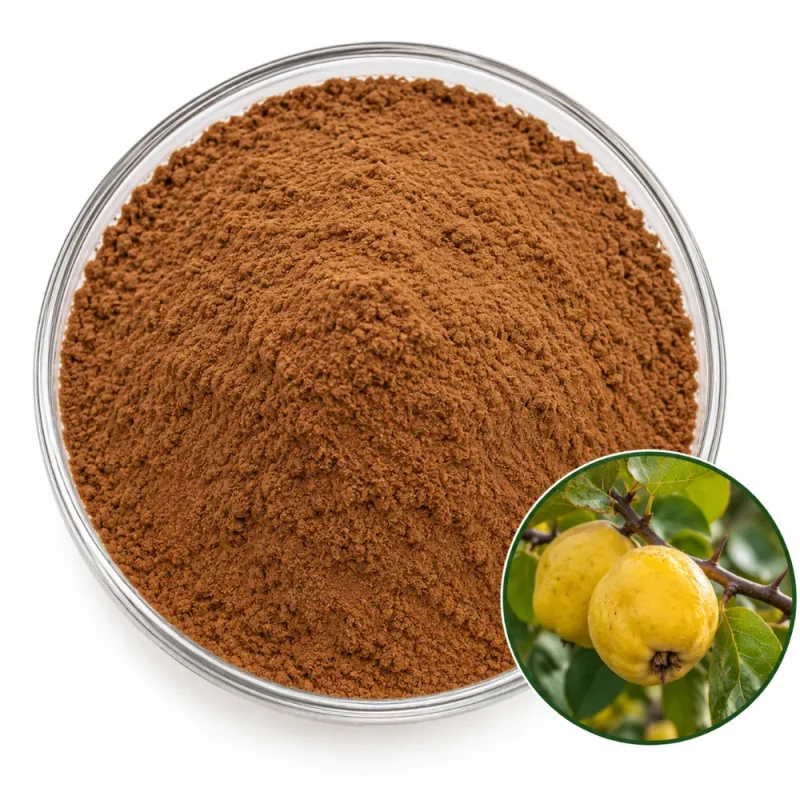
Chaenomeles Speciosa Extract Powder

Chaenomeles speciosa extract starts from the fruit of the flowering quince, the small, hard, fragrant pome used as mu gua, with the leaves, flowers and seeds not singled out. Water extraction concentrates the soluble fruit fraction, and the liquor is dried into a light brown powder that disperses in water.

The extract is supplied at a 10:1 ratio with no marker percentage and is milled to 80 mesh. It is a plain fruit extract, and Chaenomeles sinensis is a closely related but separate species with a larger fruit.

Chaenomeles speciosa Identity & Plant Part

The botanical entity is Chaenomeles speciosa (Sweet) Nakai, the flowering quince, a thorny Rosaceae shrub with bright red-orange spring blossoms. The part used is the fruit. Leaves, flowers and seeds are not part of this ingredient. In Chinese herbal trade the fruit is known as mu gua, and that name is also applied to related quince fruits.

That shared name is the identity risk. Chaenomeles sinensis is a sister species with larger, smoother fruit, and common quince, Cydonia oblonga, is a different genus. Chaenomeles speciosa fruit carries organic acids, procyanidins, triterpenic acids and pectin, named only as families.

What 10:1 Means for Chaenomeles speciosa

The sourness of flowering quince fruit comes from its organic acids, and a water extract concentrates them together with pectin and phenolics. The 10:1 ratio measures that concentration step against the Chaenomeles speciosa fruit and does not define an acid, procyanidin or triterpenic acid level. A stated acid or procyanidin value has to come from a marker-based product. One who names species, fruit and ratio can use this extract directly. The smaller fruit of this species is the one traded as mu gua in most herbal lists.

Typical Specifications

Specification ItemProduct Information
Latin NameChaenomeles speciosa
Plant PartFruit & Berry
ProcessingWater Extraction
Common NameFlowering Quince Fruit
Ingredient TypeRatio Extract
Extract Ratio10:1
AppearanceLight brown powder
Solubility / DispersibilityWater Dispersible
Quality Parameters
Moisture (LOD)≤5.0%
Total Ash≤5.0%
Particle Size80 mesh
Heavy MetalsLead ≤2 ppm · Arsenic ≤1 ppm · Cadmium ≤1 ppm · Mercury ≤0.1 ppm
MicrobiologyTPC ≤1,000 cfu/g · Yeast & Mold ≤100 cfu/g · E. coli Negative · Salmonella Negative/25 g
Shelf Life24 months in unopened original packaging, cool and dry storage

Application Areas

Quince Extract Capsules

A dispersible light brown powder, the Chaenomeles speciosa extract suits two-piece capsule filling. The acids and pectin make a fruit extract more hygroscopic than a root extract, so a flow aid in the premix and a dry filling room keep the fill steady. Disintegration is run on the finished capsule.

Tart Gummy Systems

In gummies the extract adds a sharp, apple-like acidity and tolerates the low pH of a pectin gel. Fruit pectin from the extract can shift gel strength slightly, so a small test batch is run before scaling up.

Stirred Drink Sachets

In sachets built for stirred drinks the extract brings a sour, astringent edge that works with honey, ginger or citrus flavors. The liquid stays hazy and tan. Dry blend with a carrier to keep the dose even from sachet to sachet.

Chewable Fruit Tablets

Chewable tablets use the extract’s own acidity as part of the flavor, with mannitol as the bulk sweetener. A short pre-compression dwell and a dry room keep the sticky acidic powder from picking on punch faces.

Fruit Bar Binders

Bars use the extract in the dry fraction, where its sharp acidity cuts through sweet date or raisin pastes. The pectin in the extract adds a little tack to the binder, so syrup levels are trimmed slightly during pilot batches.

Formulation Notes

Chaenomeles speciosa extract is a light brown powder with a faint fruity aroma and a distinctly sour, astringent taste. In water it disperses to a hazy tan liquid, and a little fine material settles on standing. The sourness comes from the fruit acids and is stronger than in most extracts.

Organic acids and pectin make the powder tacky in humid air, so it is weighed promptly in a dry room. After opening, reseal at every draw, because the extract clumps and darkens at the surface when it takes up moisture. Premix the Chaenomeles speciosa extract with a flowing carrier before capsule filling to prevent bridging, and fold the liner closed after each draw to slow moisture pickup.

Packaging & Commercial Supply

Essencefield supports product evaluation, formulation trials, commercial orders, and ongoing ingredient supply. Packaging, storage, and shipping arrangements are determined by product characteristics, order quantity, stability requirements, and destination-market needs.

Supply ItemGeneral Information
SampleAvailable upon request for formulation, testing, and supplier evaluation
Order Quantities100 g · 1 kg · 5 kg · 25 kg · 100 kg · 500 kg · Bulk
Sample Lead TimeTypically 5–7 days after sample confirmation
Production Lead TimeTypically 15–30 days after order and specification confirmation
PackagingSuitable protective inner packaging with bags, cartons, drums, or other appropriate outer packaging
StorageStore in tightly sealed, suitable protective packaging in a cool, dry environment. Protect from moisture, heat, and direct sunlight. Specific storage conditions follow the approved product specification.
DocumentationCOA · Product Specification · TDS · SDS · Applicable declarations (as applicable)

Final order quantities, lead times, packaging, documentation, and shipping arrangements are confirmed according to the selected product and commercial requirements.

Request Ingredient Specifications & Quote

Share your target specification, application, quantity, and documentation needs. We’ll help confirm suitable options, samples, and commercial supply details.