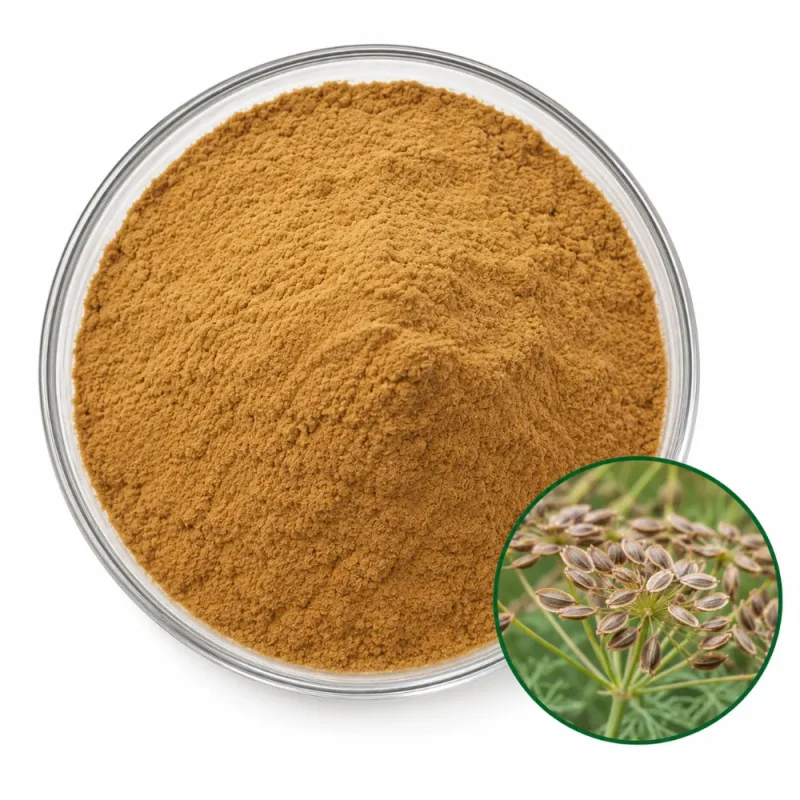
Dill Seed Extract Powder

Dill seed extract starts from the ripe fruits of Anethum graveolens L., the small flat seeds of the dill plant, and not from the feathery dill weed or from fennel and caraway. Water extraction takes up the soluble fraction of the crushed seed, and the liquor is dried to a light brown powder.

The extract ratio is 10:1, and the powder is milled to 80 mesh and is water dispersible. No marker figure is stated, so the ratio is the only number that defines the dill seed extract, and the volatile oil that carries the aroma of the whole seed is largely absent.

Dill Seed Identity & Plant Part

Anethum graveolens L. is an annual herb of the carrot family grown across Europe, Asia and North America. The part used here is the dried ripe fruit, sold as dill seed. The feathery leaves, called dill weed, and the flowering umbels are not used. Dill seed is easily confused with caraway and fennel seed, both from other plants in the same family, and with Indian dill, which is sold under a separate botanical name. The seed holds a volatile oil rich in carvone and limonene, together with flavonoids, coumarins and a fixed oil. No figures are given for these families, and little of the oil reaches a water extract.

What 10:1 Means for Dill Seed

Ten parts of dried dill seed stand behind each part of extract. The ratio does not describe oil content, carvone content or flavor strength. Because carvone and limonene are lipophilic, the aromatic oil mostly remains in the spent seed, and the water extract tastes milder and less pungent than the crushed spice. Buyers choose a dill seed extract for a soluble, dispersible seed fraction with a faint spice character. Those who need the characteristic dill aroma look to the whole seed or its oil, which are different products.

Typical Specifications

Specification ItemProduct Information
Latin NameAnethum graveolens
Plant PartSeed & Grain
ProcessingWater Extraction
Common NameDill Seed
Ingredient TypeRatio Extract
Extract Ratio10:1
AppearanceLight Brown powder
Solubility / DispersibilityWater Dispersible
Quality Parameters
Moisture (LOD)≤5.0%
Total Ash≤5.0%
Particle Size80 mesh
Heavy MetalsLead ≤2 ppm · Arsenic ≤1 ppm · Cadmium ≤1 ppm · Mercury ≤0.1 ppm
MicrobiologyTPC ≤1,000 cfu/g · Yeast & Mold ≤100 cfu/g · E. coli Negative · Salmonella Negative/25 g
Shelf Life24 months in unopened original packaging, cool and dry storage

Application Areas

Capsules for Seed Extract

Dill seed extract powder fits capsule formats, whether used neat or blended. The powder is fine and can be cohesive when it picks up humidity, so check flow and fill weight on the machine and keep the filling room dry from the first capsule to the last.

Herbal Drink Powders

In drink powders the extract gives a light brown, slightly hazy liquid with a mild herbal, faintly sweet and caraway-like taste. Lemon, cucumber and mint flavors suit it, and a short pre-dissolving step in warm water prevents floating lumps in the cup.

Tablets with Seed Extract

The tablet recipe for Dill seed extract starts with a dry binder and a flow aid. The taste is mild enough that a coat is optional at low dose, but a coat still protects the tablet from humidity during storage and shipping.

Dill Seed Sachets

In stick packs the dill seed extract blends with sweeteners and citrus or mint flavors. Mix the blend until the tint is even before filling sachets, because pale bases show the extract as faint specks.

Gummies with Herbal Notes

In gummies the extract goes in after the cooked mass cools. A pale brown tint and a mild spice note fit lemon, apple and pear flavors, and the low inclusion needed keeps the recipe simple.

Formulation Notes

The powder is light brown with a weak, faintly sweet spice smell and a mild, slightly bitter taste. In water it disperses to a pale brown, hazy liquid. The volatile oil that gives dill seed its sharp aroma stays largely with the spent seed, so this dill seed extract contributes color and soluble matter more than flavor.

Soluble seed extracts attract moisture, so weigh the powder promptly and reseal the liner after each draw. Premix with a larger carrier fraction to avoid clumps and static. Store the drum cool and shaded, away from strongly scented goods, since a fine powder can take up odors in a shared warehouse.

Packaging & Commercial Supply

Essencefield supports product evaluation, formulation trials, commercial orders, and ongoing ingredient supply. Packaging, storage, and shipping arrangements are determined by product characteristics, order quantity, stability requirements, and destination-market needs.

Supply ItemGeneral Information
SampleAvailable upon request for formulation, testing, and supplier evaluation
Order Quantities100 g · 1 kg · 5 kg · 25 kg · 100 kg · 500 kg · Bulk
Sample Lead TimeTypically 5–7 days after sample confirmation
Production Lead TimeTypically 15–30 days after order and specification confirmation
PackagingSuitable protective inner packaging with bags, cartons, drums, or other appropriate outer packaging
StorageStore in tightly sealed, suitable protective packaging in a cool, dry environment. Protect from moisture, heat, and direct sunlight. Specific storage conditions follow the approved product specification.
DocumentationCOA · Product Specification · TDS · SDS · Applicable declarations (as applicable)

Final order quantities, lead times, packaging, documentation, and shipping arrangements are confirmed according to the selected product and commercial requirements.

Request Ingredient Specifications & Quote

Share your target specification, application, quantity, and documentation needs. We’ll help confirm suitable options, samples, and commercial supply details.