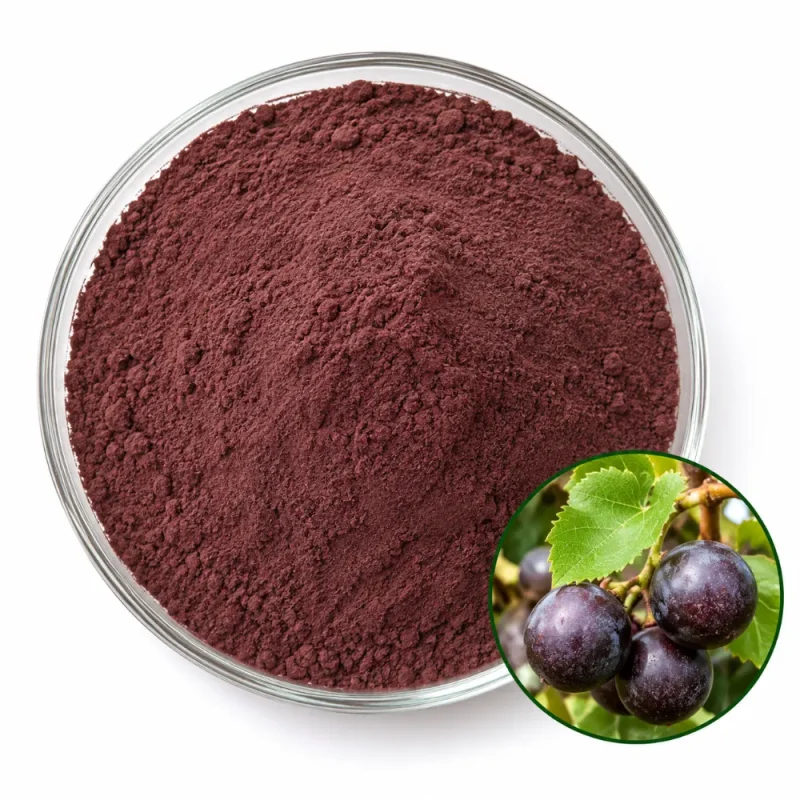
Muscadine Grape Extract Powder

Muscadine grape extract is a water extract of the fruit of Vitis rotundifolia Michx., the thick-skinned grape of the southeastern United States, dried to a purple-red powder. It is a different species from the wine grape, and its profile is not the same.

The extract ratio is 10:1, the powder is milled to 80 mesh, and it is water dispersible. It is a fruit-based ratio extract with no marker, and the range holds no milled-fruit or graded version of this grape.

Muscadine Grape Source & Identity

The species is Vitis rotundifolia Michx. of the grape family, a vigorous vine native to the southeastern United States that bears large, round, thick-skinned berries in bronze and dark purple forms. The part used is the fruit. Leaves, stems and roots are not used. Muscadine is a separate species from the European wine grape (Vitis vinifera), and it differs in its pigments and phenolics: muscadine anthocyanins are mainly diglucosides, and the fruit carries ellagic acid and ellagitannins that the wine grape lacks. Muscadine is also known for flavonols, for phenolic acids and for fruit sugars and organic acids. A water extract carries the soluble pigments, sugars, acids and polar phenolics.

What 10:1 Means for Muscadine Grape

The 10:1 figure is a concentration ratio of the starting fruit: a large weight of dried muscadine grape is reduced to one part of extract. It does not describe anthocyanin, ellagic acid, sugar or polyphenol content, and none is declared. The range holds no milled or graded form of this grape, so there is no sibling comparison. The key points for a buyer are the species and the color. Muscadine is often listed under a generic grape label that hides which species is in the powder, so the Latin name should be on every order. The purple-red tone of muscadine grape extract comes from anthocyanin pigments, which shift with pH.

Typical Specifications

Specification ItemProduct Information
Latin NameVitis rotundifolia
Plant PartFruit & Berry
ProcessingWater Extraction
Common NameMuscadine Grape, Scuppernong
Ingredient TypeRatio Extract
Extract Ratio10:1
AppearancePurple Red powder
Solubility / DispersibilityWater Dispersible
Quality Parameters
Moisture (LOD)≤5.0%
Total Ash≤5.0%
Particle Size80 mesh
Heavy MetalsLead ≤2 ppm · Arsenic ≤1 ppm · Cadmium ≤1 ppm · Mercury ≤0.1 ppm
MicrobiologyTPC ≤1,000 cfu/g · Yeast & Mold ≤100 cfu/g · E. coli Negative · Salmonella Negative/25 g
Shelf Life24 months in unopened original packaging, cool and dry storage

Application Areas

Capsules with Fruit Extract

Muscadine grape extract powder fills hard capsules alone or beside other fruit extracts. A sugar- and acid-bearing powder is hygroscopic, so fill in a dry room and use a flow aid. The purple-red fill is visible through clear shells, and opaque shells give a more uniform look.

Berry-Colored Drink Sticks

Dissolved in water, muscadine grape extract gives a purple-red to ruby drink with a sweet-tart, grape-like taste that is slightly more astringent than wine grape. Citrus, berry and pomegranate flavors suit it. A little warm water for the first mix prevents sticky lumps.

Tablets with Color Protection

Muscadine grape extract tablets come from a dry-binder blend with a little lubricant. Anthocyanin pigments fade in light and with humidity, so use a film coat, opaque packaging and a desiccant to keep the purple-red color through storage.

Gummies with Natural Color

In gummies, muscadine grape extract adds a natural purple-red tint without added colorants, suiting grape and berry flavors. Add it to the cooled mass. Color shifts toward blue-purple in higher-pH bases and toward red in acidic ones, so test the recipe’s final pH.

Instant Drink Granules

Instant granules combine muscadine grape extract with sugar and maltodextrin. The carrier reduces the stickiness of the sugar- and acid-rich powder, helps the grains wet quickly, and the pigmented granule gives cold-water fruit drinks their color.

Formulation Notes

The powder is purple-red with a sweet, grape-like aroma and a tart, mildly astringent taste. In water it gives a ruby to deep red liquid, clear to lightly hazy, and the color is bright in acid and dull toward neutral or alkaline. Anthocyanin pigments fade in light, heat and with ascorbic acid or metals in the mix.

Protect finished products from light and heat, and keep contact with iron and copper low. Sugars and acids make the powder very hygroscopic, so weigh quickly in a dry room. Seal opened packs and store them cool and dry, away from sunlight.

Packaging & Commercial Supply

Essencefield supports product evaluation, formulation trials, commercial orders, and ongoing ingredient supply. Packaging, storage, and shipping arrangements are determined by product characteristics, order quantity, stability requirements, and destination-market needs.

Supply ItemGeneral Information
SampleAvailable upon request for formulation, testing, and supplier evaluation
Order Quantities100 g · 1 kg · 5 kg · 25 kg · 100 kg · 500 kg · Bulk
Sample Lead TimeTypically 5–7 days after sample confirmation
Production Lead TimeTypically 15–30 days after order and specification confirmation
PackagingSuitable protective inner packaging with bags, cartons, drums, or other appropriate outer packaging
StorageStore in tightly sealed, suitable protective packaging in a cool, dry environment. Protect from moisture, heat, and direct sunlight. Specific storage conditions follow the approved product specification.
DocumentationCOA · Product Specification · TDS · SDS · Applicable declarations (as applicable)

Final order quantities, lead times, packaging, documentation, and shipping arrangements are confirmed according to the selected product and commercial requirements.

Request Ingredient Specifications & Quote

Share your target specification, application, quantity, and documentation needs. We’ll help confirm suitable options, samples, and commercial supply details.