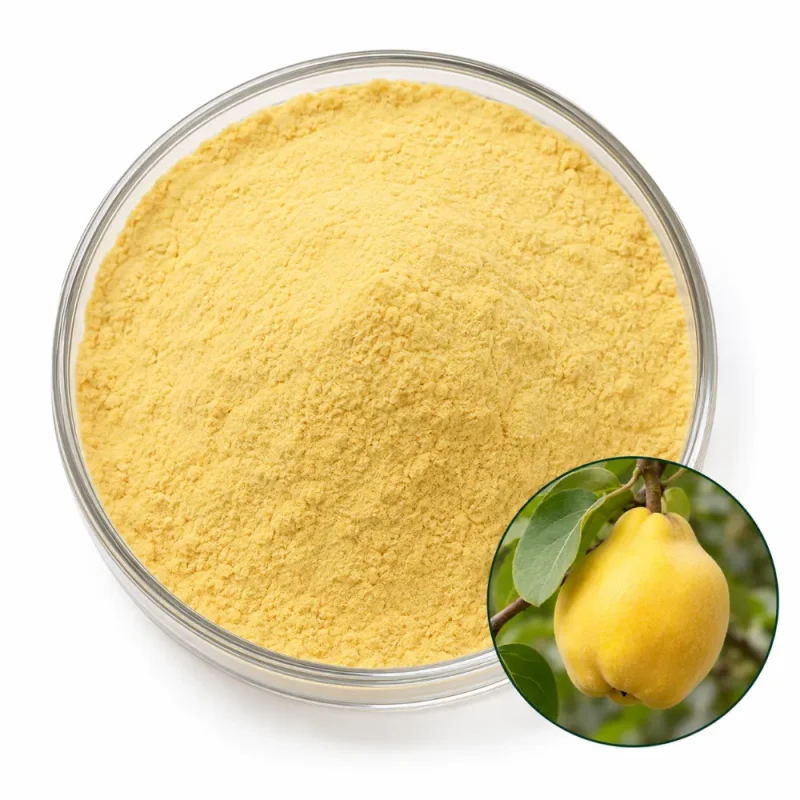
Quince Extract Powder

Quince extract starts from the fruit of Cydonia oblonga, the hard, fragrant pome of the common quince, with the seed, leaf and bark excluded. Water extraction concentrates the soluble fruit fraction, and the liquor is dried into a light brown powder that disperses in water.

The extract is supplied at a 10:1 ratio with no marker percentage and is milled to 80 mesh. It is a ratio extract of the fruit and is distinct from quince seed mucilage and from juice powder. Chinese and flowering quinces belong to other genera.

Cydonia oblonga Fruit Source & Identity

The botanical entity is Cydonia oblonga Mill., the common quince of the Rosaceae, a small deciduous tree with large pink-white flowers and a golden, downy pear-shaped fruit that is hard, sour and strongly aromatic when raw. The part used is the fruit. Seed, leaf and bark are not part of this quince extract.

Several look-alike fruits are traded as quince. Chinese quince, Pseudocydonia sinensis, and flowering quince, Chaenomeles species, are separate genera, and the Chinese herb mu gua usually refers to a Chaenomeles fruit. Quote the Latin binomial on the specification. The fruit holds pectin, chlorogenic acids, procyanidins and organic acids, named here only as families.

What 10:1 Means for Quince

A 10:1 ratio on a quince extract describes concentration against the starting fruit and reports no pectin or phenolic figure. Quince is unusually rich in pectin and tannins for a fruit, so a water process produces a powder that is astringent and sets a gel readily. A defined grade with a declared marker is not listed for Cydonia oblonga, so a buyer who needs one must source elsewhere. Quince extract is identified by Latin binomial, fruit and the 10:1 ratio. Quince fruit is also distinctive because its pectin gels on cooling, which gives the extract a modest thickening effect in drinks and a helpful setting action in gummies.

Typical Specifications

Specification ItemProduct Information
Latin NameCydonia oblonga
Plant PartFruit & Berry
ProcessingWater Extraction
Common NameCommon Quince Fruit
Ingredient TypeRatio Extract
Extract Ratio10:1
AppearanceLight brown powder
Solubility / DispersibilityWater Dispersible
Quality Parameters
Moisture (LOD)≤5.0%
Total Ash≤5.0%
Particle Size80 mesh
Heavy MetalsLead ≤2 ppm · Arsenic ≤1 ppm · Cadmium ≤1 ppm · Mercury ≤0.1 ppm
MicrobiologyTPC ≤1,000 cfu/g · Yeast & Mold ≤100 cfu/g · E. coli Negative · Salmonella Negative/25 g
Shelf Life24 months in unopened original packaging, cool and dry storage

Application Areas

Capsules for Pectin-Rich Fruit

Quince extract fills into capsules as a light brown powder. Pectin and fruit sugars attract water, so the filling suite is kept dry and a flow aid is premixed. Fill weights are logged across each run.

Quince-Style Gummies

This pome is a classic jelly fruit, and the extract supports pectin gummies with its own gelling character. It is added late in the cooked base, and pectin balance is checked in trials, because added fruit pectin changes the set and the texture.

Drink Powders with Tart Balance

Drink powders pair quince extract with apple, honey or vanilla flavors. The liquid is hazy and tan with some viscosity from the pectin. Astringency limits the dose, and sweetener and acid are tuned by sensory panel.

Chewable Tablets

Chewable tablets carry the extract on a sorbitol or xylitol base with fruit flavor. Pectin helps binding, but fruit sugars soften the compact, so hardness is rechecked after humidity exposure. Flavor added at the end of the mix makes the chew taste like the fruit.

Instant Tea-Style Mixes

Instant tea-style powders use quince extract with black tea, rose or ginger flavors. A carrier keeps the dose even between sachets, and the powder is dry-blended into the base before water is added. Rose and ginger flavors extend the floral, spiced character of the fruit.

Formulation Notes

Quince extract is a light brown powder with a faint, sweet, perfumed fruit aroma and a tart, astringent taste. In water it forms a hazy tan liquid with a slight viscosity from pectin. The fresh quince fragrance is a volatile fraction, so added flavor supplies it.

The pectin and sugars make the powder strongly hygroscopic. The quince extract is weighed in a dry room, with the liner resealed after every draw and the opened pack kept dark and out of the heat. Clumping and a deeper brown at the surface appear first when moisture gets in.

Pectin wets unevenly and forms lumps, so in drinks the powder is dry-blended with sugar before water is added and stirred during addition. Premix with a flow aid and screen into the bulk in one stage. Pilot lots show how the extract behaves with added acid.

Packaging & Commercial Supply

Essencefield supports product evaluation, formulation trials, commercial orders, and ongoing ingredient supply. Packaging, storage, and shipping arrangements are determined by product characteristics, order quantity, stability requirements, and destination-market needs.

Supply ItemGeneral Information
SampleAvailable upon request for formulation, testing, and supplier evaluation
Order Quantities100 g · 1 kg · 5 kg · 25 kg · 100 kg · 500 kg · Bulk
Sample Lead TimeTypically 5–7 days after sample confirmation
Production Lead TimeTypically 15–30 days after order and specification confirmation
PackagingSuitable protective inner packaging with bags, cartons, drums, or other appropriate outer packaging
StorageStore in tightly sealed, suitable protective packaging in a cool, dry environment. Protect from moisture, heat, and direct sunlight. Specific storage conditions follow the approved product specification.
DocumentationCOA · Product Specification · TDS · SDS · Applicable declarations (as applicable)

Final order quantities, lead times, packaging, documentation, and shipping arrangements are confirmed according to the selected product and commercial requirements.

Request Ingredient Specifications & Quote

Share your target specification, application, quantity, and documentation needs. We’ll help confirm suitable options, samples, and commercial supply details.