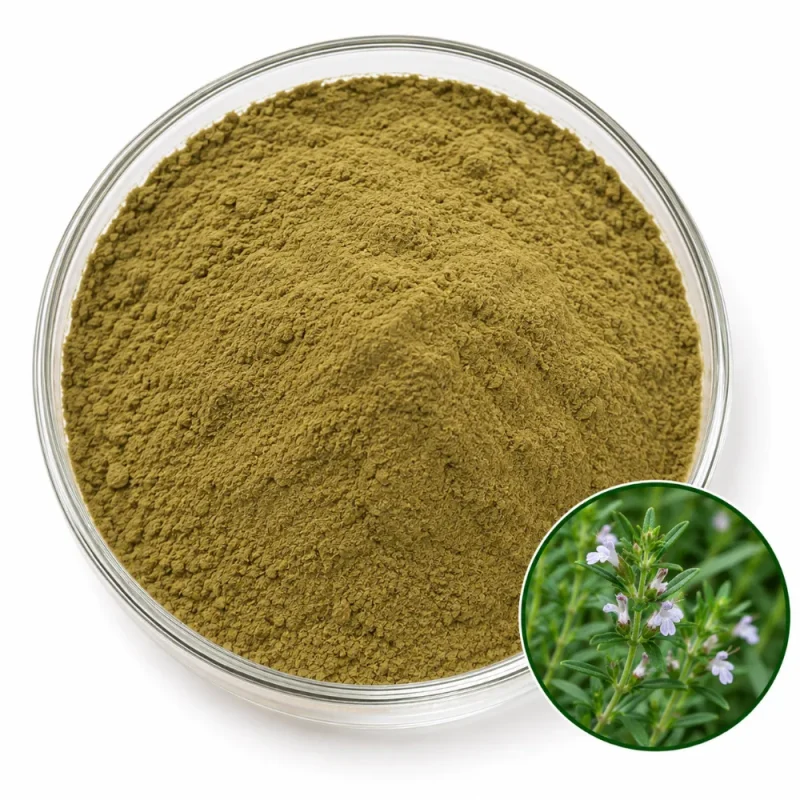
Savory Extract Powder

Savory extract starts from the aerial parts of Satureja hortensis, summer savory, an annual herb of the mint family grown as a culinary plant. Water extraction concentrates the soluble herb fraction, and the liquor is dried to a light brown powder that disperses in water.

The extract is supplied at a 10:1 ratio with no marker percentage and is milled to 80 mesh. No other savory form is listed for this botanical, so this ratio extract is the single entry for buyers who need Satureja hortensis in a water-dispersible powder.

Satureja hortensis Identity & Plant Part

The botanical entity is Satureja hortensis L., summer savory, a slender annual of the Lamiaceae. The part used is the aerial portion, meaning leaf and flowering top. Roots are not part of this ingredient. Winter savory is Satureja montana, a perennial shrub with a different, more resinous aroma, and it is not the species supplied here.

The characteristic constituents of the herb are the phenolic monoterpenes carvacrol and thymol, along with phenolic acids, flavonoids and triterpenic acids. These are largely found in the volatile oil, and the oil is mostly lost during water extraction and drying, so savory extract is milder than the fresh or dried herb.

What 10:1 Means for Savory

The 10:1 ratio describes how much dried savory herb is concentrated into the extract. It is not a carvacrol or phenolic acid figure, and this entry carries no marker percentage. Because the catalog has no powder or graded sibling for this botanical, the ratio extract is the only way to specify savory here. Buyers who expect a strong peppery culinary aroma from the extract will find it much gentler, since the volatile fraction that creates that aroma is not retained. The species and part are therefore the key specification points.

Typical Specifications

Specification ItemProduct Information
Latin NameSatureja hortensis
Plant PartLeaf & Herb
ProcessingWater Extraction
Common NameSummer Savory
Ingredient TypeRatio Extract
Extract Ratio10:1
AppearanceLight brown powder
Solubility / DispersibilityWater Dispersible
Quality Parameters
Moisture (LOD)≤5.0%
Total Ash≤5.0%
Particle Size80 mesh
Heavy MetalsLead ≤2 ppm · Arsenic ≤1 ppm · Cadmium ≤1 ppm · Mercury ≤0.1 ppm
MicrobiologyTPC ≤1,000 cfu/g · Yeast & Mold ≤100 cfu/g · E. coli Negative · Salmonella Negative/25 g
Shelf Life24 months in unopened original packaging, cool and dry storage

Application Areas

Capsule Fills for Savory Extract

Two-piece capsules take the powder as a light brown fill with a flow aid, and the herbal taste is mild enough that capsules and tablets are both practical formats. A weight and disintegration check completes the trial before the lot is released.

Tea-Style Savory Sachets

Instant sachets blend the extract with lemon, thyme or mint flavors in a dry mix. The cup is a hazy tan liquid with a mild herbal note, and sweeteners are optional because the extract has little bitterness. The mix is sealed quickly after filling to keep moisture out.

Herbal Tablet Granulates

Tablets compress with microcrystalline cellulose and a disintegrant, and the extract binds fairly well. A light coat is enough to hide the tan color. Dry granulation avoids sticking on punches, and hardness is checked once the tablet has cooled after compression.

Savory Stick-Pack Blends

Stick packs take the extract with citrus flavors and a sweetener, since its light herbal profile pairs with lemon and cucumber better than with heavy fruit flavors. Premixing keeps the dose even across the batch, and a sieve step removes lumps before filling.

Cereal Bar Dry Blends

Bars use the extract in the dry fraction with grains and seeds, where the quiet herbal note blends in without competing with the base. The powder is added before the syrup to avoid clumps, and finished bars are checked for color and moisture.

Formulation Notes

Savory extract is a light brown powder with a mild herbal aroma and a faintly bitter, slightly peppery taste. It disperses in water to a hazy tan liquid. Because the volatile oil is mostly removed, the powder smells much less than the herb it comes from, and the flavor impact in a finished format is subtle.

The powder takes up humidity from the air, so weigh it in a dry room and premix with a flow agent before capsule or stick filling. Heat can deepen the color, which is checked during stability trials. After opening, reseal the pack and keep it out of direct light and moisture.

Packaging & Commercial Supply

Essencefield supports product evaluation, formulation trials, commercial orders, and ongoing ingredient supply. Packaging, storage, and shipping arrangements are determined by product characteristics, order quantity, stability requirements, and destination-market needs.

Supply ItemGeneral Information
SampleAvailable upon request for formulation, testing, and supplier evaluation
Order Quantities100 g · 1 kg · 5 kg · 25 kg · 100 kg · 500 kg · Bulk
Sample Lead TimeTypically 5–7 days after sample confirmation
Production Lead TimeTypically 15–30 days after order and specification confirmation
PackagingSuitable protective inner packaging with bags, cartons, drums, or other appropriate outer packaging
StorageStore in tightly sealed, suitable protective packaging in a cool, dry environment. Protect from moisture, heat, and direct sunlight. Specific storage conditions follow the approved product specification.
DocumentationCOA · Product Specification · TDS · SDS · Applicable declarations (as applicable)

Final order quantities, lead times, packaging, documentation, and shipping arrangements are confirmed according to the selected product and commercial requirements.

Request Ingredient Specifications & Quote

Share your target specification, application, quantity, and documentation needs. We’ll help confirm suitable options, samples, and commercial supply details.