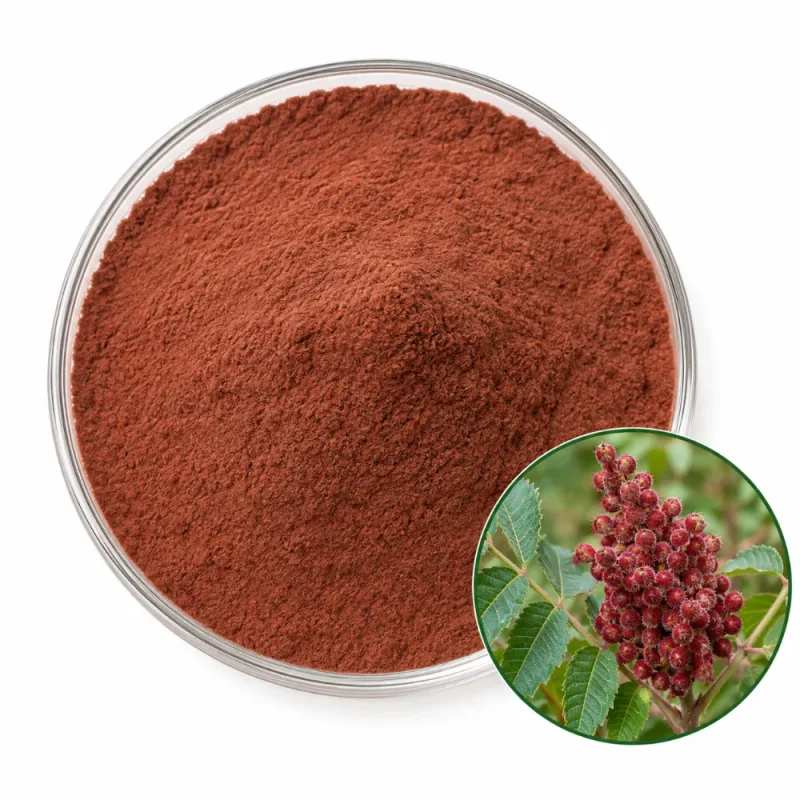
Sumac Extract Powder

Sumac extract starts from the fruit of Rhus coriaria, the Sicilian or tanner’s sumac, a shrub whose dried red drupes give the sour spice of Middle Eastern cooking. Water extraction concentrates the soluble fruit fraction, and the liquor is dried to a light brown powder.

The extract is supplied at a 10:1 ratio with no marker percentage and is milled to 80 mesh. No other sumac form is listed for this botanical, so this ratio extract is the single entry for buyers who need Rhus coriaria fruit in a water-dispersible powder.

Rhus coriaria Fruit Identity & Plant Part

The botanical entity is Rhus coriaria L., sumac, a shrub of the Anacardiaceae from the Mediterranean and western Asia. The part used is the fruit, the clustered, hairy red drupes that ripen in late summer. Leaves, bark and wood are not part of this ingredient, although those parts are used elsewhere as tanning material.

Sumac extract should not be confused with poison sumac, which is a Toxicodendron species, or with the North American staghorn sumac, Rhus typhina. The fruit carries hydrolysable tannins, gallic acid, flavonols, anthocyanins in the skin and malic acid, which is the main source of its sourness. These are named as families only.

What 10:1 Means for Sumac

The 10:1 ratio describes how much dried sumac fruit is concentrated into the extract. It is not a tannin or gallic acid figure, and sumac extract carries no marker percentage on this entry. With the catalog listing no powder or graded sibling, the ratio extract is the only way to specify sumac here. Ground sumac sold as a spice is a different material, a milled whole fruit with its sour taste, and the water extract concentrates only the soluble share of that fruit. Species and part are the specification points that count.

Typical Specifications

Specification ItemProduct Information
Latin NameRhus coriaria
Plant PartFruit & Berry
ProcessingWater Extraction
Common NameSumac Berry
Ingredient TypeRatio Extract
Extract Ratio10:1
AppearanceLight brown powder
Solubility / DispersibilityWater Dispersible
Quality Parameters
Moisture (LOD)≤5.0%
Total Ash≤5.0%
Particle Size80 mesh
Heavy MetalsLead ≤2 ppm · Arsenic ≤1 ppm · Cadmium ≤1 ppm · Mercury ≤0.1 ppm
MicrobiologyTPC ≤1,000 cfu/g · Yeast & Mold ≤100 cfu/g · E. coli Negative · Salmonella Negative/25 g
Shelf Life24 months in unopened original packaging, cool and dry storage

Application Areas

Capsule Fills for Sumac Fruit

Two-piece capsules take sumac extract as a free-flowing light brown powder after a flow aid is added. The sharp sour taste and astringency stay inside the shell, and moisture pickup is moderate. A disintegration check closes each lot.

Tart Drink Sachets

Sumac extract dissolves into an amber-pink, hazy drink with a clean sour note that suits lemonade-style, pomegranate and herbal blends. The acidity lowers the need for added citric acid. Sweetener rounds the profile, and the sachet is filled in dry air.

Acidic Chewable Tablets

Chewable tablets use mannitol and a disintegrant, and the natural acidity of sumac extract can attack uncoated tooling over long runs. Coated punches or short press runs avoid this, and a hardness check confirms that the tablet binds.

Gummy Premix Systems

Gummies carry the extract in pectin bases where its tartness replaces part of the added acid. The brown tint suits dark red and amber shades. Add the powder after the main cook so that the acid note and color are preserved.

Tangy Seed Bar Layers

Bars use sumac extract in the dry fraction with seeds, nuts and dried fruit, where the tartness balances sweet binders. The powder is premixed with dry ingredients before syrup is added, and finished bars are checked for moisture and color.

Formulation Notes

Sumac extract is a light brown powder with a fruity, tangy aroma and a strongly sour, astringent taste. In water it disperses to a hazy amber liquid with a pink tone at a low pH. The organic acids and tannins carry the flavor, and the sourness limits how much a flavored format can take. The extract is browner and less vivid than the red ground spice, which is a different material.

Acids and sugars make the powder hygroscopic, so weigh it in a dry room and reseal the pack after each draw. Tannins darken in contact with iron, so mineral premixes are kept apart. A flow agent helps in capsule fillers. Opened packs belong in a closed container away from heat and light.

Packaging & Commercial Supply

Essencefield supports product evaluation, formulation trials, commercial orders, and ongoing ingredient supply. Packaging, storage, and shipping arrangements are determined by product characteristics, order quantity, stability requirements, and destination-market needs.

Supply ItemGeneral Information
SampleAvailable upon request for formulation, testing, and supplier evaluation
Order Quantities100 g · 1 kg · 5 kg · 25 kg · 100 kg · 500 kg · Bulk
Sample Lead TimeTypically 5–7 days after sample confirmation
Production Lead TimeTypically 15–30 days after order and specification confirmation
PackagingSuitable protective inner packaging with bags, cartons, drums, or other appropriate outer packaging
StorageStore in tightly sealed, suitable protective packaging in a cool, dry environment. Protect from moisture, heat, and direct sunlight. Specific storage conditions follow the approved product specification.
DocumentationCOA · Product Specification · TDS · SDS · Applicable declarations (as applicable)

Final order quantities, lead times, packaging, documentation, and shipping arrangements are confirmed according to the selected product and commercial requirements.

Request Ingredient Specifications & Quote

Share your target specification, application, quantity, and documentation needs. We’ll help confirm suitable options, samples, and commercial supply details.