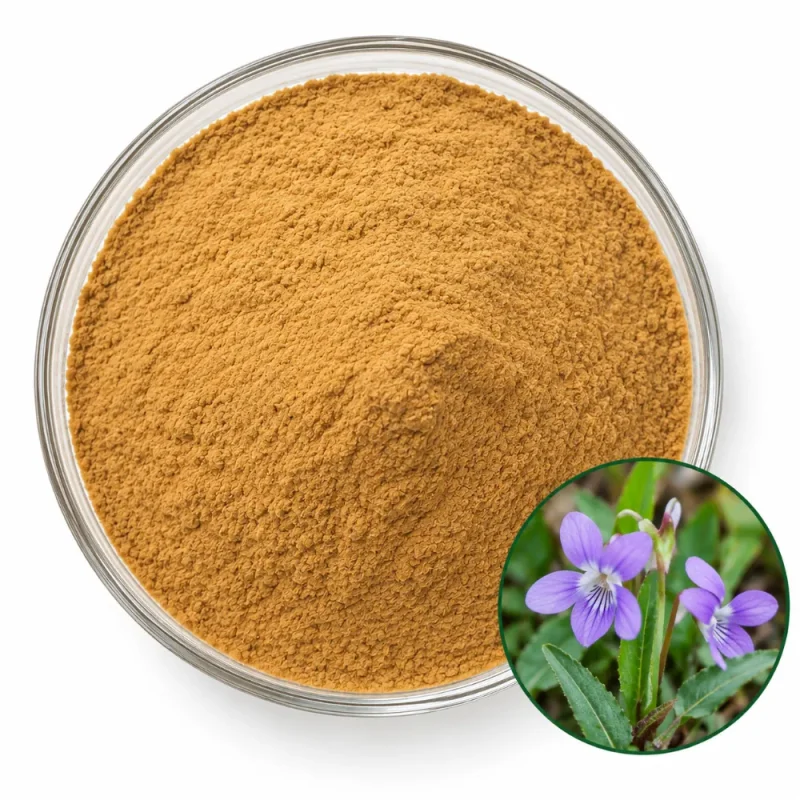
Viola Yedoensis Extract Powder

Viola yedoensis extract is made from the aerial parts of the small violet called zi hua di ding in Chinese, and not from the root or from unrelated herbs sold under the name di ding. Water extraction takes up the soluble herb fraction. Drying the concentrated liquor gives a light brown powder.

The ratio is 10:1, milled to 80 mesh and dispersible in water. This Viola yedoensis extract carries no flavonoid percentage, and the flavonoid-standardized extract of the same herb is a separate product with its own specification.

Viola yedoensis Herb Source & Identity

The botanical entity is Viola yedoensis Makino, a stemless perennial of the violet family, Violaceae, with rosettes of narrow leaves and purple flowers. Taxonomic databases treat the name as a synonym of Viola philippica, and Chinese materia medica lists it as zi hua di ding. The part used is the aerial portion of the plant, meaning leaves, flowers and short stems.

Roots are not included in this Viola yedoensis extract. The Chinese name di ding is shared by other herbs, among them members of the poppy family, so the botanical name and the Chinese name together define the identity. The herb is known for flavone C-glycosides and coumarins, with terpenoids and phenolic acids, and the water extract keeps the soluble members.

Orders for Viola yedoensis extract should state the species, the aerial part and the Chinese name, which separates the herb from Corydalis material also sold as di ding. The rosette form of the plant keeps most of its biomass in the leaves, so the aerial part is largely leaf.

Viola Extract vs Flavonoid Grade

FormWhat It IsChoose It When
10:1 Viola Yedoensis Herb ExtractWater-extracted, concentrated and dried aerial partsA whole-herb extract without a marker is needed
Viola Yedoensis Extract 5–20% Total FlavonoidsStandardized extract with a total flavonoid rangeThe specification names a flavonoid figure

The 10:1 ratio states how much herb goes into the extract and is not a flavonoid assay. The botanical contains more than a hundred identified constituents, with flavonoids and coumarins prominent, so a whole-herb water extract carries a broad profile while the standardized row narrows the specification to one measured group. The plain extract suits formulas that name the herb and want dispersible handling. A Viola yedoensis extract made as a dry, dispersible powder is also easier to meter than cut herb, which is light, bulky and slow to wet in a blender.

Typical Specifications

Specification ItemProduct Information
Latin NameViola yedoensis
Plant PartLeaf & Herb
ProcessingWater Extraction
Common NameViola Yedoensis, Zi Hua Di Ding, Chinese Violet
Ingredient TypeRatio Extract
Extract Ratio10:1
AppearanceLight Brown powder
Solubility / DispersibilityWater Dispersible
Quality Parameters
Moisture (LOD)≤5.0%
Total Ash≤5.0%
Particle Size80 mesh
Heavy MetalsLead ≤2 ppm · Arsenic ≤1 ppm · Cadmium ≤1 ppm · Mercury ≤0.1 ppm
MicrobiologyTPC ≤1,000 cfu/g · Yeast & Mold ≤100 cfu/g · E. coli Negative · Salmonella Negative/25 g
Shelf Life24 months in unopened original packaging, cool and dry storage

Application Areas

Capsule and Tablet Formats

The Viola yedoensis extract is hygroscopic, so capsules should be filled in a dry room and sealed promptly, and tablets need a hardness check after the compacts rest. A closed dosage form also keeps the slightly bitter herb taste away from the palate.

Violet-Toned Tea Sticks

Powder sticks carry the extract with floral, berry or citrus flavors. The cup is light brown and slightly hazy, and weight-based dosing keeps the dispersed solids uniform from stick to stick. A short steep keeps the bitterness mild.

Herbal Drink Premixes

Instant drink powders take the extract dry in honey, apple or chrysanthemum-style bases, where a warm brown tint is expected. Clear, colorless drinks show the haze too plainly. Cold water gives a lighter taste than hot water, which pulls out more astringency.

Fruit-Base Gummies

Cooking the gummy base first and adding the extract last keeps its phenolics from darkening. Berry and citrus flavors cover the herb note, and the dispersible solid avoids the fibrous flecks that milled herb leaves in a gel. Acidic fruit bases shift flavonoid color slightly toward yellow.

Formulation Notes

The Viola yedoensis extract is a light brown powder with a faint hay-like odor and a mildly bitter, slightly astringent taste. In water it disperses into a tan, lightly hazy liquid, since coumarin and tannin complexes and polysaccharide fragments stay partly suspended while flavonoid glycosides dissolve. The free-flowing powder responds quickly to humid surroundings, so lumps form wherever the drum is left open.

Pass the extract through a sieve first, and premix it with a small share of the base before the main blend. Flavonoid glycosides tolerate moderate heat but darken in long holds, so add the extract late in any cooking step. After a drum is opened, close the lid over the liner and keep the drum on a dry pallet. Keep the retained sample in a sealed container, away from light, so that the comparison stays fair.

Test the extract in the finished pack for a week at room temperature before sign-off, since flavonoid-bearing herbs may shift slightly in tone as they take up moisture.

Packaging & Commercial Supply

Essencefield supports product evaluation, formulation trials, commercial orders, and ongoing ingredient supply. Packaging, storage, and shipping arrangements are determined by product characteristics, order quantity, stability requirements, and destination-market needs.

Supply ItemGeneral Information
SampleAvailable upon request for formulation, testing, and supplier evaluation
Order Quantities100 g · 1 kg · 5 kg · 25 kg · 100 kg · 500 kg · Bulk
Sample Lead TimeTypically 5–7 days after sample confirmation
Production Lead TimeTypically 15–30 days after order and specification confirmation
PackagingSuitable protective inner packaging with bags, cartons, drums, or other appropriate outer packaging
StorageStore in tightly sealed, suitable protective packaging in a cool, dry environment. Protect from moisture, heat, and direct sunlight. Specific storage conditions follow the approved product specification.
DocumentationCOA · Product Specification · TDS · SDS · Applicable declarations (as applicable)

Final order quantities, lead times, packaging, documentation, and shipping arrangements are confirmed according to the selected product and commercial requirements.

Request Ingredient Specifications & Quote

Share your target specification, application, quantity, and documentation needs. We’ll help confirm suitable options, samples, and commercial supply details.